

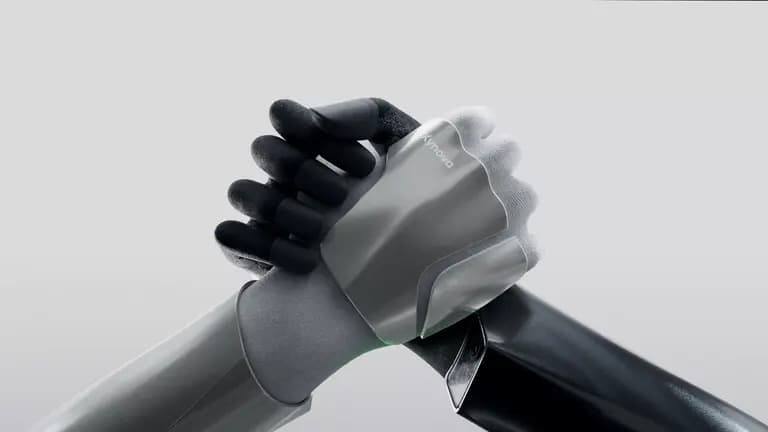
Xynova has unveiled the Flex 2 robot hand, built to look less like a metal claw and more like something that could actually pick up a dropped screwdriver without drama. The Chinese company says the new hand packs 23 degrees of freedom, a 12 kg one-hand grasp capacity, and AI-driven adaptive control aimed at humanoid robots and other physical AI systems.
That is the real race now: not just better robot brains, but better robot bodies. Language models may have grabbed the headlines, yet humanoid robots live or die on how well they can touch, squeeze, rotate, and not smash the thing they were asked to hold.
Flex 2 specs and grip performance
According to Xynova, the hand weighs about 400 grams, roughly in line with a human hand, and can make up to two full fist closures per second. It also passed the Kapandji Thumb Opposition Test, a standard used to judge thumb mobility in humans, which is a neat way of saying the thumb can actually do useful thumb things.
- 23 degrees of freedom
- About 400 grams in weight
- Up to two full fist closures per second
- 12 kg maximum grasp load
- About 4 kg sustained working load
- Force control accuracy down to 0.05 N
- Positioning accuracy of ±0.1 mm
The AI layer is doing the real work
Xynova says Flex 2 uses a multimodal sensing system with an ”artificial cerebellum” element, allowing it to detect when an object slips, adjust force automatically, and change its grip without rigid scripts. That matters because many robot hands still look impressive in demos and then get embarrassingly ordinary the moment the object is slightly awkward, slightly soft, or slightly unpredictable.
The hand also combines force and position control through micro linear actuators, while the palm is designed to resist punctures and wear through millions of open-close cycles. In other words, this is not just a lab toy for close-up videos; it is being shaped for the ugly, repetitive reality of industrial use.
Xynova’s production push in the robot hand race
Xynova was founded in 2024 and focuses on hardware for embodied AI, especially robotic hands, actuators, and compact electric cylinders. The company says it completed a Pre-A funding round in spring 2026 worth hundreds of millions of yuan, with support from one of China’s biggest internet companies, and plans to use the money for manufacturing, hiring, and commercialization.
That production piece is where the story gets interesting. Xynova says it is already working with humanoid robot makers and is preparing a facility capable of producing more than 10,000 high-dexterity robot hands a year. Tesla, Figure AI, and several Chinese rivals are all chasing similar humanoid ambitions, but the bottleneck is increasingly mechanical rather than software: robots need hands that can survive factory life, not just impress at a demo desk.
If Xynova can scale Flex 2 without losing precision, it could help define the next wave of humanoid hardware. The bigger question is whether buyers want one more clever robot hand, or whether they want the whole stack – sensors, actuators, control, durability – in a package that works on Monday morning and still works on Friday afternoon.