

SpaceX’s Starship is being sold less like a rocket and more like a moving warehouse in orbit: a reposted set of calculations claims its payload bay tops 1,000 cubic meters, roughly matching the fully pressurized volume of the International Space Station, while the ISS itself took 42 launches and more than 150 billion dollars to assemble over more than 13 years. That comparison is a little theatrical, but it gets the point across. If Starship works as advertised, the economics of getting big things to space could change fast.
The numbers being tossed around are intentionally eye-catching. One launch, the post says, could carry the volume of a large five-room house, more than 20 standard shipping containers, fully assembled ISS modules, over 100 satellites, or even sections of Boeing 737 aircraft. That is not normal rocket marketing; it is an attempt to show that Starship is aimed at bulk transport, not just the occasional flagship payload.
Starship’s payload volume and size
The reported cargo bay volume is more than 1,000 cubic meters, versus about 1,005 cubic meters for the ISS’s fully sealed volume. The rocket is also said to stand about 18 meters tall, which puts it above a standard five-story building. For a launch vehicle, that is absurdly spacious; for spacecraft designers, it is the sort of number that invites entirely new mission planning.
- Payload volume: more than 1,000 cubic meters
- ISS fully pressurized volume: about 1,005 cubic meters
- Reported height: about 18 meters
- Assembly of the ISS: 42 launches, more than 150 billion dollars, more than 13 years
Why the comparison to the ISS matters
The real story is not that Starship can brag about cubic meters. It is that SpaceX is trying to normalize the idea that one vehicle can do the work of many smaller launches, which is exactly the kind of claim that makes incumbent launch economics look clunky. That does not make the rocket operationally boring – far from it – but it does explain why every test firing and rehearsal draws outsized attention.
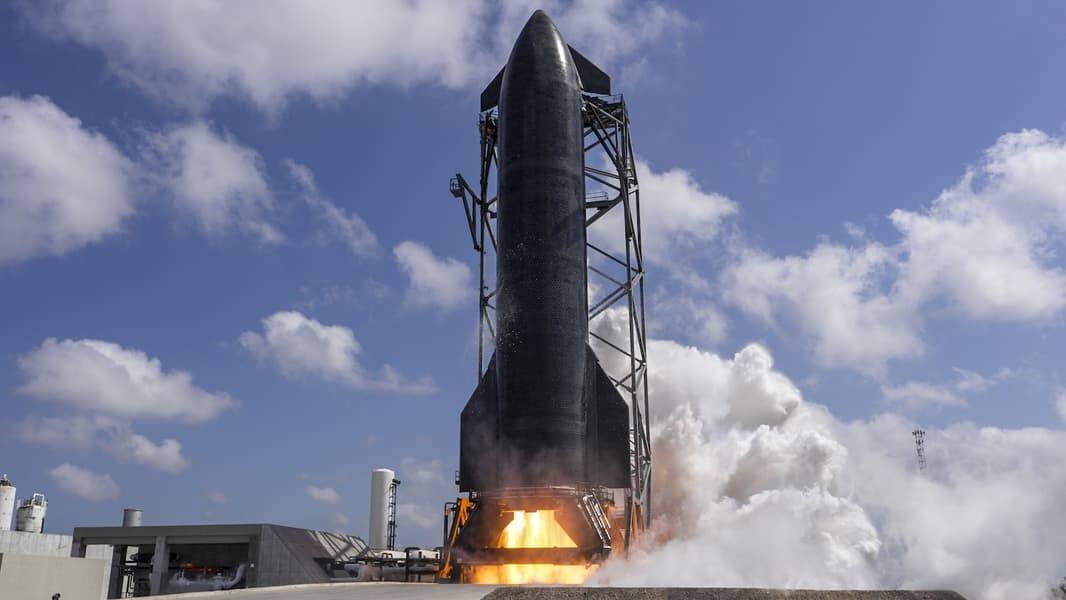
SpaceX has already completed a successful 33-engine Super Heavy static fire and a wet dress rehearsal, and Starship’s next-generation launch was reportedly cleared for no earlier than 20 May. If the company can turn the hardware into a reliable reusable system, the market will not just be watching satellites go up; it will be watching the pricing model for everything from telescopes to future orbital stations change under its feet.
What Starship could carry next
The post’s most ambitious detail is not the satellite count or the container math. It is the suggestion that a fully reusable Starship could become a routine delivery truck for telescopes, orbital station modules, and even Mars hardware. That is the promise, anyway. The next question is whether SpaceX can make the hardware repeatable enough that the size stops sounding impressive and starts sounding normal.