

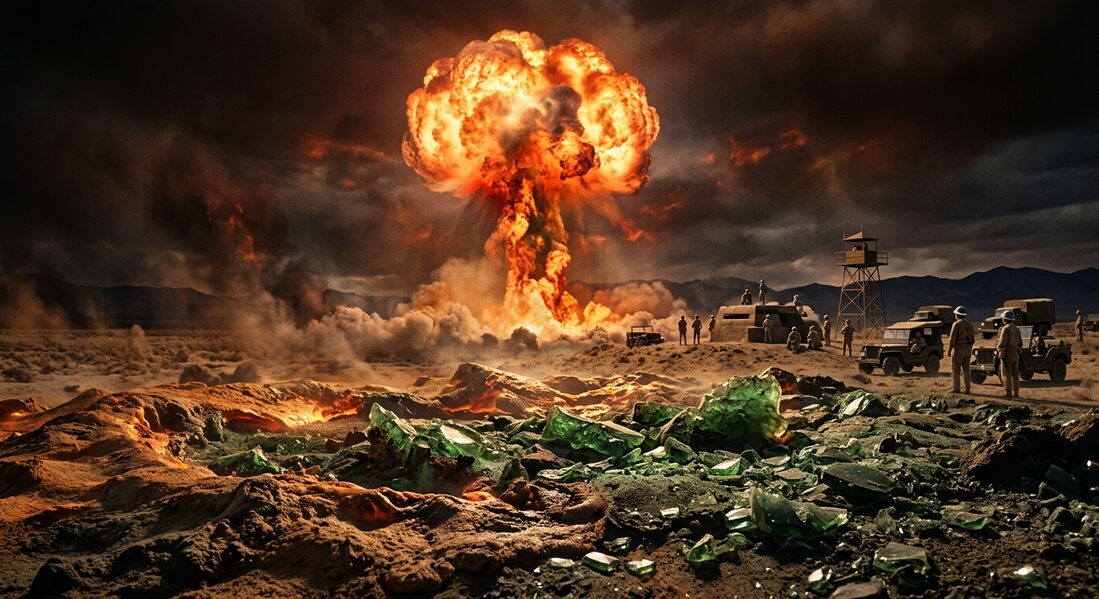
The first atomic bomb test did more than end an era before it had begun. Decades later, the scorched glass left at the Trinity test site has turned up a new surprise: a previously unknown form of silicon clathrates, packed with atoms of calcium, copper, and iron.
The material, called trinitite, formed when the ”Trinity” test melted desert soil into glass under the blast’s extreme heat and pressure. A team of physicists from the US and Europe, led by Princeton professor Paul Steinhardt, found the exotic structures while studying these remains of the first nuclear explosion in history.
What the trinitite samples revealed
The new structures are especially odd because clathrates are rare to begin with, and this version appears to be even harder to explain. The crystals contain cavities that trap metal atoms, but the usual lab methods are unlikely to reproduce them because the conditions needed are so extreme.
Steinhardt’s group has already used trinitite to uncover unusual quasicrystals, thought to have formed when copper cables near the blast zone vaporized. That earlier find hinted the site was a kind of accidental high-energy materials lab; this new discovery suggests the chemistry was even messier than expected.
Why the trinitite discovery matters for nuclear debris research
Calculations using quantum chemistry did not fully explain how the clathrates formed, which is exactly the sort of nuisance scientists tend to like. It leaves open the possibility that the world’s first nuclear detonation created multiple exotic phases of matter in rapid succession, not just a single blast-welded glass.
That kind of finding matters beyond one historical curiosity. Researchers studying nuclear debris, meteor impacts, and other high-energy events often rely on natural or accidental samples because the relevant conditions are nearly impossible to recreate cleanly in a lab.
The Trinity test site still has new stories
The ”Trinity” test took place on 16 July 1945 in the White Sands military range in New Mexico, near Alamogordo, as part of the Manhattan Project. The fact that the fallout glass still keeps yielding new minerals says as much about the violence of the blast as it does about how much material science still has to learn from history’s dirtiest laboratory.
Expect more oddities to surface as researchers keep probing the old debris. If a single bomb test could preserve this many exotic structures, the next surprise may already be sitting in another overlooked shard.