

The brain has not forgotten how to focus. A large meta-analysis spanning 32 countries and more than 21,000 people suggests that the real problem is not a biological collapse of attention in the smartphone era, but the way modern digital habits keep dragging it off course.
That is a useful correction, because the popular ”everyone has the attention span of a goldfish” story has always sounded more like a seminar slide than science. The lab data point in a different direction: children’s cognitive stability has held steady, and adults have even shown a slight improvement over the period studied.
What the 30-year data on attention actually shows
The analysis covers research from 1990 to 2021 and separates raw cognitive capacity from everyday behavior. In controlled tests, people can still sustain attention, filter noise, and keep working toward a goal much as they did decades ago, as long as the distractions are removed.
That distinction matters. A person who keeps opening tabs, checking messages, and bouncing between tasks is not proving their brain is broken; they are proving that the environment is winning. The reset cost of each interruption is the real tax here, and it adds up fast.
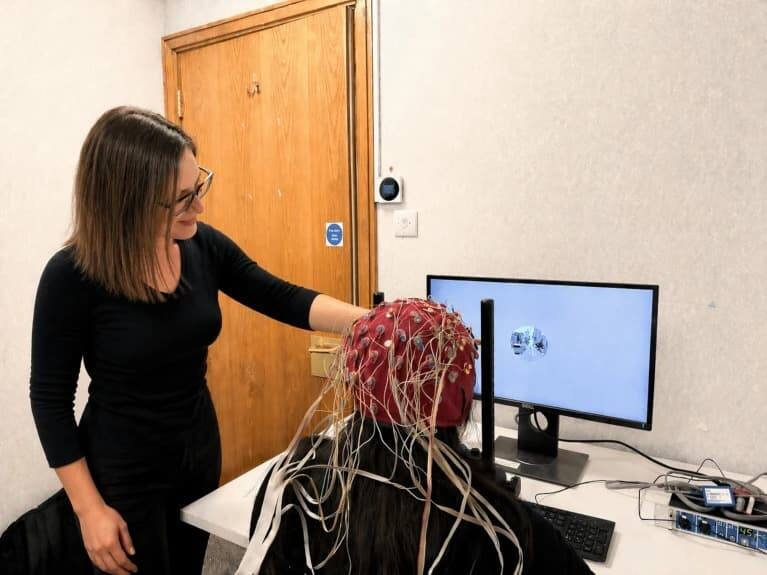
Researchers use tasks such as the d2 test to measure sustained attention, selective attention, and executive control. In other words, they are checking whether someone can stay on target, ignore visual clutter, and resist the temptation to give up for something easier. Under those conditions, the brain still performs well.
The real shift in attention is in behavior
Gloria Mark’s long-running observations of office workers show how much behavior has changed. In the mid-2000s, people stayed on one screen task for about 2.5 minutes on average; by the early 2020s, that had fallen to 47 seconds.
That is not a diagnosis. It is a workflow problem dressed up as a brain problem. Notifications, email, and messenger apps offer immediate rewards, while harder tasks pay off later and ask for patience up front. The brain is doing what brains do: choosing the shiny thing unless the system makes the dull thing harder to escape.
- Sustained attention: staying with one task for a long stretch
- Selective attention: filtering out noise and irrelevant signals
- Executive control: keeping the goal in view despite temptation
Why deep work still feels hard
The researchers also point to individual differences linked to the prefrontal cortex, the brain region tied to control and resistance to distraction. That fits a familiar pattern: attention behaves less like a fixed trait and more like a muscle that gets stronger with practice and weaker with constant interruption.
There is a neat irony here. The same devices blamed for ruining focus are also designed to capture it with brutal efficiency. Social feeds and alerts deliver quick dopamine hits; spreadsheets, reading, and long-form writing do not. Guess which one wins on a tired afternoon.

Even when nothing external is pinging, the mind still wanders. Functional MRI studies show that this drifting is normal, and sometimes useful, because it supports creativity and planning. The catch is that wandering should be a feature, not the default operating system.
The fix is less self-help, more environment design
The practical answer emerging from the research is not another app promising focus in 30 minutes. It is harder and less glamorous: remove the distractions, make the current task more valuable, and stop pretending willpower alone can outmuscle a room full of alerts.
That idea is not new. Decades ago, Hugo Gernsback floated the concept of a wooden isolation helmet to shut out the world, which sounds absurd until you look at a modern open-plan office. The principle is the same: if you want concentration back, you have to make distraction more expensive.
The open question is whether companies will redesign work for attention, or keep demanding it while engineering its destruction. My money is on a few brave teams building quieter systems, and everybody else continuing to complain about the internet between notifications.