

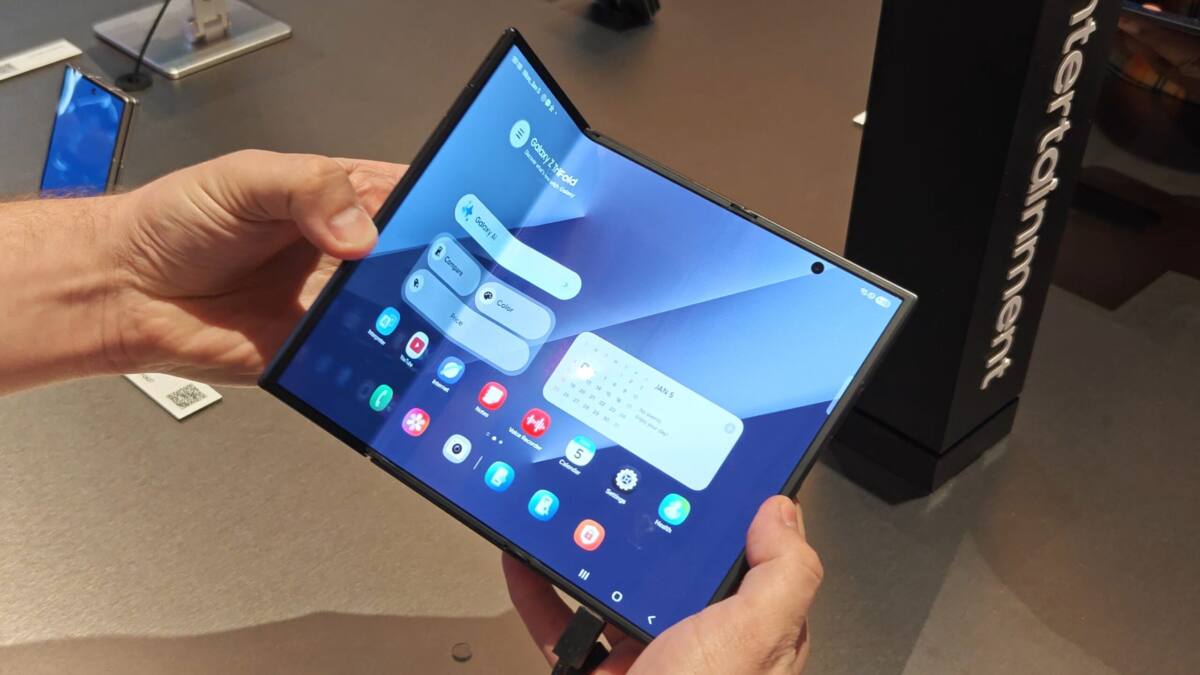
The Samsung Galaxy Z TriFold is a flex in every sense of the word: huge, expensive, and technically real. But its first outing also exposed the usual first-generation sins – too much bulk, not enough toughness, and a few specs that feel oddly conservative for a phone that costs as much as it does. If Samsung really is lining up a Galaxy Z TriFold 2, the follow-up has a clear job: stop being a demo and start acting like a phone people would carry without a second thought.
That’s easier said than done. Tri-fold designs are still the weird cousin of the foldable family, and Samsung is already fighting a market where Huawei has chased the same form factor and Google has raised the bar on durability with a fully dust-tight foldable. The next Samsung Galaxy Z TriFold model doesn’t need gimmicks; it needs fewer excuses.
A slimmer hinge and a less bulky body
At 12.9mm folded and 309g, the original TriFold was never going to feel like a normal slab phone. That’s the price of two hinges, sure, but ”because physics” is not a satisfying answer once the price climbs this high. Samsung’s rumored new hinge work is the right direction, though shaving millimetres only matters if the thing still survives daily abuse from bags, pockets, dust, and the occasional drop.
The benchmark here is no longer just Samsung’s own Fold 7, which is much slimmer and lighter. Competitors have made foldables feel less like science projects and more like premium tools, and the TriFold 2 will need to copy that confidence rather than the spectacle.
IP68 should be the starting point
The current TriFold ships with IP48, which is better than nothing and better than some rivals, but still feels like a compromise on a device meant to showcase Samsung’s best engineering. Dust protection is where foldables keep tripping over their own feet, and Google’s Pixel 10 Pro Fold has already shown that a proper IP68 rating is possible.
Samsung does not need to win a gold star for effort here. It needs to stop asking buyers to baby a premium device that is supposed to be built for the real world.
Brighter inner display, faster chip, better selfies
The TriFold’s giant 10-inch panel is the whole point of the product, which makes its 1,600-nit peak brightness hard to excuse when the outer screen goes to 2,600 nits. Bright sunlight is where phones reveal their true personality, and this one currently whispers when it should shout. A brighter inner display would make the device feel less like a luxury experiment and more like a serious multitasking machine.
Under the hood, the Snapdragon 8 Elite for Galaxy was strong, but thermal throttling held the original back. A move to the Snapdragon 8 Elite Gen 5 for Galaxy would not magically solve heat in a thin body, yet it should still give Samsung more headroom for multitasking and gaming. And yes, the selfie cameras should be better too: 10MP front sensors on a phone this expensive feel more ”good enough” than ”best Samsung can do.”
- Current TriFold folded thickness: 12.9mm
- Current TriFold weight: 309g
- Current inner display peak brightness: 1,600 nits
- Current protection: IP48
- Current chipset: Snapdragon 8 Elite for Galaxy
If Samsung gets those basics right, the TriFold 2 stops being a headline machine and becomes something more dangerous: the first tri-fold most people might actually want. The bigger question is whether Samsung wants to keep selling an engineering trophy, or whether it’s ready to make the awkward, expensive shape behave like a mainstream device.