

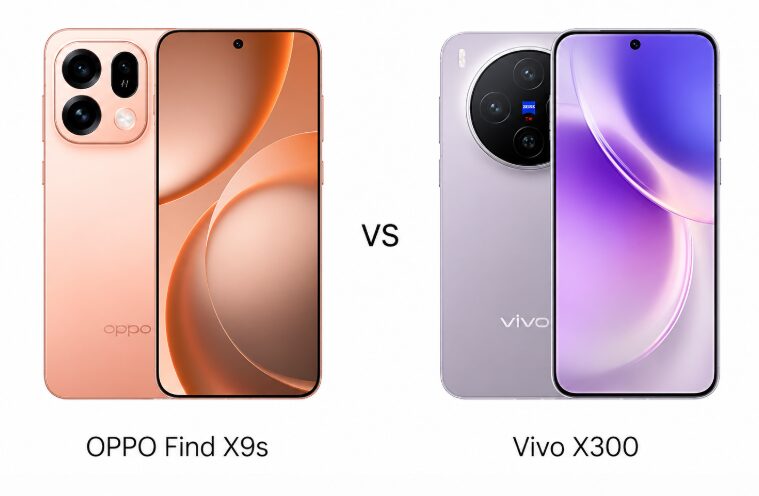
Oppo’s Find X9s and Vivo’s X300 are aimed at the same buyer, but they split the job description neatly: one is the battery-first flagship, the other is the spec-sheet showoff. On paper, Oppo leans hard into battery life and durability, while Vivo spends its extra money on display tech, cameras, and charging perks.
That divide is not accidental. In a market where premium phones increasingly win by obsessing over one or two headline strengths, these two models show the trade-off clearly: practical value versus polished excess. For buyers who keep a phone for long stretches between charges, or who care more about photos and screen quality than raw stamina, the decision gets very simple very quickly.
Display and design differences
Both phones come with premium builds and IP68/IP69 protection, but they don’t feel the same in use. The Find X9s has the denser, sturdier personality, while the X300 goes for a more compact and polished in-hand experience thanks to its aluminum frame and refined finish.
The screen story tilts more sharply toward Vivo. Oppo’s AMOLED panel is bright and colorful, but Vivo’s LTPO display, higher peak brightness, and advanced HDR support make it the more convincing choice for video, streaming, and general fluidity. That’s the kind of upgrade people notice every day, not just in spec charts.
Dimensity 9500 vs Dimensity 9500s
Under the hood, both phones use 3nm MediaTek silicon, but Vivo’s Dimensity 9500 has the clearer edge in performance and efficiency. Faster app launches, stronger sustained speed, and more ambitious RAM options give the X300 the feel of the more forward-looking device.
- Oppo Find X9s: Dimensity 9500s, flagship-class gaming and smooth everyday performance
- Vivo X300: Dimensity 9500, slightly faster and more efficient
- Vivo X300: higher RAM options and longer software support
That does not make Oppo slow or dated. It simply means Oppo is aiming for dependable flagship speed, while Vivo is trying to look like the safer long-term bet for power users.
Battery life versus charging speed
This is where Oppo lands the cleanest punch. The Find X9s packs a 7025mAh battery, a seriously large cell by premium-phone standards, and that size should translate into excellent endurance for heavy users.
Vivo answers with faster wired charging and wireless charging, which is convenient, modern, and easier to brag about. But convenience is not the same as longevity, and Oppo’s bigger battery is the more useful headline for anyone tired of living beside a charger.
Camera hardware and selfie upgrades
Vivo also takes the camera crown with less argument than Oppo fans would like. The X300’s 200MP main sensor and Zeiss optics point to a more aggressive, detail-heavy approach, and its periscope lens sounds better suited to difficult zoom shots.
Oppo’s triple 50MP setup is more conservative, but that can be a strength if consistency matters more than fireworks. Still, Vivo’s 50MP autofocus selfie camera makes the gap wider for creators, while Oppo’s 32MP front camera stays in the solid-but-safe camp.
- Oppo Find X9s: triple 50MP rear cameras, 32MP selfie camera
- Vivo X300: 200MP main sensor, Zeiss optics, refined periscope zoom
- Vivo X300: 50MP autofocus selfie camera for sharper video and portraits
Price and the better buy
At around $730 (₹60,000), the Find X9s is the more obvious value play. At approximately $900 (₹76,000), the X300 is asking you to pay for the nicer display, faster charging, wireless charging, and the more ambitious camera system.
That price gap is not small, and it changes the decision. Oppo is the smarter purchase for buyers who want battery life and balance without drifting into excess, while Vivo is the one for people who want the more premium-feeling flagship and are willing to pay for it. If Vivo’s camera tuning delivers, Oppo may end up being the sensible pick and the X300 the aspirational one – which is exactly how this kind of showdown usually goes.