

Chinese researchers say lunar soil brought back by Chang’e-5 and Chang’e-6 contains a surprisingly rich mix of nitrogen-bearing organic compounds, offering a clearer picture of how carbon-rich material arrives on the Moon, gets battered by impacts, and is altered by solar wind. The Moon is doing what Earth mostly cannot: preserving a readable record of ancient delivery routes for organic matter.
The work, led by the Institute of Geology and Geophysics of the Chinese Academy of Sciences with international collaborators, builds on earlier Apollo-era findings that confirmed carbon and nitrogen in lunar regolith but left the chemistry of those compounds fuzzy. That gap matters, because the Moon is increasingly useful as a planetary archive – a place where space-borne chemistry can survive long enough to be studied without Earth’s geology erasing the evidence.
Source: Courtesy of Institute of Geology and Geophysics, Chinese Academy of Sciences
Chinese lunar samples contain several organic forms
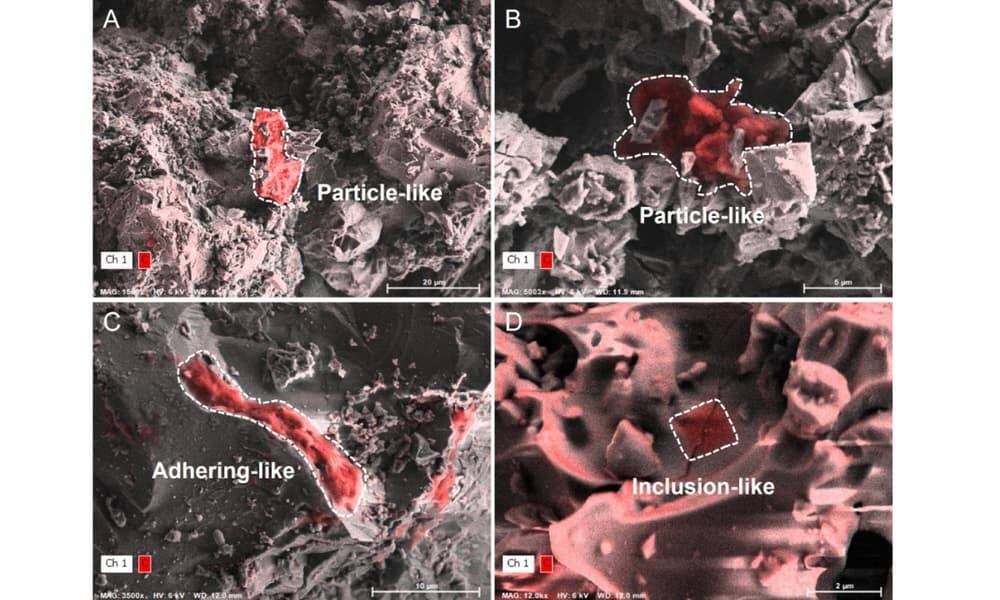
Using microscopy and spectroscopy, the team found organic material in three main forms: granular, attached, and encapsulated. The compounds range from submicron to micron scale, often mixed with ordinary lunar minerals, and are made mainly of carbon, nitrogen, and oxygen in a mostly amorphous structure.
Some samples also contain amide functional groups, a sign that the organics have been chemically processed rather than simply sitting there untouched. In other words, the Moon is not just storing cosmic debris; it is editing it.
Impacts and solar wind leave chemical fingerprints
The isotopic data point to a rough ride. Hydrogen, carbon, and nitrogen in the organic matter are lighter than in carbonaceous chondrites and asteroid samples, which fits impact-driven evaporation, condensation, and redeposition. Asteroid and comet strikes appear to do more than deliver organic material – they break it apart, move it around, and rebuild it into new compounds.
Researchers also say they have seen the first signs of solar-wind effects on lunar organic matter. Near exposed surfaces, some compounds show changes in hydrogen isotopes and in the hydrogen-to-carbon ratio, which suggests long exposure to solar radiation and helps rule out terrestrial contamination. That is the kind of detail planetary scientists love: a chemical fingerprint that says, ”No, this did not hitch a ride from Earth.”
A cleaner archive than Earth
The broader story is bigger than one set of samples. In the early Solar System, asteroids and comets likely delivered organics and life-related elements – carbon, nitrogen, oxygen, phosphorus, and sulfur – to rocky worlds. Earth’s active geology and biology scrubbed away most of that evidence, while the Moon kept it in place, making it a better witness to the chemistry of delivery, alteration, and survival.
That also gives China an edge in a very specific lunar science race: sample return is becoming the fastest way to answer questions that orbiters cannot. If future missions bring back material from deeper space, researchers may be able to trace not just where organics came from, but how they changed on contact with different worlds. The next question is whether those samples will show the same chemical remodeling – or a much messier version of it.