

Japanese researchers have pushed wireless data past 100 Gbit/s for the first time at 560 GHz, a result that puts 6G a little closer to reality and gives radio engineers a rare thing: proof that terahertz wireless links can do more than sit in PowerPoint decks.
The team, from Tokushima University, working with colleagues at the University of Tokyo and Gifu University, sent data at 112 Gbit/s over a single channel. That beats earlier terahertz demos, which tended to top out at only a few dozen gigabits, and it does so in a band where standard silicon electronics usually start waving a white flag.
How the 560 GHz wireless link was built
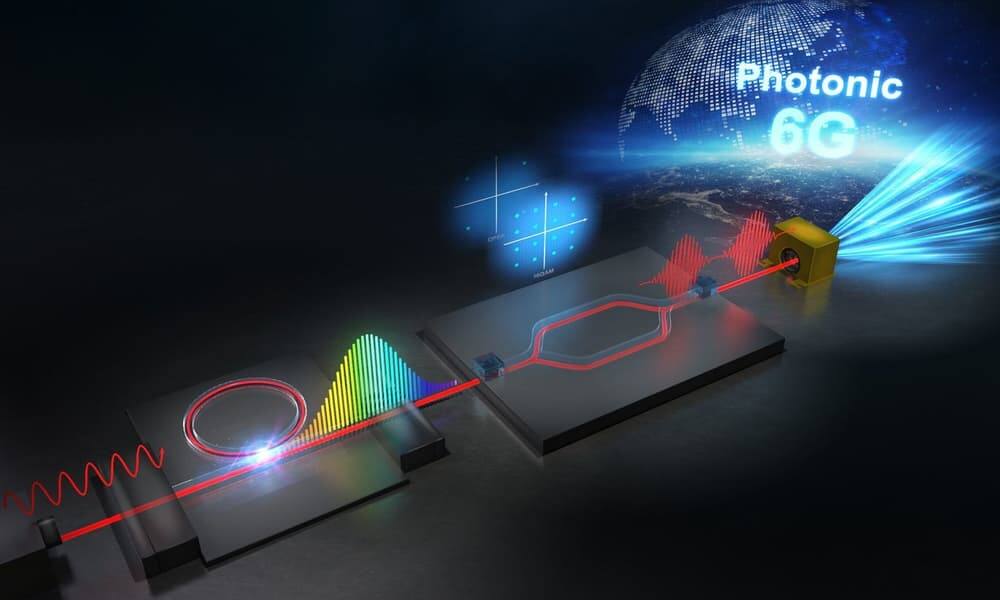
Instead of leaning on conventional electronic oscillators, the researchers used a soliton optical microcomb on a silicon nitride chip. The device splits a laser into many precisely spaced lines, then a 16QAM modulation scheme turns that light into terahertz radio waves with unusually clean phase control. It is a very elegant workaround for a very stubborn physics problem.
The practical challenge is not just speed. Above 350 GHz, conventional electronics run into falling transmitter power and rising phase noise, which can shred the signal before it has a chance to be useful. That is why the terahertz range matters: it offers huge bandwidth, but only if someone can tame the hardware enough to make it behave.
Why this 560 GHz record stayed stable for 27 hours
Past lab setups often fell apart within minutes because tiny temperature shifts knocked them out of alignment. The Tokushima team solved that by directly soldering the optical fiber to the microresonator chip and adding precision temperature control, letting the system run continuously for more than 27 hours. That is the kind of unglamorous engineering that usually decides whether a breakthrough escapes the lab.
- Speed: 112 Gbit/s
- Carrier frequency: 560 GHz
- Transmission method: single channel
- Runtime: more than 27 hours
Where 6G is likely to use 560 GHz wireless links first
Do not expect this to show up in a smartphone anytime soon. The first realistic use case is backhaul infrastructure, the hidden network links that connect base stations to each other and to core network hubs. That is exactly where blistering capacity is most useful, and where users care least about whether the hardware is optical, electronic, or a bit of both.
Consumer devices will come much later, if they come at all, because the remaining hurdles are still chunky: longer transmission distance, better antenna designs, and lower noise. But the direction is clear. The race to 6G is moving from theoretical bandwidth charts to working hardware, and Japan just set a benchmark that everyone else in the field will now have to beat.