

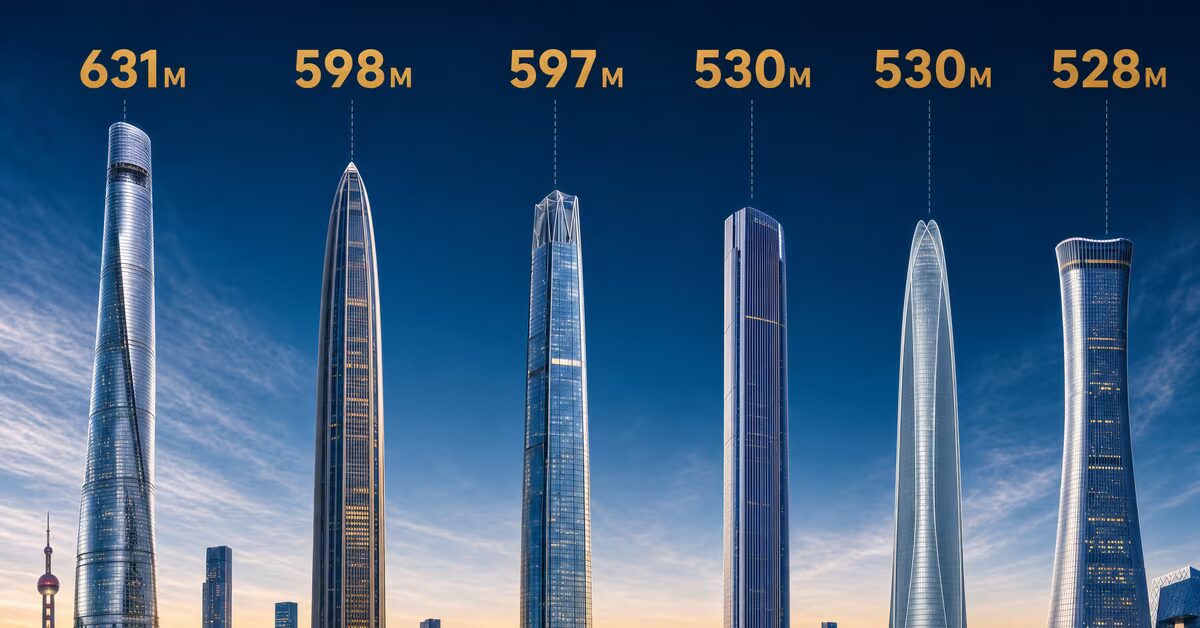
China has turned skyscraper building into a high-stakes urban sport. Home to the world’s second tallest building and a nearly 600-meter tower stuck in limbo, the country redefines what ”tall” means in architecture. Here’s a rundown of the five tallest skyscrapers in China, from Shanghai’s skyline-shaking champion to Beijing’s iconic China Zun.

Tallest skyscrapers in China by height and year
- Shanghai Tower, Shanghai – 632 m, 128 floors, completed 2015
- Ping An Finance Centre, Shenzhen – 599 m, 118 floors, completed 2017
- Goldin Finance 117, Tianjin – 597 m, 117 floors, construction paused, expected completion 2027
- Guangzhou CTF Finance Centre, Guangzhou – 530 m, 111 floors, completed 2016
- Tianjin CTF Finance Centre, Tianjin – 530 m, 97 floors, completed 2019
- China Zun, Beijing – 528 m, 108 floors, completed 2018
At the top stands Shanghai Tower, soaring 632 meters across 128 floors. Opened in 2015, it’s part of an iconic trio alongside Jin Mao Tower and Shanghai World Financial Center that defines the city’s futuristic skyline. Its twisting design is visible from miles away, and observation decks on the 118th and 119th floors offer panoramic views for visitors looking down on the metropolis instead of up.
The second tallest, Ping An Finance Centre in Shenzhen, reaches 599 meters with 118 floors. Completed in 2017 as the headquarters of Ping An Insurance, it’s a mixed-use complex packing offices, retail, hotels, and a viewing platform. From there, visitors can see as far as Hong Kong on clear days.
Then there’s Goldin Finance 117 in Tianjin, which tops out at 597 meters with 117 floors-but remains unfinished. Construction stalled amid a Chinese market slowdown and developer troubles, earning it the dubious title of the tallest incomplete skyscraper worldwide. The project was revived in 2023, with a new completion target set for 2027.
Two towers share fourth place at 530 meters. Guangzhou CTF Finance Centre, completed in 2016, is famous for some of the world’s fastest elevators, zipping at 21 meters per second. Its Tianjin sibling, completed in 2019 with 97 floors, boasts a complex aerodynamic design engineered to withstand fierce winds and typhoons common in the region.
Beijing’s China Zun rounds out the list at 528 meters and 108 floors. Its silhouette mimics an ancient Chinese ritual vessel called a zun, tapering at the middle before widening at the top. Designed by Arup with parametric modeling techniques, China Zun is the tallest building in China’s capital city.
According to the Council on Tall Buildings and Urban Habitat, China continues to lead the world in the number of buildings over 200 meters. But the boom has slowed sharply since 2021, when the government capped new skyscraper approvals-especially those topping 500 meters. This elite group of towers isn’t just a record list anymore; it marks the final chapter of China’s relentless race skyward for now.
With restrictions firmly in place, the skyscraper arms race in China could shift toward innovation in sustainability, mixed-use efficiency, or regional diversification rather than sheer height. Watch how developers respond-will the next generation of tallest buildings push architectural boundaries differently, or will the era of mega-towers pause indefinitely?