

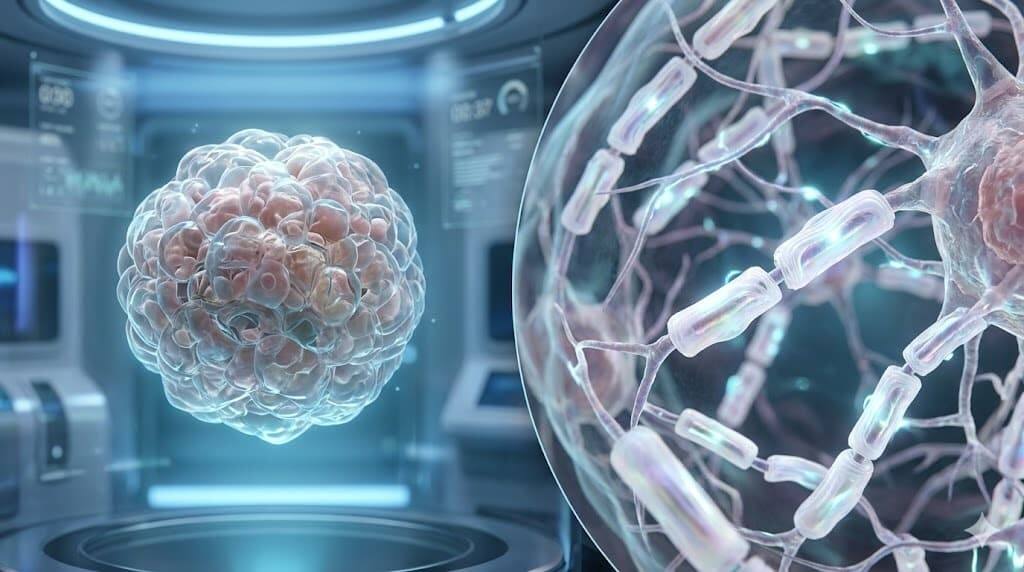
28bio has unveiled a human-cell 3D organoid platform designed to watch myelin break down and rebuild in real time, a step that could make drug testing for multiple neurological diseases far less dependent on animal models. The company says its CNS-3D Myelinated Organoids are built to reflect the biology behind multiple sclerosis, while also offering a more relevant test bed for conditions such as Alzheimer’s, Parkinson’s, and Huntington’s disease.
The pitch is simple: if your model behaves more like a human brain, your drug data gets better. That matters because mice are still a poor proxy for human myelin repair, and that mismatch has helped sink more than 99% of compounds that looked promising in animals once they reached human trials.
What makes CNS-3D Myelinated Organoids different
Unlike simpler lab models, 28bio’s organoids combine neurons, astrocytes, and oligodendrocytes in an ordered structure. That gives researchers something closer to functional tissue, not just a pile of cells under a microscope, and lets them trigger damage and then measure recovery as myelin forms around axons.
The company’s vice president for technology says the point is to measure myelin repair directly in a human biological context instead of guessing from animal data. That is especially attractive for cell and gene therapy teams, where small differences in how cells respond can make or break a program.
- Human-cell 3D organoid system
- Includes neurons, astrocytes and oligodendrocytes
- Models myelin damage and recovery in real time
- Designed for drug testing and therapy development
Why multiple sclerosis is the first obvious use case
Multiple sclerosis is the clearest target because myelin loss sits at the center of the disease. The commercial timing is decent, too: 28bio says the prevalence of multiple sclerosis has increased sixfold over the last 40 years, while existing treatments still struggle to reliably restore nerve tissue rather than just slow the damage.
This is also where the wider industry pressure shows up. Drug developers have spent decades paying for animal models that are good enough to publish papers and bad enough to disappoint regulators, and the search for human-relevant systems has become a practical necessity, not a nice-to-have.
Access, scale and the next rollout
28bio says access to CNS-3D Myelinated Organoids has already started as a service, with ready-to-use systems for 96- and 384-well formats due in the third quarter of 2026. The company also plans to integrate the organoids into its Nexon platform, aiming to help pharma companies make faster and more accurate predictions before compounds ever reach patients.
That puts 28bio in a growing race with other biotech firms trying to replace old-school animal testing with human tissue models, but myelinated brain organoids are still a narrower and more technically demanding niche. If the platform works at scale, the real winners will be drug makers that can stop burning years on dead-end candidates – and the first real losers will be the models that have been overpromised for far too long.