

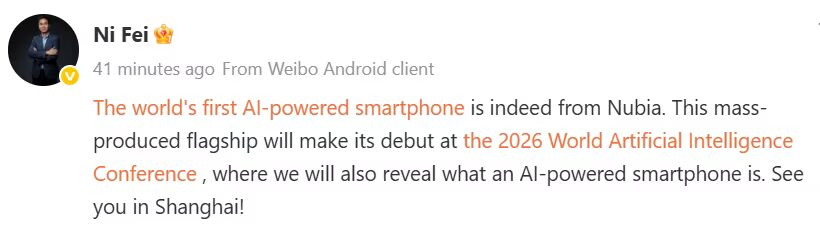
Nubia is gearing up to reveal a flagship AI agent smartphone with a built-in assistant capable of independently handling multi-step tasks-like finding and booking the cheapest tickets-without the user having to switch between apps. The company calls it the world’s first AI agent smartphone, and its official debut will happen at the World Artificial Intelligence Conference (WAIC) 2026 in Shanghai from July 17 to 20.
Nubia’s senior vice president Ni Fei described the device as more than a smartphone with added AI photo or text features. Instead, it integrates a system-wide AI agent that understands natural language commands and completes complex workflows across multiple apps autonomously. This marks a shift from simple voice assistants or chatbots to a phone that ”sees” the screen interface and interacts with it directly.
Unlike typical AI services that rely on apps’ APIs, Nubia’s solution uses a GUI-based agent combined with a local large language model. This agent can navigate app interfaces visually, fill out forms, compare options, and carry out transactions. ZTE’s proprietary CoClaw technology coordinates actions between different services, enabling the phone to execute the entire booking process-from search to payment-fully on its own.
Nubia AI agent smartphone specifications and features
The official specs are still under wraps, but the device is widely linked to the second-generation ”Doubao” smartphone project Nubia developed with ByteDance. Doubao is a notable AI-focused brand in China backed by ByteDance – a local tech giant best known internationally for TikTok. This partnership suggests Nubia’s AI agent won’t be a simple chatbot but part of a more comprehensive ecosystem leveraging ByteDance’s AI expertise.
- Launch scheduled for WAIC 2026 in Shanghai, July 17-20
- Features a system-level AI agent, not just isolated AI functions
- Capable of multi-step tasks across different apps
- Built on a GUI agent with a local large language model
- Connected to the ByteDance-backed Doubao smartphone line
Nubia previously showcased an early prototype, the Nubia M153, which sold out its initial batch of 30,000 units on day one. This is a rare feat for a nascent tech category. Most major brands in 2024 have stuck to safer AI enhancements: Samsung pushed Galaxy AI features, Google introduced Gemini Nano chip AI enhancements, and Apple focused on hybrid local/cloud AI via Apple Intelligence. None have launched a fully autonomous AI agent that handles tasks like button-pressing on the user’s behalf.
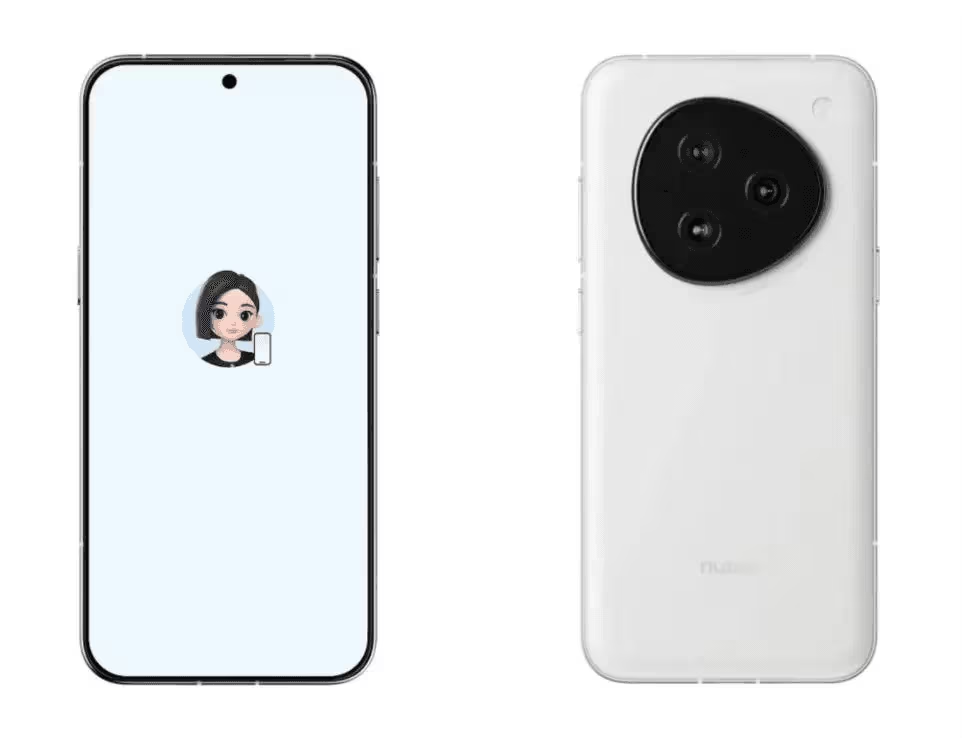
WAIC is a fitting stage for this reveal, as Chinese tech firms have been aggressively shifting AI from cloud-centric models toward on-device processing. This approach reduces latency and helps lock users into their proprietary ecosystems. Still, Nubia’s agent-driven approach raises security questions: the more the AI does autonomously, the higher the stakes around payment security, app permissions, and reliability in real-world use-not just demos.
Details on hardware, pricing, and supported services will emerge after the Shanghai event. If Nubia manages to deliver a stable AI agent that can handle complex tasks like ticket booking and payment fully autonomously, it could mark a major shift toward making AI a practical, hands-off assistant on mainstream smartphones-not just a flashy add-on.