

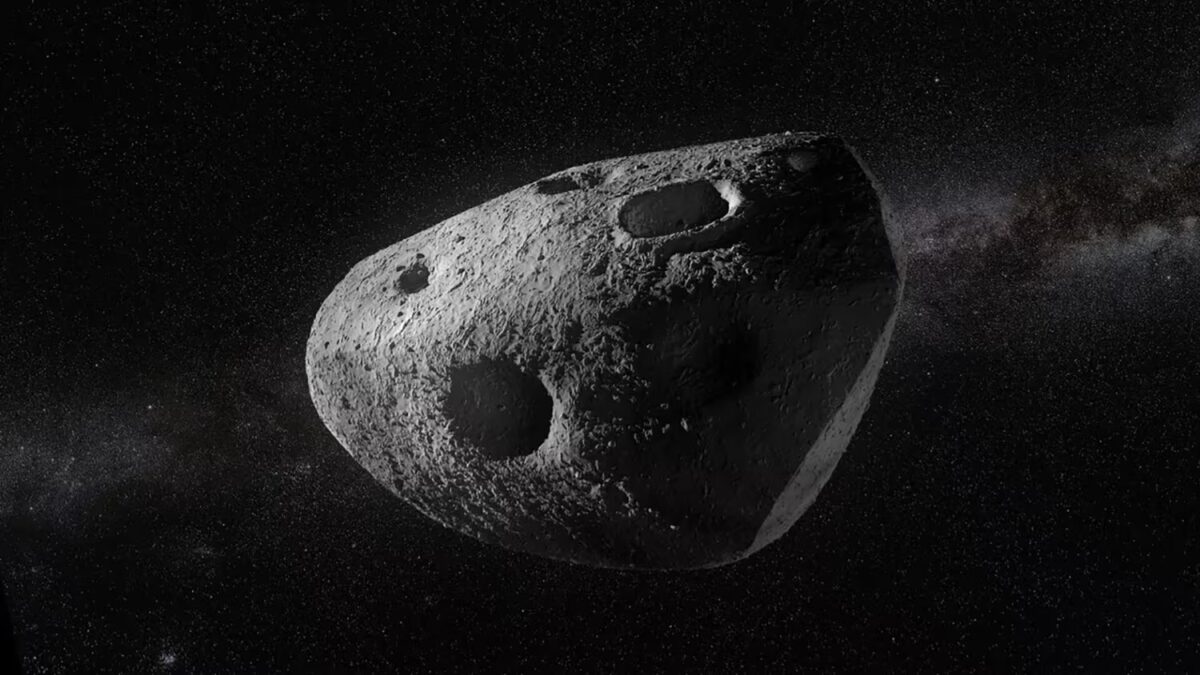
On April 13, 2029, asteroid 99942 Apophis will fly so close to Earth that nearly 90% of the world’s population will be able to see it with the naked eye. Unlike a fleeting shooting star, Apophis will appear as a bright dot moving slowly across the night sky among familiar stars. Scientists say this encounter will be one of the most striking close asteroid approaches ever observed.
At its brightest, around 11:35 p.m. Moscow time on April 13, Apophis will be visible over Cameroon. Ideal viewing will be possible from large parts of Africa, Asia, eastern South America, and some European regions. Weather permitting, about 3.9 billion people could witness the asteroid during this peak moment.
About an hour later, at 12:45 a.m. on April 14 (Moscow time), Apophis will pass roughly 31,600 kilometers above the Atlantic Ocean-closer than geostationary satellites that orbit around 35,800 kilometers up. NASA confirms that this flyby poses no threat to Earth or operational spacecraft.
From the ground, Apophis will resemble a very bright star-but one moving unusually fast. Its apparent motion will be about one full Moon diameter per minute, making the asteroid’s movement noticeable without any telescope. Measuring approximately 340 meters across, Apophis isn’t a small object, which initially sparked significant concern among astronomers.
Apophis asteroid observation history
Discovered in 2004, Apophis immediately raised alarm as one of the most potentially hazardous near-Earth objects. Early trajectories gave a roughly 1 in 37 chance of collision, briefly pegging it at a level 4 threat on the Torino scale, an unusual event that generated widespread attention long before its fate was clear.
Subsequent observations refined Apophis’s orbit and removed any collision risk. Today, the asteroid is viewed as a valuable target for scientific study. Close passes by large asteroids are rare, and this upcoming sighting will allow astronomers to observe Apophis almost in real time-from both Earth-based observatories and space missions.
Upcoming space missions are gearing up for these events. NASA has redirected its OSIRIS-APEX spacecraft to rendezvous with Apophis after the 2029 flyby, aiming to assess how Earth’s gravity reshapes the asteroid’s surface. Meanwhile, the European Space Agency has proposed the Ramses mission to study Apophis closely during this critical moment. If both missions succeed, scientists will gain a rare dataset on how Earth’s gravity ”stirs up” small bodies in the solar system.
Researchers expect Earth’s gravitational pull to slightly alter Apophis’s orbit and trigger landslides that expose fresh rock layers. Observatories worldwide will monitor these changes, turning this close encounter into a ready-made experiment for planetary science-no need to design a complex mission, as the asteroid will come to the perfect spot at the perfect time.
The key findings will emerge after April 2029, when telescope observations mesh with spacecraft data. For casual viewers, the event will last just one night, but astronomers will be analyzing Apophis’s flyby for years. A 340-meter asteroid passing this close to Earth is a rare spectacle-not something that happens every year or even every decade.
For context, Earth’s geostationary satellites-used for communication and weather monitoring-orbit at about 35,800 kilometers altitude, so Apophis’s 31,600-kilometer flyby puts it closer than these satellites. While many large asteroids pass near Earth, few have come this close visibly to billions of people. This event offers an unprecedented chance to study the dynamics of near-Earth objects.
As 2029 approaches, all eyes will be on Apophis, not as a threat but as an extraordinary natural laboratory. The upcoming missions and global observations promise to enrich our understanding of asteroid behavior under Earth’s influence-a valuable insight for future planetary defense and space exploration.