

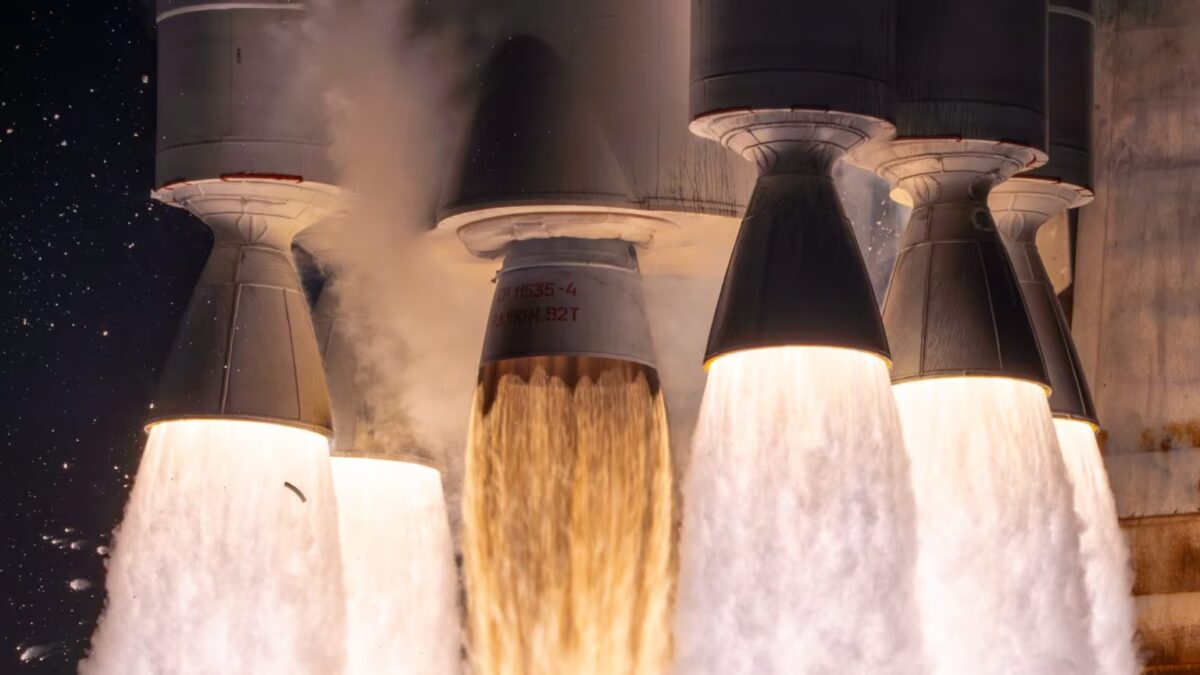
United Launch Alliance (ULA) completed the last-ever orbital flight of its Atlas V rocket powered by the Russian-built RD-180 engine. On July 2, an Atlas V 551 lifted off from Cape Canaveral, deploying 29 Amazon broadband satellites into low Earth orbit. This mission marked the end for the heavy Atlas V configuration with five solid rocket boosters and the RD-180 engine’s nearly 20-year service on a U.S. launch vehicle.
The LA-08 mission proceeded without a hitch. The Atlas V first stage ran on the RD-180 engine developed by Russia’s NPO Energomash, after which the rocket’s upper stages expertly placed Amazon’s satellites into their target orbit. Amazon’s Vice President Chris Weber revealed the company has now launched over 390 satellites, enough to maintain continuous coverage at low latitudes.
The Atlas V 551 was the most powerful variant of the rocket family. It featured a five-segment payload fairing, a Centaur upper stage, and five solid rocket boosters attached to the first stage. ULA has historically used these heavy-lift versions for military and interplanetary missions, but recently repurposed them to speed up Amazon’s satellite constellation deployment.
RD-180 engine on Atlas V for two decades
The RD-180 engine has flown on Atlas V rockets since 2002, making it one of the most prominent symbols of U.S. dependence on Russian rocket technology. Derived from the Soviet RD-170/171 engine family, the RD-180 is a kerosene- and liquid oxygen-fueled powerhouse that provides the main thrust for the first stage. Over more than 100 Atlas V launches, this Russian engine helped build an impressive reliability record, embedding itself as a staple of American launch operations rather than a temporary solution.
However, political tensions and sanctions pushed the U.S. aerospace sector to move away from Russian engines. In 2021, ULA halted purchases of new RD-180 units, drawing down its existing stock. This final Atlas V launch with the RD-180 symbolizes both a milestone for Amazon’s Project Kuiper and the likely end of Russian propulsion on U.S. rockets.
Atlas V’s successor is the Vulcan Centaur, designed with U.S.-made Blue Origin BE-4 engines on the first stage. This rocket will gradually take over ULA’s commercial and government missions, marking a critical shift toward domestic supply chains for key launch components in the U.S. industry.
Amazon’s satellite ambitions also depend heavily on these developments. Project Kuiper aims to build a constellation of 3,236 satellites-far larger than the 390 currently deployed, which represents just 12% of the final network. By comparison, SpaceX has already launched thousands of Starlink satellites and entered large-scale service deployment by mid-2026. Kuiper still lags behind but has multiple launch partners lined up.
Amazon’s launches are split across several providers:
- United Launch Alliance (Atlas V and Vulcan rockets)
- Arianespace
- Blue Origin
- SpaceX (despite being Kuiper’s direct competitor)
This unusual setup highlights the complex ties in the satellite launch business, where the biggest launch provider profits from sending up rival constellations.
The pace of Kuiper’s rollout now hinges less on the RD-180 engine and more on how swiftly ULA and partners can ramp up launches with new rockets. U.S. regulators require Amazon to deploy significant parts of the constellation within specific deadlines. If Amazon accelerates its launch cadence through 2026 and 2027, Kuiper could finally transition from limited coverage to broader commercial service. Otherwise, the RD-180’s final Atlas V flight may be remembered not only as the end of an era but one of the last swift developments in Amazon’s satellite timeline.