

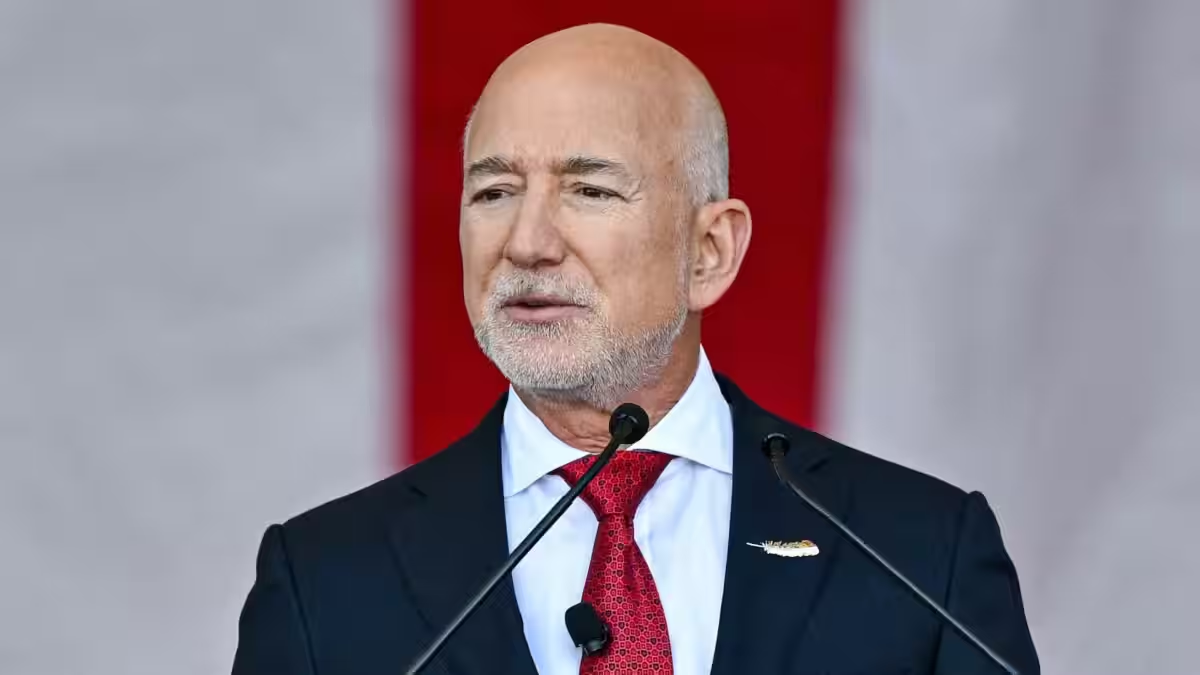
In 1994 Jeff Bezos spent months pitching an idea that most people did not understand: buying books over the internet. His account of that period is not a vanity anecdote about grit so much as a reminder of how much early-stage fundraising is about selling the future, not the product in hand.
Bezos later told The New York Times that persuading angels in 1994 was ”the hardest thing I’ve ever done.” He says he met roughly 60 angel investors; 40 declined. He remembers trying to get people to write a $50,000 check and coming up against the same question: ”What’s the internet?”
Why the story matters beyond nostalgia
At one level this is a contrast story: the founder who knocked on dozens of doors and went on to build a company now worth over $2.2 trillion, while Bezos’s net worth sits near $219 billion and Amazon has just taken the top spot on the Fortune 500. Those numbers are cheap at conveying scale, but they hide the real leverage point in the anecdote: timing and imagination.
In 1994 the internet was unfamiliar to most investors. That made capital scarce for ideas that required people to believe a fundamentally new behavior. Today the opposite is occasionally true: many investors understand the technology but still fail to grasp the product-market leap required to make it matter.
Not unique – but instructive
Bezos’s early rejection run is part of a long list of famous founding myths. Airbnb, Uber and Dropbox all faced waves of skepticism before finding the investors who saw the behaviour change first. Those stories teach two lessons: the eventual winners need resilience, and early investors either get rewarded enormously or miss out entirely.
There’s also a structural shift worth noting. The 1990s had far fewer specialized seed investors; founders with novel ideas often had to cobble together funding from angels or bootstrap. Over the last decade micro-VCs, accelerator networks and online dealflow platforms have lowered the barrier to finding early checks. That makes the mechanics of getting a first round different today – but it doesn’t make the core problem go away: convincing someone to finance uncertainty.
What Bezos’s story leaves out
The triumphant retelling risks survivorship bias. For every Amazon, there are many founders who persevered and failed. Persistence plus timing plus product-market fit equals outcomes – persistence alone is not a formula.
Also missing from the myth: the role of early supporters and follow-on capital. Winning one skeptical investor is rarely enough; scaling requires multiple inflection points where further capital and distribution come together. That’s the part of the story founders should study closely.
So what should founders do?
Don’t treat rejection as a moral failing. Frame it: if investors keep asking the same basic question, your pitch is explaining the wrong thing. Learn to sell the user behavior you want, not just the technology behind it. Seek investors who have backed similar leaps rather than ascribing virtue to the first yes.
And investors who fear missing the next Amazon should remember that the rare big winners are noisy signals in a very large field. That means portfolio diversity and early-stage patience still matter more than a single instinctive thumbs-up.
Verdict
Bezos’s account of 60 meetings and 40 nos is a useful corrective to sanitized origin stories. It’s a lesson in selling an uncertain future, not proof that stubbornness equals success. For founders and angels both, the takeaway is practical: sharpen the narrative, pick the right early backers, and accept that timing often decides more than talent.