

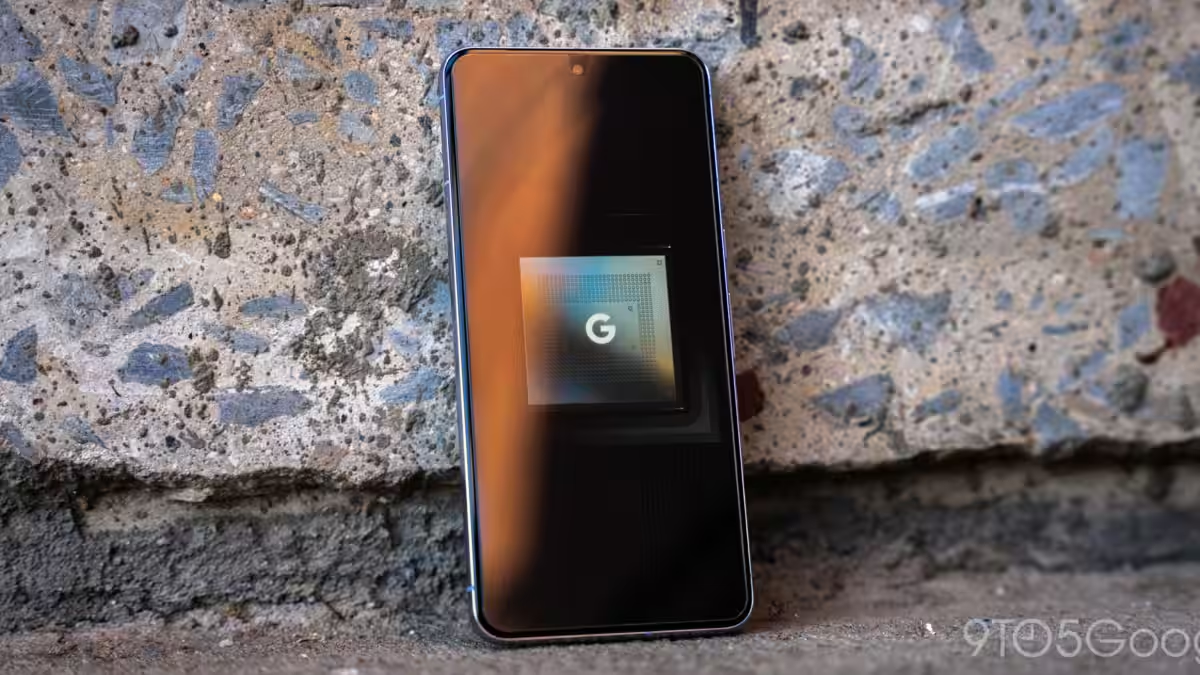
Smartphones are storing more sensitive data and running more private AI than ever. That makes the invisible chip that guards keys, biometrics, and boot sequences suddenly important in marketing copy – and in boardroom strategy. If recent leak chatter proves accurate, Google is preparing a new Titan M3 security coprocessor to sit alongside its next in-house Tensor chip. That would be more than incremental engineering; it would be a statement about where Google thinks Android’s weak link still lies.
A short history of Titan and why it matters
Google introduced the original Titan M in 2018 with the Pixel 3 as a dedicated trust anchor for things like bootloader validation, limiting lock-screen attempts, and storing private keys via StrongBox KeyStore. The follow-up, Titan M2, moved to a RISC-V design alongside Google’s Tensor effort and advertised protections against electromagnetic analysis, voltage glitching, and even laser fault injection.
Those moves mirrored an industry trend: control the silicon that enforces security policies and you control what users – and apps – can trust. Apple has been doing this for years with its Secure Enclave. Samsung and chipmakers such as Qualcomm have their versions too. For Google, Titan chips are how it buys parity on security promises where Android historically lagged.
What the rumor actually says
Leaked internal listings posted online indicate Google may pair a Titan M3 with the upcoming Tensor G6. Details are thin, but that pairing alone is meaningful: it signals Google wants a tighter, purpose-built link between its system-on-chip and its trust anchor.
Why a new Titan would matter in practice
There are three practical arenas where a more capable Titan would make a difference.
First, on-device AI. As models and private data move off servers and into phones, companies need a hardware-protected space to store model weights, licensing keys, and sensitive prompts. A Titan M3 could offer stronger isolation and attestation so apps and services can prove a model ran on an untampered device.
Second, enterprise and authentication. Banks, password managers, and government apps increasingly demand hardware-backed attestation and certified tamper resistance. A refreshed Titan could let Google push for broader enterprise certification and sell Pixel devices as secure endpoints for corporate fleets.
Third, physical attack resistance. The earlier Titan M2 touted defenses against invasive techniques. If M3 raises that bar – and if Google documents and certifies those improvements – it narrows the gap against attackers who go beyond software exploits.
Who stands to gain – and who loses
Winners: Google, if it can market genuine, demonstrable security advantages; enterprises that want Android endpoints with hardware guarantees; privacy-minded users who prefer device-based protections over cloud-only solutions. Independent app developers that rely on attestation could also benefit if Google standardizes APIs around the new coprocessor.
Losers: the modding and custom-ROM communities. Stronger, more widely enforced hardware roots of trust can make unlocking or modifying devices harder by design. Also, other Android OEMs lose out on a point of differentiation unless Google chooses to license the tech – and historically it has not.
What Google still needs to prove
Hardware is only part of the equation. For Titan M3 to matter beyond a press release, Google must show three things: measurable improvements over M2, transparent attestations so third parties can verify claims, and a software ecosystem that actually uses the new capabilities. Without developer-facing APIs and ecosystem buy-in, a faster, tougher Titan is just an extra chip costing time and money.
There’s also a political dimension. As governments debate access to encrypted data, stronger local security could become a flashpoint. Hardware that resists extraction is technically impressive but politically controversial when law enforcement seeks the keys.
Outlook: incremental upgrade or platform shift?
If Google ships a Titan M3 with Tensor G6 this year, expect the company to frame it as both a privacy win and a reason to buy a Pixel during what it will likely bill as an anniversary refresh. Practically speaking, look for features focused on on-device AI protection, stronger attestation for apps, and documented resistance to invasive attacks.
But remember: the impact will be limited unless Google turns that silicon into a platform – clear developer tools, documented attestations, and some way for enterprises and consumers to see the protection in action. Without that, M3 will be a sophisticated component doing work most users never notice.
Either way, hardware security is now a competitive axis for Android. If Google wants to claim parity with Apple on trust and privacy, it needs more than announcements – it needs measurable, usable features that third parties can verify. Titan M3, if real, is a necessary step. It may not be sufficient.