

Dogecoin isn’t just flatlining on a chart. It’s exposing the same structural truth that has governed memecoin cycles for a decade: when sentiment stalls, so does price – and the next move depends more on volume and social flows than on technical geometry.
A tightened range hides a bigger question
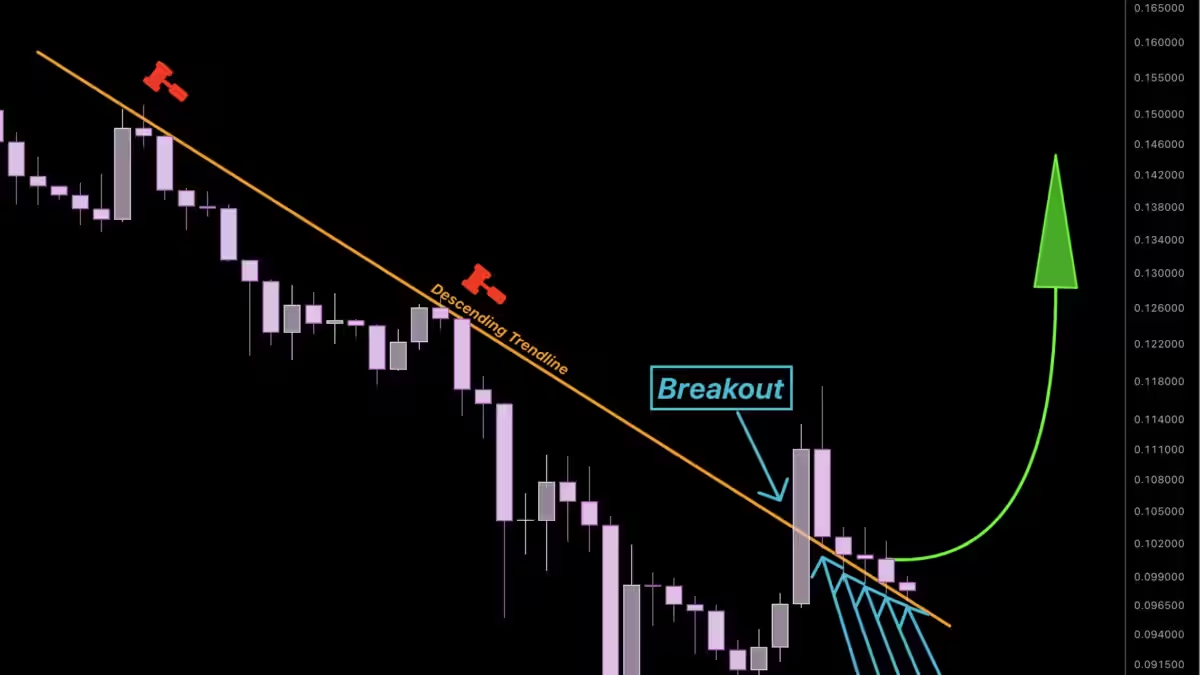
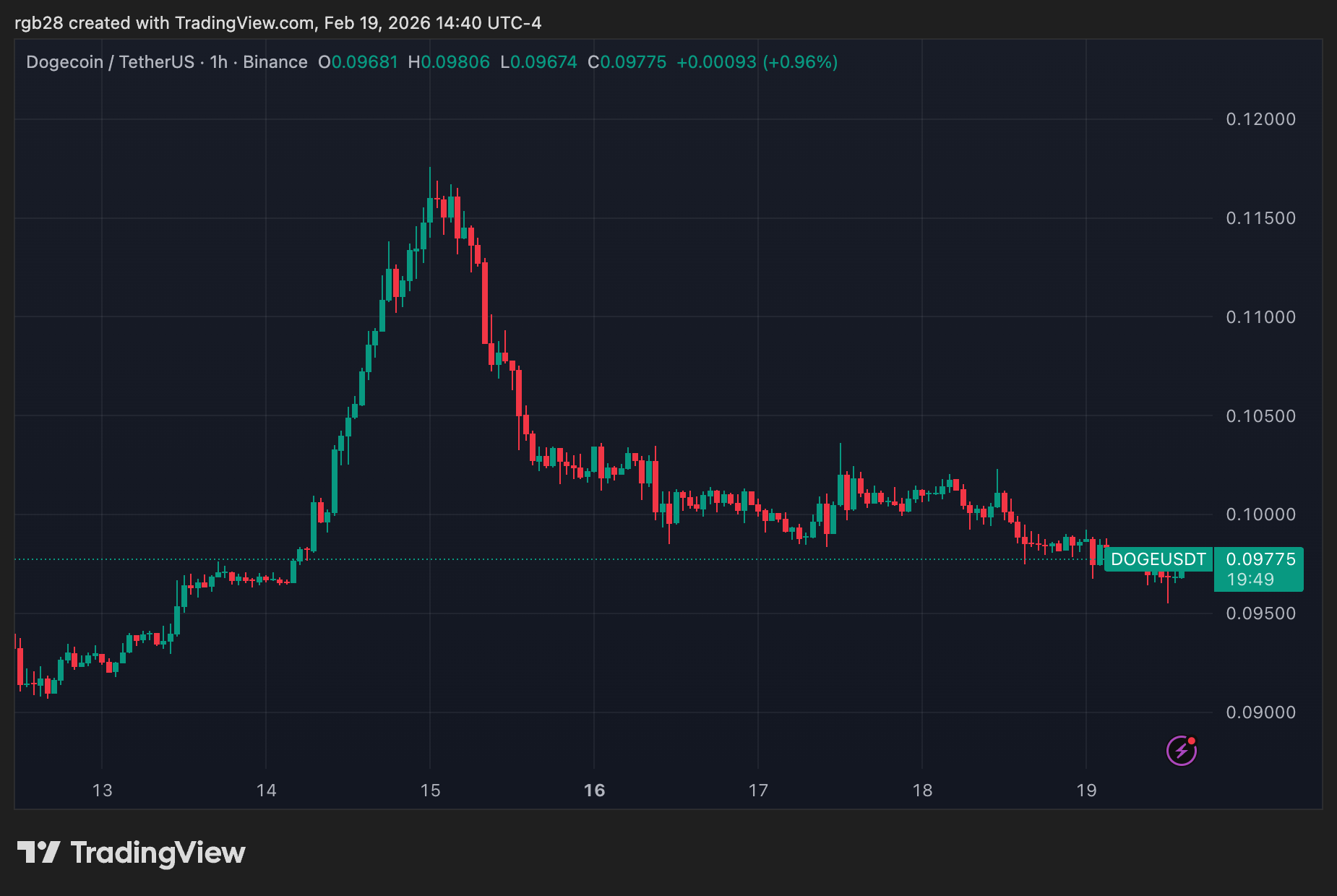
Over the past week DOGE slid to a one-week low of $0.095 before bouncing back above the $0.098 support level. For six days it has traded in a tight band between $0.096 and $0.104, briefly touching $0.117 over the weekend. The coin did clear a one-month descending trendline during last week’s surge, but that breakout has lost momentum and the price is essentially moving sideways.
Traders watching the chart point to a clear pivot: the horizontal support around $0.097. Market observers have described it as ”the ultimate support level,” noting it has flipped roles several times over the past two years. If that level fails, the case for further downside strengthens. If it holds, the risk/reward for buyers is tempting – provided actual demand arrives.
What the charts don’t say
Technical breakouts that stick need three things: follow-through volume, cleaner macro conditions (risk-on markets), and an external story to keep new entrants buying. Right now Dogecoin has a breakout-without-punch – multiple daily closes above the breakout level, yes, but weak candles and subdued volume. One analyst summed that up bluntly as ”optimism with a seatbelt on.”
That matters because Dogecoin’s price has historically been highly correlated with broader crypto risk appetite and social attention spikes. Past parabolics for DOGE followed long consolidation phases – the piece references earlier base-builds in 2016 and 2020 – and, in those cases, breakouts fed on waves of retail FOMO and celebrity-driven hype.
Quick context: why Dogecoin’s next leg isn’t automatic
Three contextual points put the current price action into perspective:
– Supply dynamics: Dogecoin is inflationary and has no hard cap, which dampens per-token scarcity compared with capped assets. That makes sustainable, massive percentage gains harder to engineer without enormous demand.
– Sentiment dependency: DOGE’s biggest moves have often followed outsized social-media attention and celebrity endorsements. When the social signal weakens, so does speculative demand.
– Macro linkage: altcoin rallies tend to amplify only when Bitcoin and risk assets are moving up. With flows into crypto funds under pressure recently, memecoins are disproportionately exposed to capital rotation.
Who wins and who loses if the range persists
Winners: short-term traders willing to scalp range-bound moves and liquidity providers collecting fees during sideways trading. Losers: late-arriving retail buyers who buy breakouts without volume confirmation, and holders expecting an immediate parabolic leg purely on technical symmetry.
There’s also a soft political economy here. Exchanges and derivative desks benefit from sustained volatility; long-term holders do not. And commentators who sell the narrative of an inevitable parabolic run win attention regardless of outcome.
What to watch next
If you trade or follow DOGE, monitor three indicators closely: volume on spot exchanges (does it rise on up-days?), net flows to exchanges, and social momentum measures (mentions, influential endorsements). Analysts who see the current setup as a repeat of previous base builds point to potential big moves – the article notes earlier cycles producing large multiples, including a 95x move between 2017 and 2028 and a later 310x rally after the 2020 breakout – but those outcomes were conditioned on very different market environments.
Absent a fresh catalyst, the more likely near-term path is continued compression around $0.097-$0.10. Breakouts that matter will arrive with punchier candles and heavier volume; otherwise the ”breakout” risks being a false start that simply lures in buyers before a deeper retrace.
Verdict
Dogecoin’s pause is not a death knell, but it’s a reminder: meme-driven assets rise and fall on appetite, not just technical formations. The breakout is real, for now, but it needs fresh demand to become more than a chart pattern. Treat the current setup as a trade rather than a thesis – unless you have a long-term tolerance for headline-driven volatility.