

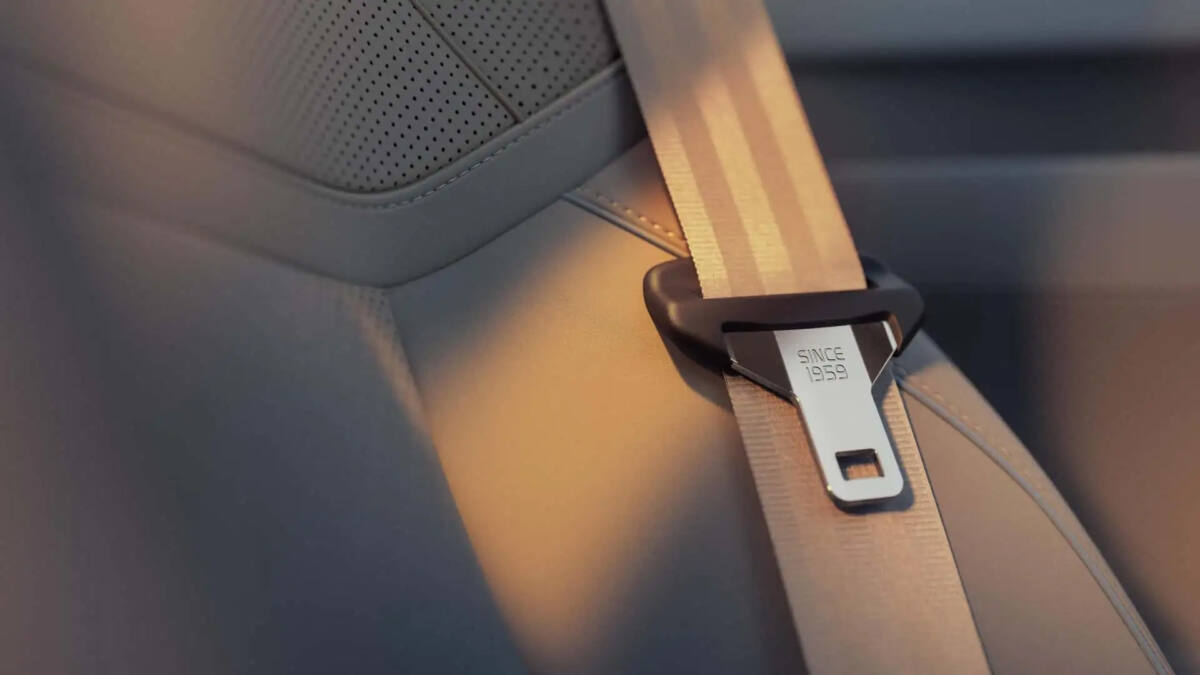
Volvo is marking the 70th anniversary of its pioneering seatbelt by unveiling a new ”multi-adaptive seatbelt” system that adjusts itself to each passenger in real time. This innovation debuts in the upcoming EX60 crossover, set to hit roads by the end of 2026. Unlike traditional seatbelts that apply a uniform force regardless of who’s wearing them, Volvo’s latest technology uses multiple sensors to continuously gauge the occupant’s body type, seating position, and the severity of deceleration during a collision.
By instantly adjusting the belt’s tension, the system aims to optimize protection and reduce injuries. For larger adults, the belt tightens more aggressively to help prevent head impact, while for smaller passengers or children, the force is reduced to avoid excessive pressure on the chest that traditional belts sometimes cause. The setup continuously refines itself through over-the-air updates, evolving its algorithms to better address different body shapes and crash scenarios over time.
Personalized safety in real time
This development underscores a shift in automotive safety-from generic solutions to personalized, data-driven systems. Volvo’s multi-adaptive seatbelt tackles a well-known issue with conventional belts: one size doesn’t fit all when it comes to crash forces. Many existing belts can cause blunt trauma to smaller passengers while inadequately restraining larger occupants, which increases injury risks for both.
Similar attempts at smart restraint systems have been made before, such as adjustable pretensioners and seatbelt force limiters, but Volvo’s continuous real-time adjustment based on live sensor feedback represents a more dynamic approach. Bridging sensors, machine learning, and vehicle telematics marks a logical step forward for occupant protection.
Why this matters beyond Volvo
The timing of Volvo’s announcement reflects both growing consumer demand for personalized safety features and mounting regulatory pressure worldwide to reduce traffic fatalities. With driver-assist and airbag tech maturing, seatbelts remain the last piece of the crash protection puzzle where innovation lags behind digital possibilities.
Competitors like Mercedes-Benz and Tesla have introduced smart restraint features that adapt for crash severity, but Volvo’s focus on multidimensional adaptation-taking into account individual anatomy and posture-pushes this technology into more thoughtful territory. If widely adopted, this could cut down on seatbelt-induced injuries, a subtle but persistent issue in crash data.
Looking forward, we can expect other automakers to accelerate similar sensor-driven safety refinements as connected vehicle ecosystems expand. Volvo’s willingness to support over-the-air updates also hints at a future where safety systems continuously evolve after a car leaves the showroom instead of stagnating.