

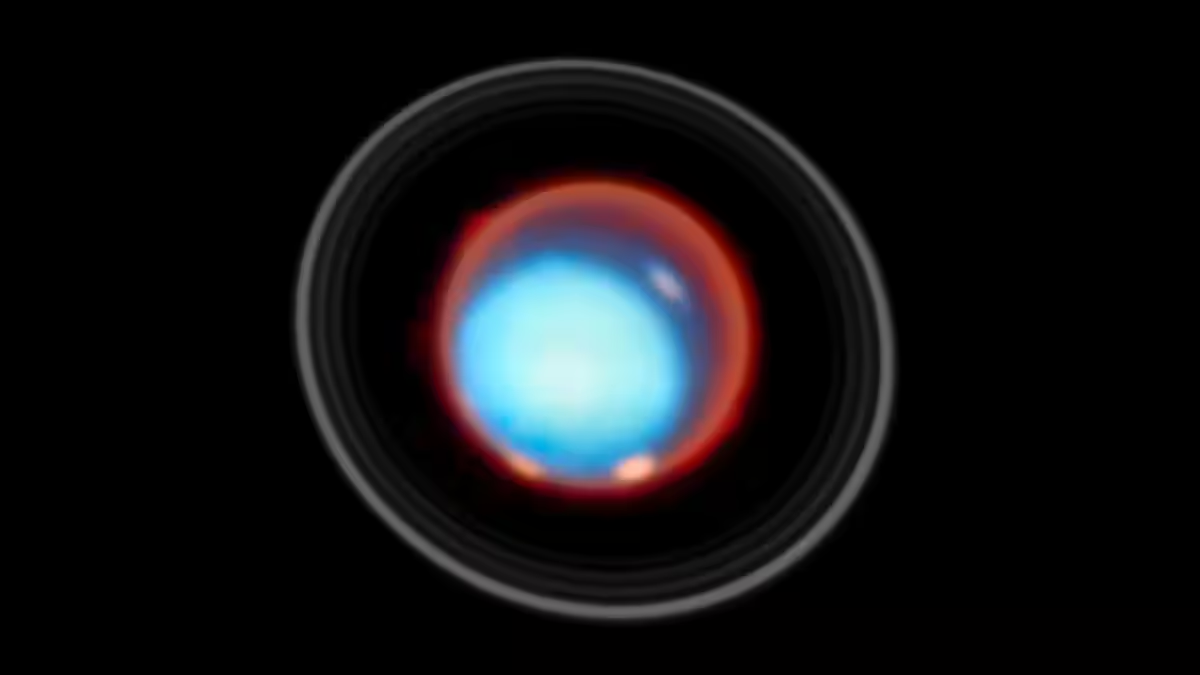
We have never had a three-dimensional picture of how Uranus’s upper atmosphere responds to its bizarre magnetic geometry – until now. Using the James Webb Space Telescope, astronomers have for the first time traced temperature and ion density from the cloud tops up to thousands of kilometres above them, revealing how magnetic forces sculpt the planet’s ionosphere.
What Webb actually did
On January 19, 2025, the Webb telescope used NIRSpec’s Integral Field Unit to stare at Uranus continuously for 15 hours as the planet rotated. The observing program (JWST General Observer program 5073, PI: H. Melin of Northumbria University in the United Kingdom) captured faint infrared emissions high above the visible clouds and produced vertical profiles of temperature and ion concentration up to about 5000 km altitude.
The headline numbers are compact but telling: an average upper‑atmosphere temperature of about 426 kelvins (about 150 degrees Celsius), temperatures that peak between 3000 and 4000 km above the clouds, and ion densities that reach their maximum much lower, closer to 1000 km. Webb also found two bright auroral bands near the magnetic poles and a darker region between them where emissions and ions drop off – a sign the lopsided magnetosphere is channeling charged particles unevenly across longitude.
”This is the first time we’ve been able to see Uranus’s upper atmosphere in three dimensions,” said Paola Tiranti of Northumbria University, who led the project. With Webb’s sensitivity, the team could follow how energy moves upward through the planet’s atmosphere and see how deeply the tilted, offset magnetic field reaches.
Why this matters beyond a pretty map
Uranus’s magnetic field isn’t just unusual; it is misaligned with the planet’s rotation axis and offset from the planet’s centre. Voyager 2’s flyby in 1986 first revealed that odd geometry, but flybys and ground‑based telescopes only offered snapshots and narrow slices through the atmosphere. Webb’s continuous infrared view gives the vertical context that those earlier observations couldn’t provide.
The observations also reinforce a long‑running puzzle: Uranus’s upper atmosphere appears to be cooling. The new measurements confirm a cooling trend first identified in the early 1990s and measured again by ground instruments; Webb’s value of about 426 kelvins is lower than many earlier readings. That cooling ties into a deeper mystery – unlike Neptune, Uranus seems to emit very little internal heat – and remote sensing like Webb’s can only take us so far toward explaining why.
What Webb can and cannot tell us
Infrared spectroscopy is excellent for tracing molecular emissions and temperatures, and NIRSpec’s IFU lets astronomers build a quasi‑3D map by stacking spectra from different altitudes and longitudes. But Webb does not directly measure charged‑particle fluxes, magnetic field lines in situ, or the fine structure of plasma flows. To understand the detailed mechanics of auroral acceleration, particle precipitation, and magnetospheric dynamics you still need in‑place instruments: magnetometers, particle detectors, radio and plasma wave suites.
In practice that means Webb’s maps are necessary but not sufficient. They point to where energy is being deposited and how the magnetosphere sculpts the ionosphere, but they can’t tell us the exact drivers – whether changes come from the solar wind, internal plasma sources, or slow seasonal adjustments linked to Uranus’s extreme axial tilt.
How this changes the playbook
Modelers and exoplanet researchers should pay attention. Ice giants are a common outcome of planet formation, and we often find Neptune‑size worlds around other stars. If complex, tilted magnetospheres can push auroral heating and ionisation far into an atmosphere, that affects escape rates, observable spectra, and interpretations of atmospheric chemistry on distant planets. Webb is starting to supply the vertical constraints those models have lacked.
For observers, the takeaway is clear: combine Webb’s infrared maps with UV and radio monitoring and repeat the observations. Auroral features and ionospheric structure change with the solar wind and season; a single 15‑hour rotation gives a powerful snapshot but not the long view.
What’s next
The results, published in Geophysical Research Letters, will almost certainly prompt more Webb campaigns on Uranus and Neptune, and renewed calls for an orbiting return mission that can carry the in‑situ instruments Webb cannot. For now, Webb has delivered the kind of vertical detail planetary scientists have been asking for: a clearer picture of where auroras form, how magnetic topology shapes the ionosphere, and how heat moves through an ice giant’s upper atmosphere.
That’s progress. But remote sensing alone still leaves the door open to competing explanations – which means the field should expect lively debate, follow-up observations, and, eventually, the kind of targeted mission that can answer the particle‑level questions Webb cannot.