

Tired of plug-in hybrids that barely deliver on their promise of electric driving? Toyota has quietly addressed one of the biggest complaints about PHEVs: too little electric range and too little real-world utility.
The most important parts of the update are simple and easy to measure. The RAV4 PHEV, due to go on sale in Japan on 9 March, packs a total system output of 329 hp and offers up to 150 km of electric-only range – up from the previous generation PHEV’s limit of 95 km. Toyota also says the car’s power electronics use silicon carbide semiconductors to reduce losses, and the traction battery can supply external devices with up to 1500 W of power.
What Toyota announced
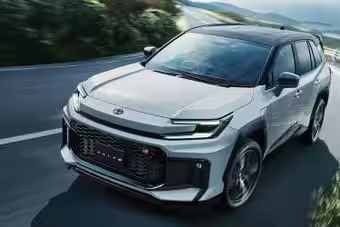
Alongside the PHEV, Toyota will add a GR Sport trim to the RAV4 line, also going on sale in Japan on 9 March. The GR Sport is a styling-and-chassis pack: an aggressive front bumper, a rear spoiler, 235/50 R20 wheels on unique alloy rims, red brake calipers, body-side vibration dampers and GR Performance Damper shocks with sportier tuning.
Why this matters
PHEVs have lived in a strange limbo for years. Regulators and fleet managers like them because they can cut official CO2 numbers; drivers are supposed to like them because they offer electric driving without range-anxiety. The reality was often a short electric range that nudged buyers toward the hybrid behavior they were trying to avoid.
Boosting electric range from about 95 km to 150 km turns the RAV4 PHEV from a commuter-only novelty into a car that can handle genuine weekly electric use for many families. Add the ability to power 1500 W of external gear, and the package is attractive to people who camp or work off-grid for short periods.
How this fits the market
Longer-range PHEVs are the obvious response to a market that has been nudged by stricter emissions rules and growing BEV adoption. Automakers are increasingly using silicon carbide (SiC) components in inverters and chargers because SiC cuts losses and can improve charging and drivetrain efficiency – meaning more of that battery capacity translates into usable range. Toyota’s mention of SiC is a sign it’s taking the engineering side of electrification seriously rather than treating plug-in models as badge-engineered add-ons.
On the utility front, Toyota’s 1500 W external output is useful but modest compared with some EVs with vehicle-to-load systems: mainstream EVs such as Hyundai’s family of electric models offer higher V2L outputs, and pickup-based EVs can send even more power to homes. Still, for tailgating or running camping gear, 1500 W will cover a lot of small appliances.
What Toyota didn’t say – and why that matters
Key omissions leave important questions unanswered. Toyota hasn’t published the battery capacity, the onboard charging rate, curb weight, AWD configuration details, or pricing. Those figures will determine whether the RAV4 PHEV’s 150 km is achievable on real roads and whether the car competes with short-range BEVs on total cost of ownership.
Likewise, GR Sport usually signals a cosmetic and suspension-focused trim rather than a full Gazoo Racing performance model. Expect sharper looks and firmer damping rather than a radically re-engineered powertrain. For buyers after true GR performance, Toyota’s full GR models remain the target.
Who wins, who loses
Buyers who wanted a PHEV that actually lets them drive electric most days win. Outdoor and recreational users gain a modest mobile-power option. Toyota wins politically and commercially: a longer-range PHEV is easier to market to consumers and regulators in jurisdictions where tailpipe emissions matter.
Manufacturers that have relied on short-range PHEVs as a compliance trick may feel pressure to follow. Pure-EV makers, depending on price, could see some buyers opt for long-range PHEVs instead of affordable BEVs if charging infrastructure is a concern.
Bottom line and what’s next
Toyota’s moves show the next phase of electrification won’t be only about battery capacity and raw BEV range; it will be about making hybrids and plug-ins genuinely useful. The RAV4’s 150 km electric range and V2L-style capability are overdue upgrades, but the impact will depend on price, charging speeds and global availability. Expect more details from Toyota before buyers decide whether the PHEV is a smarter middle ground or just a pricey hybrid with a bigger battery.
For now, Japan gets the first taste on 9 March; everyone else will be watching to see if Toyota expands the PHEV and GR Sport options beyond the home market.
Missing details aside, Toyota has made the RAV4 PHEV an answer to a common complaint: some plug-in hybrids finally feel like plug-in cars.