

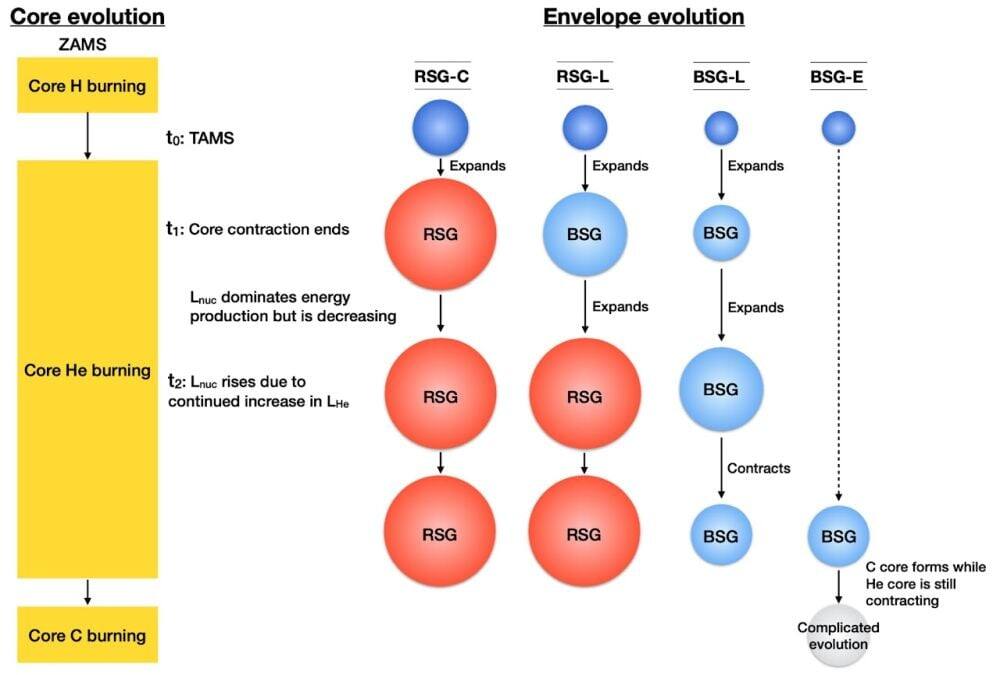
Supernovae, the spectacular deaths of massive stars, have long fascinated not only astronomers but also cultures around the world, as ancient records reveal. Most of these explosions stem from red supergiants-massive stars that have exhausted their core fuel and undergo a dramatic collapse. Yet the details behind what sets these stars on the path to explosion remain murky, particularly regarding the nature of their extended envelopes and how this affects the supernova light we observe. Recent research from scientists at Academia Sinica in Taipei sheds new light on how a star’s metal content and mass loss govern whether it swells into a red supergiant or remains a more compact blue supergiant, and how these traits influence the brilliance and timing of shock breakouts witnessed when stars explode.
The concept of metallicity-how many elements heavier than hydrogen and helium a star contains-emerges as a key factor determining a supergiant’s ultimate fate. By modeling stellar evolution, researchers found that stars must reach about one-tenth the Sun’s metallicity to expand into red supergiants. Those with lower metal content stay more compact and blue. This difference stems from how metallicity alters nuclear burning rates and the star’s opacity, which impacts the radius the star can achieve at the end of its life sequence before core collapse. Larger-radius stars have envelopes held more loosely by gravity, allowing stellar winds to shed mass more effectively and transform the star’s outer layers.
This finding revises our understanding of supernova progenitors and suggests that stellar populations in the early universe-often metal-poor-would have produced fewer red supergiant supernovae. The massive star Betelgeuse, visible in Orion’s constellation and a well-known red supergiant, likely fits this profile and is expected to explode as a supernova within the next 100,000 years. It also ejects material into a circumstellar envelope, a trait relevant to how shock waves escape during the final explosion.
Going beyond stellar structure, the team tackled the elusive process of shock breakout-the fleeting moment when the supernova’s shock wave breaches the star’s surface and floods space with intense light. Using two-dimensional radiation hydrodynamic simulations, they modeled how winds and pre-explosion mass loss influence the shock breakout’s appearance. Previously, unexplained variations in supernova brightness and timing prompted theories of extreme mass loss, but these new simulations attribute slower and dimmer breakouts mainly to the star’s extended envelopes and dense circumstellar material rather than catastrophic material shedding.
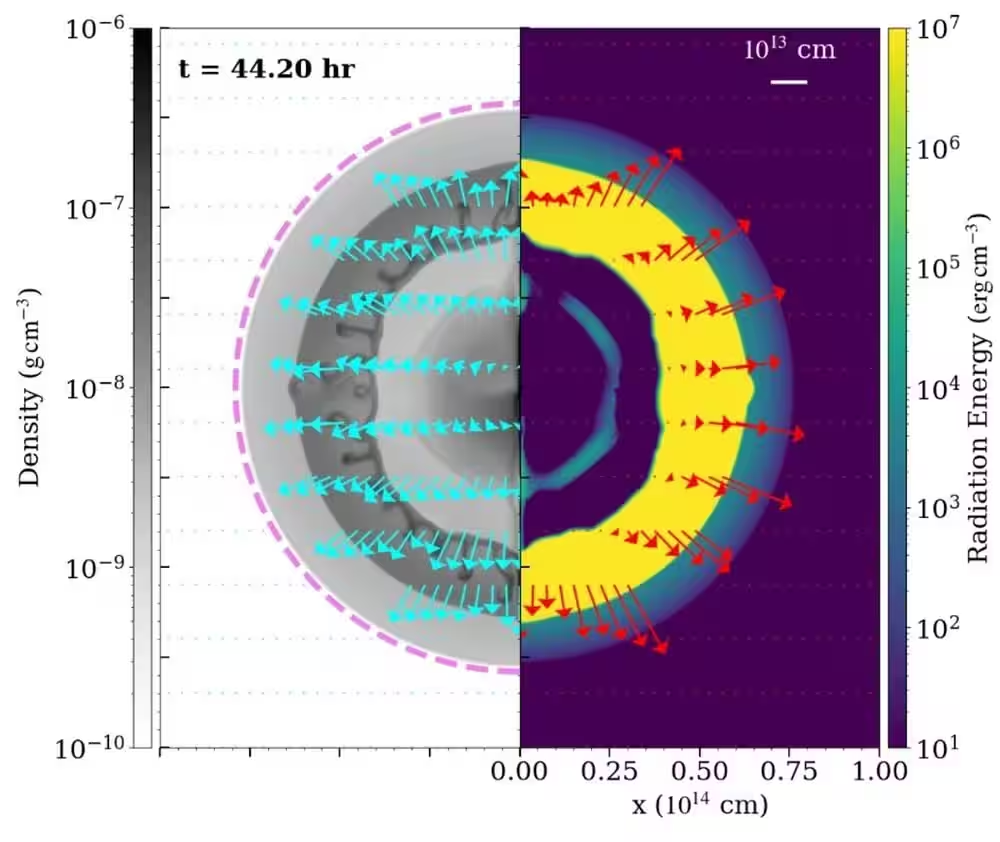
The simulations reveal that radiation escaping ahead of the shock generates instabilities and causes the star’s outer layers to swell and slow the shock’s emergence. This radiation precursor-and the surrounding dense gas-both elongate and dim the light curve’s initial burst. This nuanced physical picture helps explain why supernova detections often show distinct light curve variations, and provides a framework to interpret the growing flood of supernova observations expected from upcoming sky surveys.
The timing of these studies is critical as the Vera Rubin Observatory prepares to launch its Legacy Survey of Space and Time (LSST), which could uncover millions of supernovae over the coming decade. Unlocking the secrets behind supergiant envelopes and shock breakouts means astronomers will better decode these transient signals’ clues about stellar evolution and death. In an era brimming with data, these insights underscore the subtle interplay of metallicity, stellar winds, and radiation in shaping the spectacular ends of massive stars, reminding us there is still much to learn about cosmic beacons that briefly rival whole galaxies in brightness.