

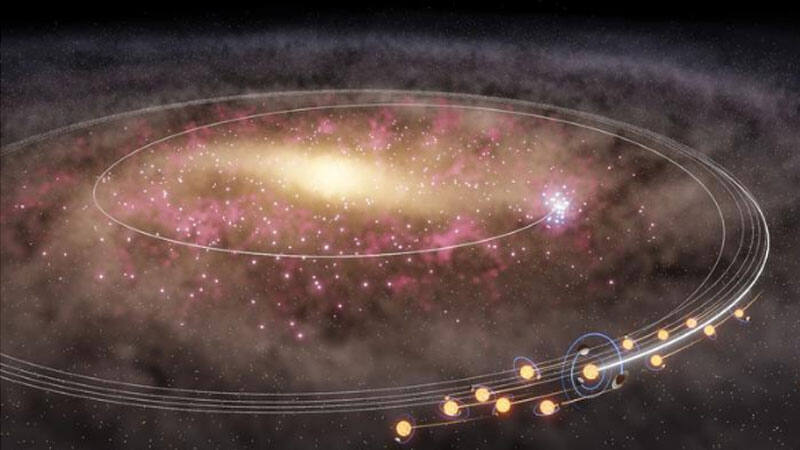
A new study by Japanese astronomers reveals that the Sun and thousands of stars nearly identical to it were not born where they currently orbit-but closer to the bustling core of the Milky Way. This insight, powered by data from ESA’s Gaia mission, challenges assumptions about the Sun’s origins and suggests a massive outward migration of stars from the galaxy’s center several billion years ago.
Using Gaia’s unparalleled astrometric catalog, researchers assembled an unprecedented list of 6,594 ”solar twins”-stars sharing nearly identical temperature, surface gravity, and chemical composition with our Sun. This collection dwarfs previous samples by a factor of 30, providing a detailed lens through which to examine the lifespans and trajectories of these stellar siblings.
The timing is telling: a sharp peak in the ages of these solar twins falls between 4 and 6 billion years, matching the Sun’s own age of approximately 4.6 billion years. Their positions indicate a wholesale migration outward by more than 10,000 light-years, aligning with a turbulent epoch in the Milky Way’s evolution marked by the formation of the galactic bar.
The galactic bar-a stretched structure of stars near the core-creates a ”corotation barrier” that normally blocks stars from drifting outward beyond the inner galaxy. However, during the bar’s formation, special orbital resonances emerged that enabled these solar twins to break through and settle into quieter, safer outer regions like our Sun’s present neighborhood. This explains not only the Sun’s safe perch but also why many of its twin stars share similar orbits far from the galactic center.
This discovery also sheds light on why Earth’s star resides in a relatively calm zone, protected from the energetic dangers frequent in the galaxy’s core-such as intense radiation, supernova explosions, and crowded stellar environments. The Sun was not a lucky outlier but part of a large stellar diaspora that ultimately created habitable conditions here.
Beyond revising our understanding of the Sun’s journey, the study offers fresh perspectives on the dynamic history of the Milky Way and the cosmic factors that nurture life-supporting environments. It’s a vivid reminder that our solar system’s past is tied to grand galactic migrations rather than a static birthplace under the stars.
Gaia mission data reveals the Sun’s stellar twins and their migration
Gaia’s detailed astrometric catalog enabled astronomers to identify thousands of solar twins by comparing temperature, gravity, and chemical makeup. This data was crucial in tracing their migration paths from the Milky Way’s center to their current positions in the galactic disk.
The role of the galactic bar in star migration
The formation of the galactic bar around the Milky Way’s core created orbital resonances that allowed stars to cross the usual corotation barrier. This mechanism explains how the Sun and its stellar twins moved outward more than 10,000 light-years to quieter, safer parts of the galaxy.
Implications for the Sun’s origin and habitable zones
The findings suggest the Sun’s birthplace near the energetic and hazardous galactic center but moved outward, settling in a calmer orbit. This migration helped establish the habitable zone conditions necessary for life on Earth.