

Stellantis posted a staggering $22.3 billion loss in 2025, largely driven by misjudging electric vehicle demand and failing to capture consumer interest with its EV lineup, particularly from brands like Jeep and Ram. The automaker’s gamble on transitioning too quickly into electric models, many of which fell flat in the market, has forced a strategic retreat back to combustion engines, highlighting deeper industry tensions about the pace and nature of the EV shift.
While many automakers are doubling down on EVs, Stellantis’s approach appears to have backfired. Its electric offerings, especially in the U.S., have been tepid, with models like the Fiat 500e and Jeep Wagoneer S criticized for uninspiring performance and design. Meanwhile, European models like the Citroën e-C3 and Peugeot e-208 haven’t been able to break into the sales leaders’ circle despite being present in the market.
This failure led Stellantis to reconsider the ”freedom of choice” mantra, now pushing to balance investments between electric, hybrid, and traditional combustion vehicles. CEO Antonio Filosa framed the losses as a consequence of overestimating how fast consumers would adopt EVs, a reminder that the transition is far from linear and demand varies dramatically by region and brand.
The stumble of Jeep and Ram dents Stellantis’s profits
Jeep and Ram, once pillars of Stellantis’s profitability, have struggled amid quality concerns, high prices, and the removal of beloved V-8 engines. The Ram 1500 electric pickup was scrapped as a full EV, replaced with plans for an extended-range hybrid instead-a clear sign of the company’s recalibration. Similarly, Jeep has resorted to steep price cuts to revive demand, underscoring the brand’s urgent need to reconnect with buyers.
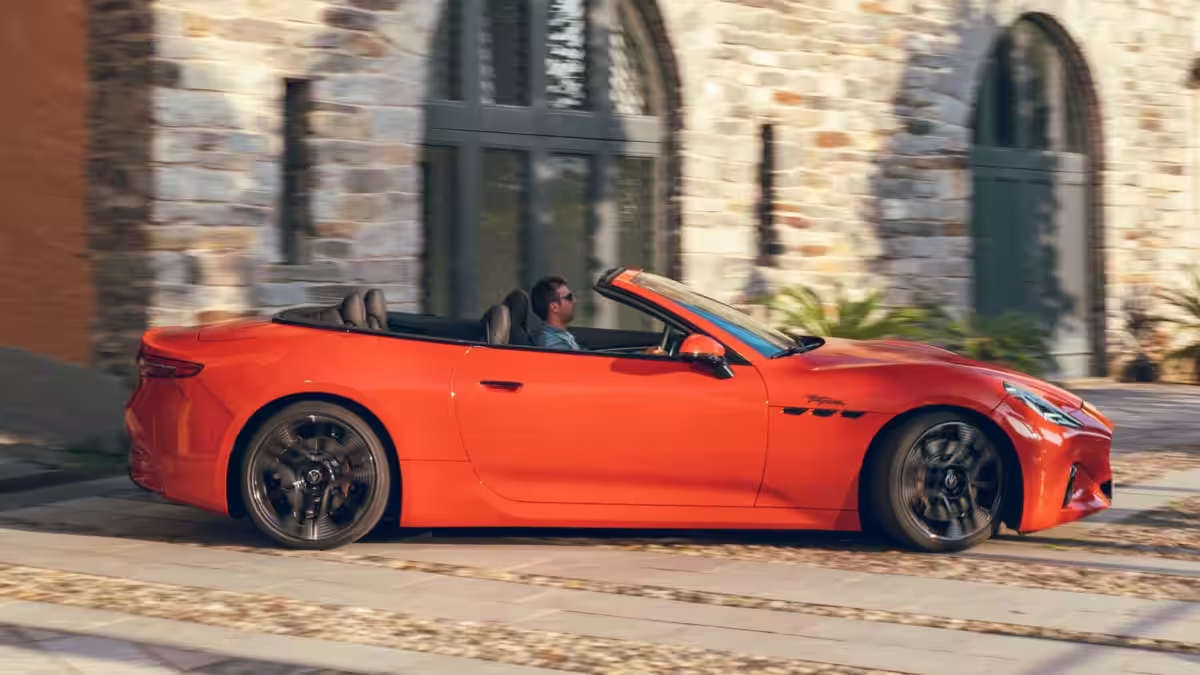
Stellantis also cut losses by canceling the electric Maserati MC20 Folgore, a model many expected to deliver a standout performance. Although the GranTurismo Folgore arrived, the market’s lukewarm response to electric models signals that the company’s current EV offerings lack the appeal and innovation to compete in what has become a fiercely competitive segment.
Why Stellantis misread the EV market
The company’s miscalculation wasn’t just about timing, but also the nature of its EV investments. Its electric models largely rely on two shared platforms with similar batteries and motors-offering little differentiation across brands. In contrast, rivals like Tesla, Hyundai, and Volkswagen have leveraged distinct platforms and technologies to create compelling, competitive EVs tailored to diverse consumer preferences.
Furthermore, Stellantis’s retreat underscores a broader industry pattern where legacy automakers grapple with balancing EV development costs and consumer demand that remains split between electric and internal combustion engine vehicles. Ford and General Motors have faced similar financial hits due to EV strategy resets, though Stellantis’s losses appear more severe, partly due to heavy severance charges in Europe and warranty costs linked to quality issues.
Despite the rocky year, Stellantis saw a rebound in the second half of 2025, posting an 11% increase in vehicle deliveries and 10% year-over-year revenue growth, driven mainly by North America. This recovery owes much to renewed focus on its core brands and easing pricing, hinting at lessons learned from its overzealous EV push.
Still, the company’s experience highlights how the EV transition is proving far messier than many predicted. Forget the view that automakers either win or lose on electrification alone. What’s clear is that delivering the right product with the right technology at the right time is an evolving challenge no one has fully solved yet.
As Stellantis looks ahead to 2026, its main challenge is closing execution gaps and winning back consumer trust while navigating an increasingly crowded EV marketplace. The question is whether doubling down on combustion engines alongside selective electrification can restore profitability or just delay an inevitable reckoning in a sector racing toward battery-powered mobility.