

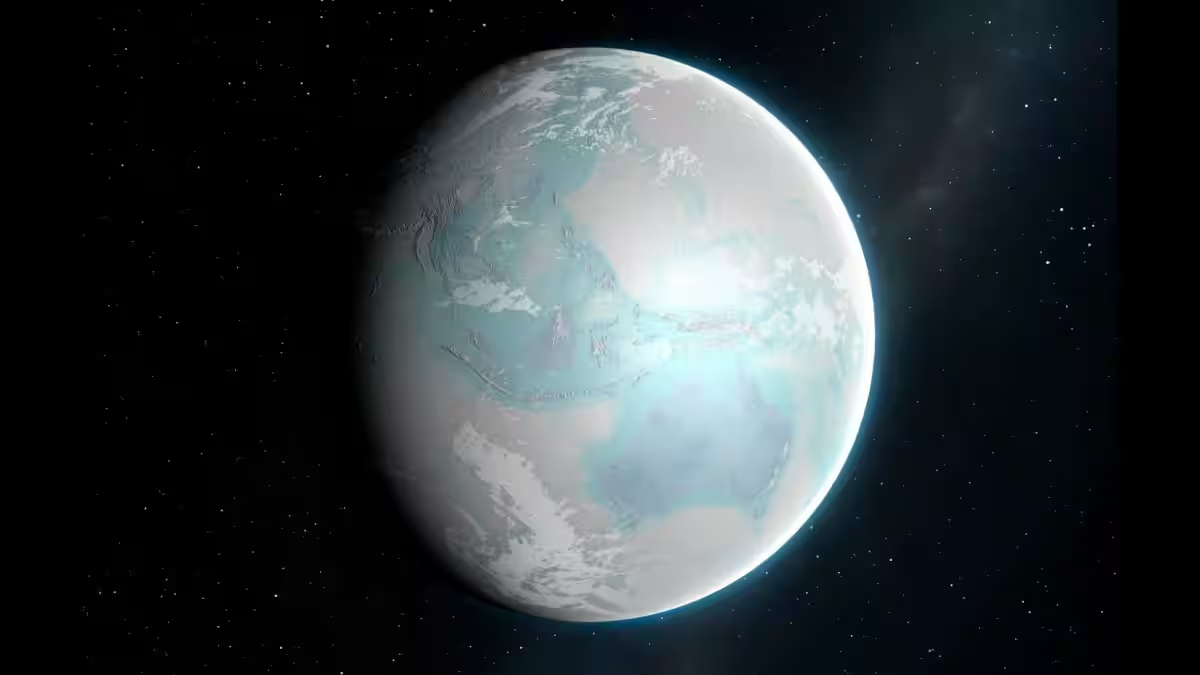
About 717 million years ago, Earth plunged into a deep freeze so severe that its oceans likely remained liquid well below the freezing point of pure water. Researchers have pinpointed sea temperatures during this period-known as Snowball Earth-to about −15°C, with salty brines preventing complete ice solidification. This finding challenges earlier assumptions about the planet’s glacial past and paints a harsher picture of ancient oceanic conditions that shaped the evolutionary course of life.
Iron formations reveal chilling ocean history
Scientists studied rusty iron deposits formed where glaciers met ice-covered seas during the Sturtian glaciation, extracting temperature clues from the isotopic makeup of iron minerals. Under oxygen-poor, icy conditions, lighter iron isotopes rust preferentially, enriching seawater in heavier isotopes. The unusually heavy iron isotopes found in these formations suggest ocean temperatures roughly 40°C colder than those measured in the pre-glacial Archean oceans, supporting extremely frigid, hypersaline waters.
This method acts as a geological thermometer, unlocking details of Earth’s cryogenic episodes and revealing a planet encased in glaciers potentially a kilometer thick-where sunlight failed to penetrate, photosynthesis halted, and oxygen starved the oceans beneath.
Saltier seas kept oceans liquid amid the freeze
Additional isotope analysis of strontium and barium points to Snowball Earth oceans having four times the salinity of today’s seas. Elevated salt concentrations depress the freezing point of water, allowing vast liquid brines to persist despite subzero temperatures. Modern analogs, like Antarctica’s ice-covered Lake Vida, host similarly salty brines, though Snowball Earth’s waters were even colder.
Notably, this means Earth’s oceans were not entirely locked in ice but sustained complex chemical environments beneath thick ice sheets. This detail deepens our understanding of how life might have survived and evolved during global glaciations-a question central to piecing together Earth’s biological and atmospheric history.
Implications for understanding Earth’s climate extremes and habitability
What makes the Snowball Earth episodes especially compelling is their runaway feedback loop: ice’s high reflectivity reduced solar warming, thickening ice further and amplifying the chill. These findings underscore how delicate Earth’s climate balance can be-and how life persisted through planetary conditions alien to our current experience.
Comparing these results with existing geological evidence refines models of ancient climates, showing that even frigid water bodies maintain complex chemical and physical states. By integrating isotope geochemistry with paleoclimate data, researchers forge new pathways to reconstruct Earth’s past environments with growing precision.
Understanding this ancient freeze advances broader climate science, offering a window into potential tipping points and stabilization mechanisms relevant to future climate change studies. It also prompts rethinking the resilience of early life forms under extreme and prolonged environmental stress.