

Qualcomm just raised the bar for smartwatch chips with the Snapdragon Wear Elite, revealed at MWC 2026. Targeting Wear OS devices and other intelligent wearables, this new platform packs a punch in speed, AI processing, and battery life, promising to reshape what we expect from wrist tech in the coming year.
The Snapdragon Wear Elite leapfrogs Qualcomm’s current high-tier W5+ Gen 2 chip with a slimmer design and a powerful 3nm manufacturing process. It’s the first Wear Snapdragon chip to use a big.LITTLE architecture, boasting a 2.1 GHz high-performance core alongside four smaller 1.95 GHz cores. Qualcomm claims this design boosts single-core CPU performance by five times over its predecessor, speeding up apps, multitasking, and boot times considerably.
Graphics have not been left in the dust either. The new Adreno GPU supports up to 1080p at 60 frames per second and can deliver a sevenfold improvement in maximum frame rates, ensuring smooth interaction and more visually intensive apps on your wrist.
Where the Wear Elite really shines is in on-device AI capabilities. Its Hexagon neural processing unit (NPU) can handle up to 2 billion parameters, facilitating advanced functions like computer vision, voice recognition, and real-time translation right on the watch without relying on cloud support. Complementing this is a dedicated eNPU designed for ultra-low power tasks such as always-on keyword detection, activity monitoring, and noise suppression-functions that extend battery life by smartly distributing workloads across multiple power-efficient ”islands” inside the chip.
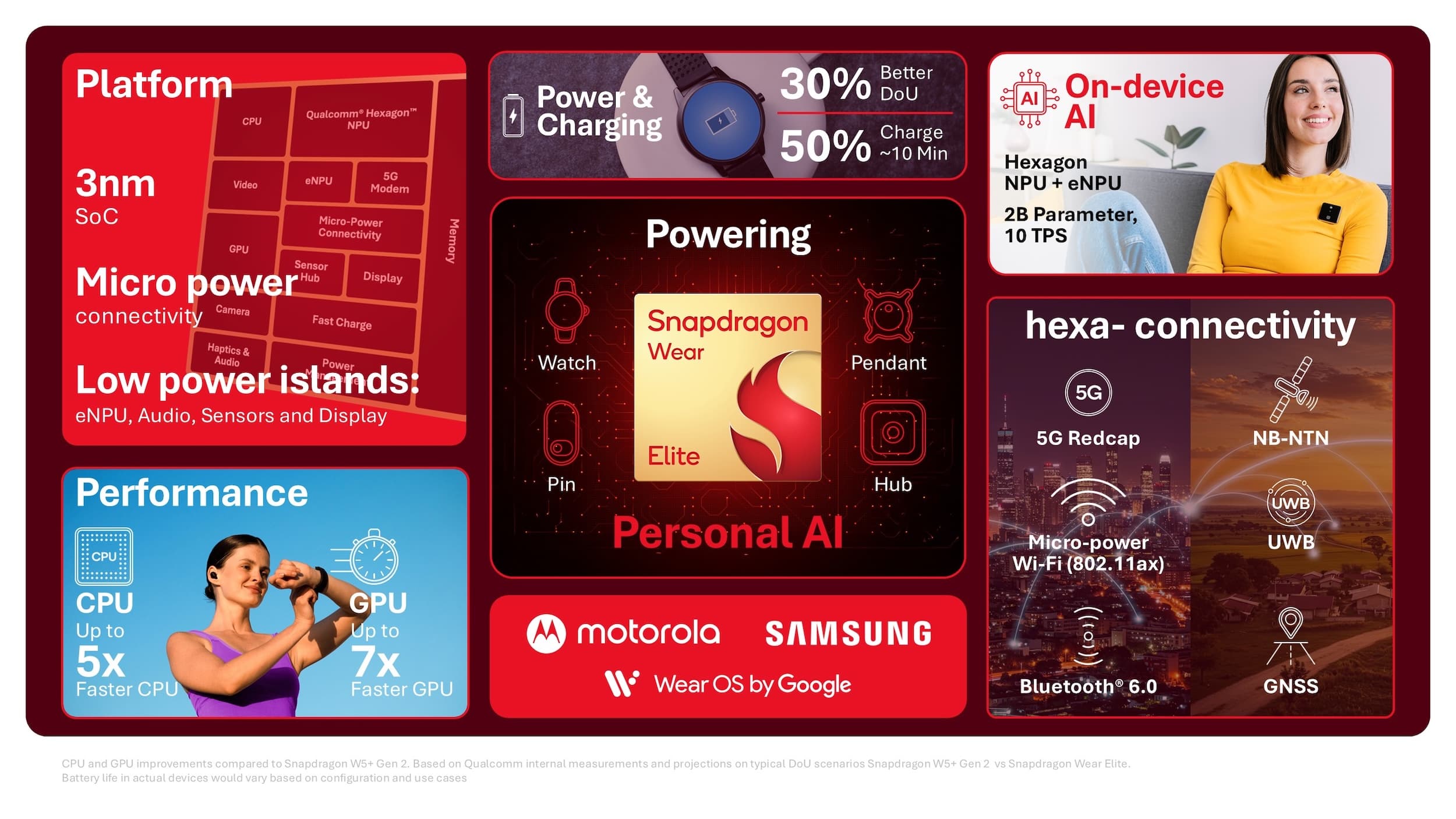
The chip also boasts comprehensive connectivity support, including Wi-Fi 6 (802.11ax), Bluetooth 6.0, ultra-wideband (UWB) for secure device unlocking, GNSS for precise location tracking, 5G RedCap, and satellite-based NB-NTN communications. Its micro-power Wi-Fi mode reduces power consumption by 80%, enabling continuous wireless connections without a massive hit to battery endurance.
Battery life improvements come paired with quick charging capabilities. The Wear Elite can recharge typical smartwatch batteries (300-600 mAh) by 50% in just 10 minutes using 9V fast charging, while delivering around 30% longer usage than prior chips.
Qualcomm has made it clear that the Snapdragon Wear Elite supports not only Android and Wear OS but also Linux-based lighter operating systems, underscoring the chip’s versatility across a wider array of AI-driven wearables like smart glasses and camera-equipped pins. This means device makers can craft truly innovative products beyond traditional smartwatches.
Google and Samsung are on board with Qualcomm’s vision. Google’s recent message about transitioning Wear OS from a simple smartwatch platform to an ”always with you intelligent system” aligns closely with the performance and AI muscle the new chip delivers. Samsung promises the next Galaxy Watch, powered by Snapdragon Wear Elite, will be an ”even more holistic wellness companion,” highlighting enhanced health and lifestyle monitoring capabilities.
The first Snapdragon Wear Elite-powered devices are expected to hit the market in the coming months, kicking off a new chapter where wristwear could move beyond fitness tracking toward true on-device AI assistants and richer interactivity without sacrificing battery life.
Qualcomm’s announcement signals a push to reclaim wearable performance leadership amid a market hungry for smarter, faster, and more efficient devices. Yet the strategy bypasses the company’s newer Oryon cores for now, hinting that this premium chip is more of an evolutionary upgrade than a revolution. Time will tell if this approach lets Qualcomm outpace competitors like Apple’s S9 chip or Google’s future Wear silicon.