

Qualcomm’s Snapdragon 8 Gen 5 and MediaTek’s Dimensity 9300 are aimed at different buyers on paper, but the benchmark numbers make the choice look pretty lopsided. The newer Snapdragon 8 Gen 5 chip wins the CPU race, posts higher graphics stability, and brings a more modern connectivity stack, while the older Dimensity 9300 mainly counters with a lower price tag.
Snapdragon 8 Gen 5 benchmark scores
In Geekbench v6, the Snapdragon 8 Gen 5 scored 2,837 in single-core and 9,352 in multi-core testing, compared with 2,208 and 7,380 for the Dimensity 9300. That is about a 27% lead in both tests, which is the kind of gap you feel in heavier multitasking, not just in a spreadsheet. AnTuTu v11 tells the same story: 2,961,236 for Snapdragon versus 2,324,872 for MediaTek.
The sub-scores are where the Snapdragon chip really stretches its legs. It leads the Dimensity 9300 in CPU, GPU, memory, and UX, with the biggest margin in UX at 44%. For buyers, that usually translates into fewer stutters in day-to-day use and less annoying performance drift under load.
Gaming stability is where the gap widens
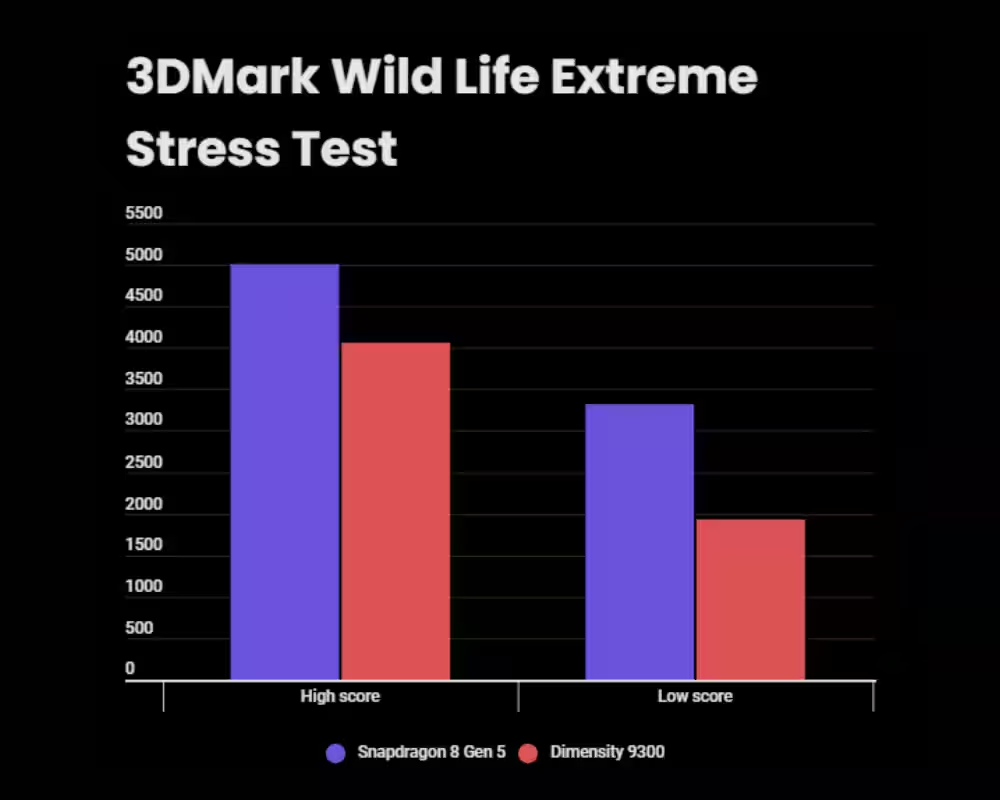
3DMark Wild Life Extreme Stress Test is even less flattering to the Dimensity 9300. The Snapdragon 8 Gen 5 delivered a best loop score of 5,009 against 4,062, but the more telling number is the lowest loop score: 3,321 versus 1,933. That means the Snapdragon chip held up far better once sustained load kicked in, with stability at 66.30% compared with 47.59%.
This matters because phone makers love to talk up peak performance, then quietly hope you never play something demanding for long enough to expose the throttling. The Snapdragon 8 Gen 5 looks better for longer sessions, while the Dimensity 9300 is more of a good-starts-strong kind of chip.
Snapdragon 8 Gen 5 specs vs Dimensity 9300
The Snapdragon 8 Gen 5 is built on TSMC’s 3 nm process, while the Dimensity 9300 uses 4 nm. Qualcomm also pairs two Oryon prime cores at 3.8 GHz with six Oryon performance cores at 3.32 GHz, while MediaTek uses a 1 + 3 + 4 layout with Cortex-X4 and Cortex-A720 cores. In plain English: the Snapdragon part is tuned harder for performance.
- Snapdragon 8 Gen 5: Adreno 829 GPU, Snapdragon Elite Gaming features, Bluetooth 6.0
- Dimensity 9300: Arm Immortalis-G720 MP12, HyperEngine Adaptive Gaming Technology, Bluetooth 5.4
- Snapdragon 8 Gen 5: up to 10 Gbps 5G download speed
- Dimensity 9300: up to 7 Gbps 5G download speed
MediaTek does keep one neat card up its sleeve: Wi-Fi 7 peak speed is listed at 6.5 Gbps, ahead of the Snapdragon chip’s 5.8 Gbps. That said, Qualcomm counters with the more modern Bluetooth version and the broader performance lead elsewhere, so the trade-off is pretty clear.
Camera and AI hardware are close, but not equal
On imaging, both chips support up to 320MP single cameras, but the Snapdragon 8 Gen 5 gets a 20-bit Spectra AI ISP with up to 4K/120fps video recording, while the Dimensity 9300 uses an 18-bit Imagiq 990 ISP and goes up to 8K video recording. The Snapdragon side leans into real-time semantic segmentation and Qualcomm’s latest camera stack, which is the sort of feature list OEMs love to put in launch slides.
For AI, Qualcomm’s Hexagon NPU is positioned for agentic assistants and heavier on-device workloads, while MediaTek’s NPU 790 supports up to 33 billion parameters and LoRA Fusion. The two chips are both trying to sell the same future: more AI on-device, less cloud dependency, and fewer reasons for your phone to be idle.
Which chip makes more sense
For most premium buyers, the Snapdragon 8 Gen 5 is the safer pick. It is faster in benchmarks, more stable in sustained gaming, and stronger on modem speed and Bluetooth support. The Dimensity 9300 still makes sense if the phone around it is materially cheaper, because raw value can beat spec-sheet bragging rights faster than marketing teams would like to admit.
The more interesting question is how aggressively handset brands will price these two chips against each other. If MediaTek phones keep landing at a real discount, the 9300 will stay relevant; if not, Snapdragon 8 Gen 5 devices are going to look like the default recommendation.