

Qualcomm is preparing to launch the Snapdragon 8 Elite Gen 6 series this September, showcasing a dual-chip strategy with the Snapdragon 8 Elite Gen 6 and the more powerful Snapdragon 8 Elite Gen 6 Pro. Recent leaks illuminate key details about these processors, highlighting a shift toward more distinct performance tiers within Qualcomm’s premium lineup. Both chips are expected to be fabricated using TSMC’s advanced 2nm process, promising state-of-the-art efficiency and power.
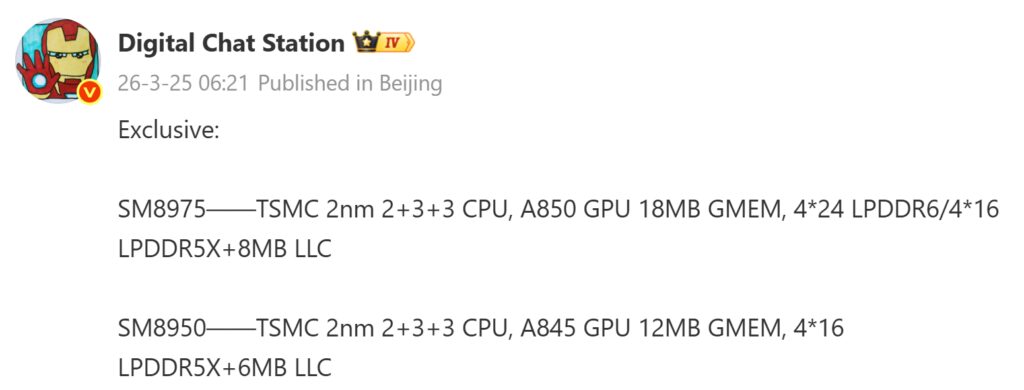
The two chips, designated SM8950 and SM8975, adopt a 2+3+3 CPU core architecture that balances high-performance and power-efficient cores. Despite this similarity, the differences lie in their graphical and memory capabilities. The SM8975, presumably the ”Pro” variant, will feature the flagship Adreno 850 GPU with 18MB GPU memory (GMEM) and support LPDDR6 memory in a 4×24 configuration, bolstered by an 8MB last-level cache (LLC). Meanwhile, the standard SM8950 will be equipped with the slightly pared-down Adreno 845 GPU, 12MB GMEM, and LPDDR5X in a 4×16 configuration with a 6MB LLC cache.

The positioning of the SM8975 as the high-end Pro model suggests Qualcomm aims to sharpen competition against MediaTek’s upcoming Dimensity 9600, which is rumored to slot between these two Snapdragon variants in performance. Compared to the prior generation, Qualcomm’s approach with two premium-tier chips signals an intent to cover a broader spectrum of flagship devices-from mainstream advanced to ultra-premium tiers.
There’s also mention of an additional Snapdragon 8 Gen 6 chip in development, expected to have lower specs. This may serve markets or devices that don’t require ultra-high-end performance, allowing Qualcomm to diversify offerings without cannibalizing its flagship lineup.

The cost of producing the SM8975 Pro is reportedly far higher, meaning it may be reserved for premium flagship models only, while the SM8950 is likely to see broader adoption. Qualcomm could also maintain development flexibility with fallback plans depending on market demand and manufacturing yields.
Qualcomm’s leap to the 2nm node aligns with industry trends to embrace next-generation semiconductor fabrication, aiming for gains in efficiency and performance. This positions the Snapdragon 8 Elite Gen 6 series as a key pillar in the mobile processor market for 2026, matching the growing expectations for power, graphics, and AI capabilities in flagship smartphones.