

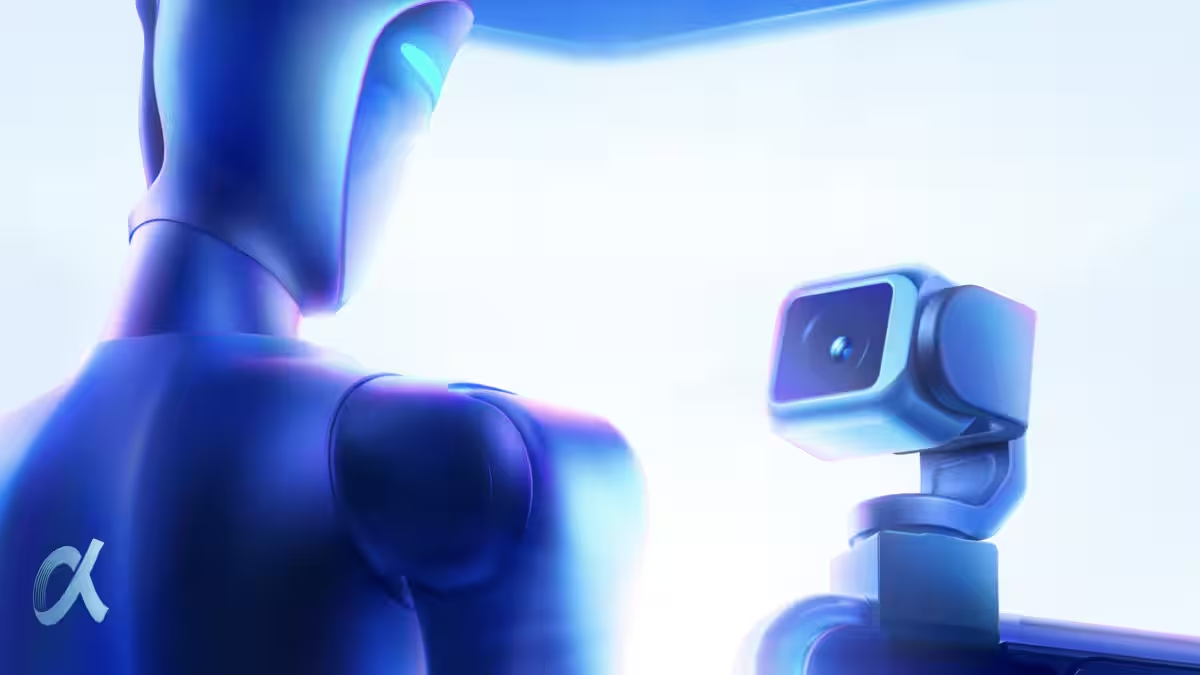
Smartphones no longer have to be the end of the story for consumer hardware. When phones stop selling faster than last quarter, companies look sideways – and robotics is an obvious, flashy sidestep. Honor’s tease that it will bring a humanoid robot (and its Robot Phone) to Mobile World Congress is less about a cute demo and more about a strategic pivot: making the phone the brain or control hub for a new class of devices that can charge recurring revenue and services.
The headline: Honor says it will show an unnamed AI-powered humanoid robot alongside its Robot Phone at MWC in Barcelona. The company posted a teaser on X that reads, ”Something revolutionary is about to step out of the shadows. We’ve combined cutting-edge robotics with the ultimate mobile experience. The result? Something you have to see to believe.” Bloomberg reported the robot will be a ”service robot” intended to help with tasks like shopping, and that it will be connected to Honor’s Robot Phone. Honor’s MWC showcase kicks off at 7 a.m. ET on March 1, 2026.
Why this matters
Smartphone markets are saturated and margins are getting squeezed. One straight answer is to sell subscriptions and services; another is to expand the ecosystem of devices that can use those subscriptions. A robot that pairs with your phone can be billed as an accessory, a platform for new services, and a marketing spectacle all at once. For a phone brand that needs to differentiate, that’s an attractive proposition.
Where this fits in a messy history
The idea of commercially useful humanoid robots has been promised – and postponed – for years. From retail-facing peddlers to research prototypes, humanoid machines have often delivered more headlines than practical use. There have been modest commercial successes for short, specific roles (retail greeters, kiosk attendants) and a string of high-profile demos that struggled to become reliable, affordable products.
What changed recently is twofold: phones got absurdly powerful, and edge AI + connectivity (5G, Wi‑Fi 6/7) gives manufacturers a convenient way to offload heavy compute or deliver regular feature updates. That combination makes a tight phone-to-robot playbook plausible: the phone supplies compute, identity, network, payments and an app store; the robot supplies motion, sensors and a physical presence.
Why Honor’s move is smart – and risky
Smart moves: tying a robot to a phone helps Honor leverage existing strengths – handset design, supply chains and a potential installed base – rather than building a standalone robotics business from scratch. A phone as a control center lowers the bar for the robot’s onboard hardware and gives Honor a channel for software, subscriptions and cloud services.
Big risks remain. Humanoid robots are expensive to design and expensive to insure. Battery life, safe locomotion in crowded spaces, regulatory approvals and the mundane problem of convincing buyers the robot is more useful than a cheaper stationary device are all real hurdles. Consumers rarely pay premium prices for single-purpose hardware unless there’s a clear service attached – something phone makers are still figuring out.
Who wins and who loses
Winners if this works: ecosystem-heavy companies that can bundle services with hardware, and vendors that can make robots useful in commercial settings like retail, hospitality or logistics. Phone makers with large software platforms can nudge enterprise customers toward managed, subscription-style deployments.
Losers if it fails: consumers who pay for a novelty device that never earns its keep, small robotics startups that struggle to compete with phone-makers’ marketing budgets, and investors chasing demos rather than repeatable business models.
What to watch at MWC
Honor’s demo will tell us a lot. Key questions to look for: how autonomous is the robot versus phone-assisted; what explicit use cases does Honor demonstrate (shopping help, concierge, inventory tasks); whether there’s a developer platform or SDK that third parties can use; and, critically, the price and shipping timeline. If this is a marketing prototype, expect showy demos but no purchase options. If it’s a product, Honor should show integration details and a clear go‑to‑market strategy.
Either way, expect other smartphone companies to watch closely. Phones as brains is a sensible extension of existing advantages – but turning that into profitable, mass-market robots is still the hard part.
”Something revolutionary is about to step out of the shadows. We’ve combined cutting-edge robotics with the ultimate mobile experience. The result? Something you have to see to believe.”
Honor
Honor’s MWC session begins at 7 a.m. ET on March 1, 2026. Expect spectacle, a dash of practical detail, and – probably – more questions than answers when it comes to whether the phone-plus-robot combo is the next mainstream consumer platform or just another expensive curiosity.