

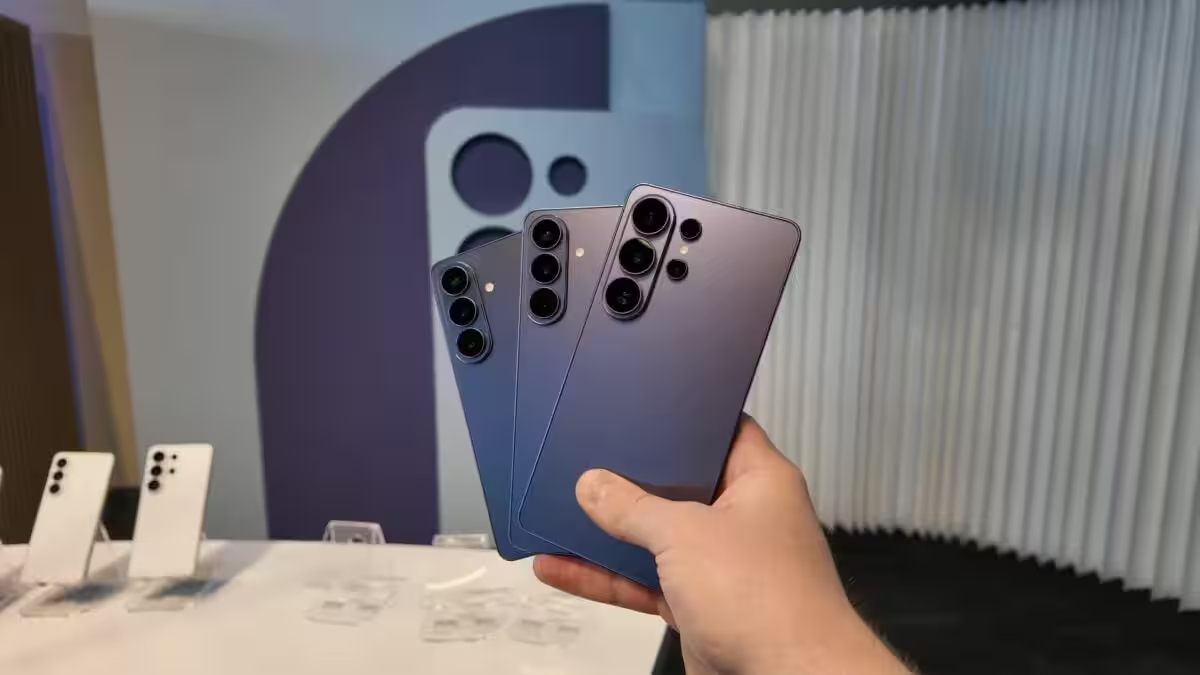
Mobile signals die. Mountains, storms, ship decks, and airplane aisles have reminded us that the cellular network is a convenience, not a guarantee. That gap is exactly what satellite connectivity promises to fill – and now Samsung’s new Galaxy S26 family is officially joining the crowd.
Samsung confirmed that the Galaxy S26, Galaxy S26+, and Galaxy S26 Ultra will offer satellite-based messaging and data services in Europe, Japan, and North America. The company is rolling the feature out through partnerships with local carriers rather than through a single global satellite partner, which means the experience will vary by country and operator.
How Samsung plans to connect phones off the grid
In Europe, Samsung is working with Virgin Media O2 and is collaborating with MasOrange in Spain and Vodafone to enable satellite communications. In Japan, it has deals with Docomo, KDDI, and SoftBank, and is working with Rakuten Mobile to expand availability. In North America, Samsung has partnered with AT&T to support the feature on its devices.
These carrier pairings are additive to existing satellite efforts in the Android space. The Galaxy S22 (and newer) and select Galaxy A phones have had satellite-based data, texting, and tsunami warning (ETWS) on KDDI’s network since 2025. T-Mobile’s T-Satellite service (T911), powered by Starlink, has supported text and data on select Galaxy A and Galaxy S phones since 2025, while Verizon already offers eSOS and texting on Galaxy S25 and newer phones. Several operators – AT&T, Rakuten, Verizon, and Vodafone – use AST SpaceMobile’s satellite solution for compatible handsets.
”Samsung has a rich legacy in wireless communication technologies, and we strive to be at the forefront of innovation in this space through open collaboration with global partners. As satellite connectivity becomes an important part of the mobile landscape, we are committed to ensuring Galaxy users have reliable access to communication, especially when they need it most.”
Samsung
Why this matters – and why it won’t feel seamless
The real story is not that Samsung added satellite capability – Apple kicked off mainstream attention to emergency satellite SOS with the iPhone two years earlier – but that satellite backup is becoming table stakes for flagship phones. That should be a win for consumers who want a safety net. But the industry is building that net out of very different rope.
There are at least three types of actors here: the device maker (Samsung), the cellular carriers that control service activation and billing, and multiple satellite infrastructure providers (AST SpaceMobile, Starlink/SpaceX, Globalstar, and others). Each one has commercial incentives to favor its own arrangement. The result: the same Galaxy phone may offer different satellite features depending on which carrier you buy it from and where you travel.
Winners, losers and the messy middle
Winners: carriers that bundle satellite as a premium safety feature, Samsung for closing a feature gap with rivals, and satellite operators finding new retail routes for their networks. Consumers also win when these links actually work in emergencies.
Losers: anyone who expected a single, universal satellite experience. The patchwork approach creates fragmentation – different routing, different partners, inconsistent feature sets (text-only vs two-way messaging vs limited data), and likely different terms of service. Emergency responders and international travelers could face confusing support scenarios. Smaller satellite companies that don’t secure enough carrier deals risk being squeezed out.
Technical and regulatory limits you should know
Satellite phone links are not a substitute for 4G/5G. They tend to be low-bandwidth, higher-latency, and constrained to short messages or tiny data payloads. That makes them ideal for SOS and brief check-ins, not streaming or large file transfers.
There are also persistent policy and spectrum questions. Regulators have had to weigh how terrestrial carriers, satellite constellations, and new entrants coordinate frequencies and roaming. Astronomers and some regulators have pushed back on large low Earth orbit (LEO) constellations over interference concerns. Expect more scrutiny as satellite-to-handset traffic scales up.
What Samsung’s phrasing really hints at
Samsung said it is working with more cellular operators to bring satellite communication support ”across Galaxy product categories.” That wording is deliberate: it leaves open extensions to lower-cost Galaxy phones and even to Galaxy Watch models. Adding satellite links to wearables would be the next logical step, but wearables face even stricter size, power, and antenna constraints.
Expect more carrier-specific launches and a continued soup of providers. For consumers, the practical takeaway is simple: check the fine print before you buy. If you travel off-grid frequently, confirm which satellite partner and carrier your region uses and what kinds of messages or data are supported.
