

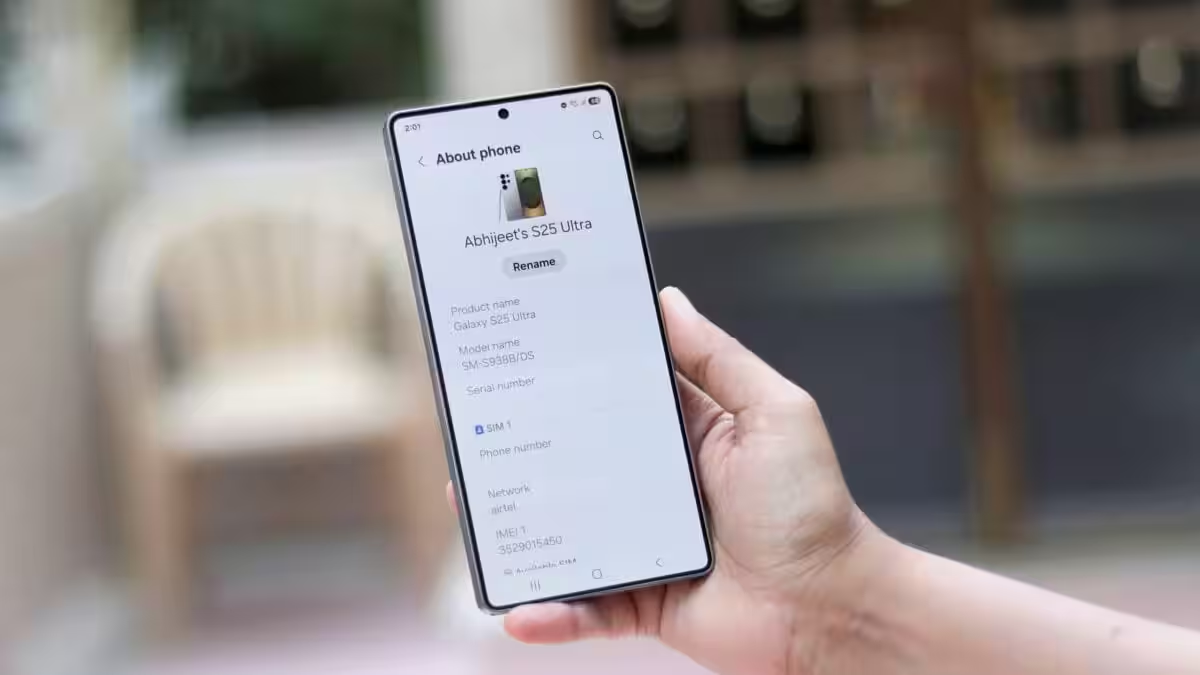
People glance at phones on trains, in cafés, and at counters. For years the easiest fix has been a cheap privacy screen protector that turns your display into a narrow-beam flashlight. Samsung has taken a different route: a built-in, hardware Privacy Display that finally arrived on the Galaxy S26 Ultra after being planned for the S25 Ultra.
The basic promise is simple: stop shoulder-surfing at the hardware level. Samsung says the feature lives in its Flex Magic Pixel OLED panel and hides content from side angles so anyone beside you can’t read your screen. The company first trialed other display upgrades recently too – its anti-reflective display debuted with the Galaxy S24 Ultra – but the privacy screen required more time.
”Our goal was to have this, to be honest with you, on the S25 Ultra. We were almost there. But we had to kind of solve a couple of the last challenges. So we took another year to resolve those. It has been quite a journey.”
Bloomberg
That admission from Samsung MX Chief Operating Officer Won-Joon Choi explains the delay: the idea dates back three to four years and moved from concept into engineering with Samsung Display, but last-mile technical problems kept it off the S25 Ultra.
Why a hardware privacy layer is different
Privacy screen protectors and apps try to limit viewing angles by adding a physical film or reducing brightness and contrast. They work, but they add thickness, can dull colors, and are easy to remove. A built-in solution promises a cleaner user experience: no extra accessory, better optical integration, and the ability to toggle privacy on and off in software.
Hardware privacy implementations are not new – laptop makers like HP have offered integrated privacy modes for years – but putting similar behavior on an OLED smartphone is harder. Directional control of light in a foldable, flexible panel requires new pixel architectures or micro-structures that change how light leaves the screen. Those changes can affect brightness, color fidelity, and manufacturing yields, which matches Samsung’s explanation that it needed another year to ”solve a couple of the last challenges.”
Winners, losers, and the rollout question
Samsung Display and Samsung Electronics win if Privacy Display becomes a visible differentiator – it gives them another component-level advantage against rivals. Consumers who work in public or handle sensitive information win too: an integrated privacy mode is easier and cleaner than an aftermarket film.
Accessory makers that sell clip-on privacy filters could see a long-term hit if OEM-built privacy becomes common. And expect fast followers: once the technical kinks are ironed out, other phone makers that buy panels from Samsung Display or develop similar tech will likely offer comparable features.
Samsung says it plans to bring Privacy Display to more affordable phones as the technology matures, and it’s researching how to adapt it for the Galaxy Z foldables. Adapting directional optics to folding glass and plastic presents extra mechanical and longevity headaches, so expect a slower, staged rollout rather than a broad sweep next year.
What Samsung still needs to prove
There are three practical questions buyers will want answered once they can test the feature: how much the mode reduces brightness and color accuracy, whether it introduces flicker or ghosting at certain angles, and whether enabling privacy measurably reduces battery life. Samsung’s early messaging promises a refinement rather than a blunt trade-off, but the proof will be in hands-on reviews and long-term user reports.
Finally, there’s a market question: is hardware privacy a feature regular consumers will pay for, or mainly a corporate/enterprise selling point? If Samsung can make the tech cheap and transparent enough to ship across midrange models, it could become an expected convenience rather than a niche premium option.
For now, Privacy Display arriving on the Galaxy S26 Ultra – a year later than planned – is a reminder that some display advances need patient engineering. Samsung has signaled intent; the next step is turning intent into a durable, mass-market feature that actually improves privacy without trading away the things people buy smartphones for: bright, accurate, long-lasting screens.
Tags: samsung, galaxy-s26, privacy, oled, displays, mobile, hardware