

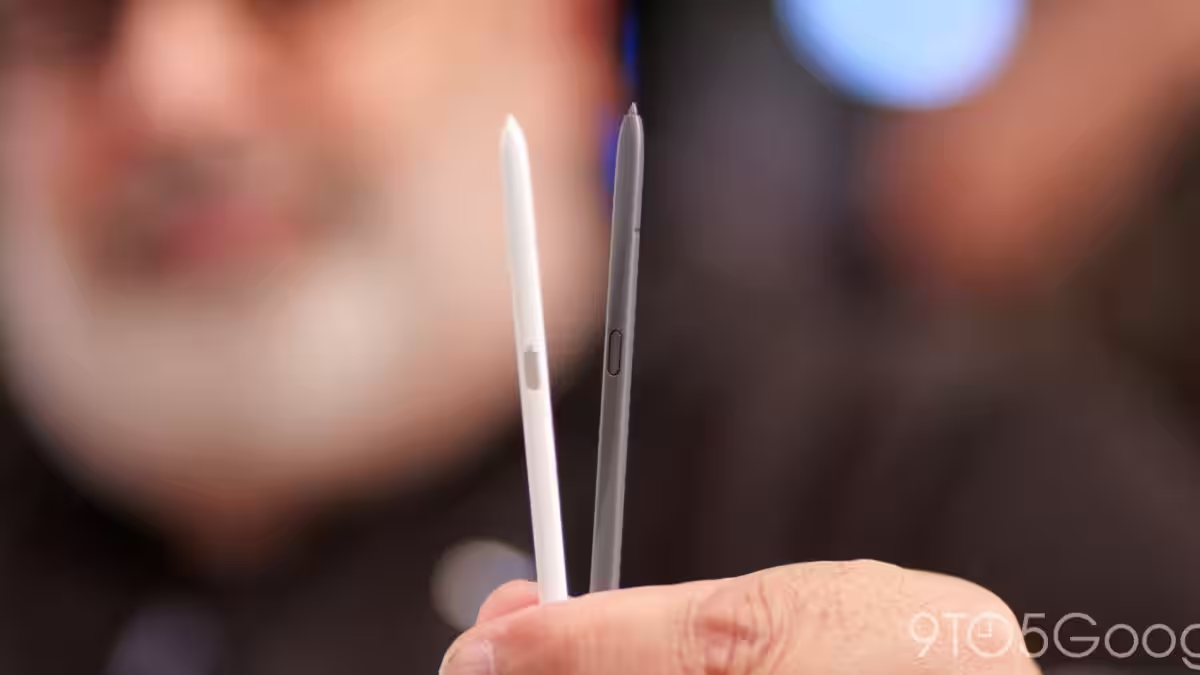
Samsung has a problem with its most loyal peripheral: the S Pen is still a signature feature, but the hardware that supports it is increasingly at odds with the thin, magnet-friendly phones Samsung wants to build.
After the Galaxy S26 launch, Samsung’s COO said the company plans to ”upgrade” the S Pen and even hinted at a new display structure that would reduce the design penalty of including the stylus. At the same time, Samsung has no timetable for follow-ups to experimental devices such as the TriFold or the S25 Edge, underscoring how priorities have shifted toward shaving millimeters and fixing compatibility problems.
We’re working on a more advanced technology within S Pen to come up with a new structure of display, so the penalty of having S Pen is diminished. S Pen will continue to be one of the core technologies.
Bloomberg (interview with Samsung COO Won-Joon Choi)
That terse promise masks several practical constraints. The S Pen experience on Galaxy phones traditionally depends on an active digitizer layer beneath the screen – useful for precision, pressure sensitivity, and latency, but costly in thickness and complexity. Those trade-offs are why the Fold 7 dropped S Pen support, and why Samsung is nervous about magnets from the Qi2 charging standard interfering with the current system.
Why this matters
Two core tensions are playing out. One is industrial design: premium phones keep getting thinner, and engineers hate anything that forces extra depth or awkward internal layouts. The other is standards and accessories: newer magnetic charging ecosystems and ever-more compact foldables don’t mix easily with a dedicated stylus stack built into the chassis.
The winners if Samsung pulls this off are obvious: users who rely on pen input get better compatibility across more device types, and Samsung preserves a genuine functional differentiator versus rivals that don’t offer a pen-centric phone experience. The losers are also clear – any third-party pen makers or accessory ecosystems that depend on the current S Pen architecture, and experiment-heavy handset projects that can’t compete for engineering attention.
What Samsung (and you) can do
There are a few realistic routes Samsung could pursue without breaking physics: integrate a slimmer digitizer implementation that’s less intrusive; move more sensing into the display itself; or rely on clever magnetic and mechanical design to tuck a pen into a thin frame. Each carries trade-offs in latency, battery life, manufacturing cost, or accessory compatibility.
Samsung’s public stance – that the S Pen is ”core” – is smart marketing. But the company is being deliberately vague about timelines. Saying a technology is ”in the works” buys product teams time while keeping fans on edge and competitors guessing.
How the competition stacks up
No major rival puts a built-in pen at the center of its flagship phones the way Samsung does. Apple has kept the Pencil as an iPad accessory, and most Android makers don’t offer integrated stylus support at all. That gives Samsung a niche advantage – if it can preserve the pen’s feel while resolving the practical headaches that have sidelined it in recent foldables and edge experiments.
What to watch next
Expect incremental change rather than a dramatic pivot. Samsung will likely tease improved S Pen behavior across marketing cycles and may introduce revised hardware on a future Ultra model or a redesigned foldable. Don’t hold your breath for a TriFold or a revived Edge any time soon; Samsung’s comments make clear those projects are experimental or lower priority.
Meanwhile, the Galaxy S26 series is available for pre-order, with Samsung’s usual trade-in boosts and launch offers running through March 11, when the phones hit store shelves.
Bottom line: Samsung still believes the stylus is a differentiator. The real test will be whether it can deliver the same S Pen magic without the bulk – or whether fans will have to keep choosing between precision and portability.