

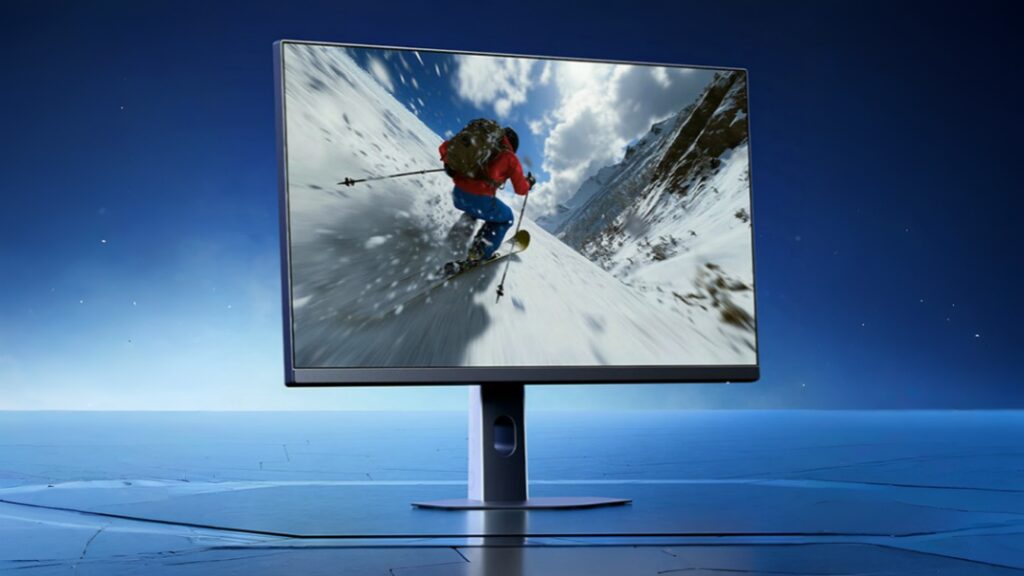
Xiaomi has added a faster option to its Redmi G25 monitor lineup: the Redmi Monitor G25 300Hz. It keeps the same 24.5-inch, 1080p Fast IPS formula, but pushes the refresh rate to 300Hz and prices it at 749 yuan ($108), which is exactly the kind of spec bump gamers notice and budget buyers have to think about twice.
Redmi Monitor G25 300Hz specifications
The panel uses a 1920 x 1080 resolution and a Fast IPS layer with a 178° viewing angle. Xiaomi says the display reaches 400 nits peak brightness, carries VESA DisplayHDR 400 certification, and hits ΔE < 2 for color accuracy. It also supports 8-bit color, 100% of the sRGB gamut, and 95% of DCI-P3, which is a fairly serious color spread for a screen aimed at high-frame-rate gaming rather than just spreadsheet duty.
- Size: 24.5 inches
- Resolution: 1920 x 1080
- Refresh rate: 300Hz
- Panel: Fast IPS
- Brightness: 400 nits peak
- HDR: VESA DisplayHDR 400
- Color coverage: 100% sRGB, 95% DCI-P3
Gaming features and eye comfort
Adaptive Sync is on board too, with support for both Nvidia G-Sync and AMD FreeSync, so tearing and stutter should stay out of the way. Xiaomi also includes TÜV Rheinland-certified low blue light mode and DC dimming, two features that are increasingly standard on gaming monitors because people have finally accepted that staring at a bright panel for hours is not a hobby for the eyes.
Design-wise, the Redmi Monitor G25 300Hz stays minimal, with slim bezels, tilt adjustment, wall-mount support via a separate mount, a DisplayPort 1.4 port, an HDMI 2.0 port, and a joystick-style OSD controller for menu navigation. That puts it in the same general lane as a wave of aggressive-value gaming displays from rivals, where the real competition is less about flashy design and more about how far brands can stretch refresh rates without blowing up the price.
A faster answer to cheap gaming monitors
The interesting part is not that Xiaomi made a 300Hz monitor; it is that it did so while keeping the Redmi G25 family firmly in low-cost territory. The company already has a 240Hz version in the same series, so the new model is clearly aimed at buyers who want the cheapest possible ticket to esports-grade smoothness, even if 300Hz on a 24.5-inch 1080p panel is still very much a niche flex for most players.
What happens next is predictable enough: expect other value brands to keep chasing higher refresh rates at the same screen size, because that is still the easiest spec to sell on a product page. The harder question is whether more buyers care about 300Hz than they do about better contrast, and that is where this sort of monitor usually meets reality.