


The 2026 Turing Award has been granted to Charles Bennett and Gilles Brassard for their foundational contributions to quantum cryptography, revolutionizing how the world secures sensitive information. What started as a theoretical idea in the 1980s has become a cornerstone in protecting data against the looming threat posed by quantum computers.
Back in 1983, Bennett and Brassard published a paper introducing quantum tokens that could not be forged even if the hardware was stolen. By 1984, they unveiled what’s now called the BB84 protocol, a system that uses photons to generate encryption keys with security guaranteed by quantum mechanics. Any attempt to eavesdrop alters the photons’ state, making tampering immediately detectable – much like breaking a tamper-proof seal.

This breakthrough stands in stark contrast to conventional encryption methods dating back to the 1970s, which quantum computers developed by tech giants like Google and Microsoft threaten to crack. The BB84 protocol and subsequent quantum cryptography techniques offer an unbreakable defense rooted in physics rather than computational complexity alone.
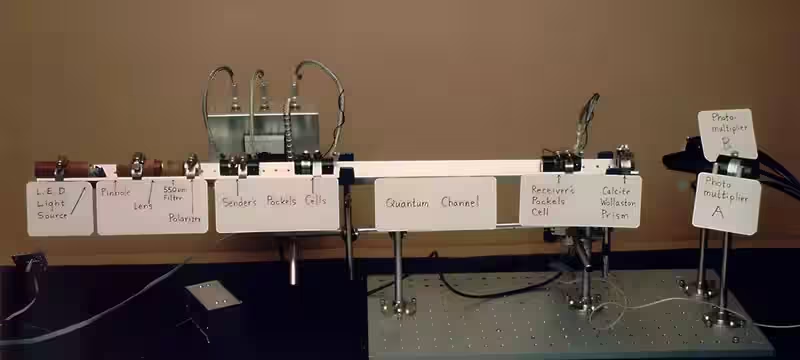
Prineha Narang, a quantum materials expert at UCLA, highlights the significance of this work: by employing fundamental physical laws, Bennett and Brassard created a fundamentally tamper-proof encryption method. The fields of quantum teleportation and entanglement, explored by the duo in the 1990s, further paved the way for secure data transmission over great distances-sidestepping interception altogether.
Their collaboration began in 1979 at a conference in Puerto Rico, where a casual conversation sparked the idea of a quantum-secure banknote. This rare meeting between minds catalyzed decades of research that today underpins efforts by governments and corporations to build future-proof quantum communication networks.
Now in their 70s and 80s, Bennett and Brassard have seen their once theoretical construct become an essential defense as the quantum computing era dawns. The $1 million Turing Award not only recognizes their academic achievement but also the practical impact of their work in securing digital communications worldwide.