


Foldable phones have improved fast, but the visible crease down the middle has remained the most conspicuous reminder that they are still a compromise. Now Oppo appears poised to attack that compromise head-on: leaks point to a March unveiling of the Find N6 and to a pair of engineering moves – a titanium-alloy hinge and a self-healing memory glass – that the company says cut the crease problem down to size.
According to Weibo tipster Bald Panda, the Find N6 may go official on March 17 in China, with regional availability in other Asian markets expected soon after. That timing matches an uptick in leaks and teases from Oppo this month, suggesting the company is gearing up for a public reveal.
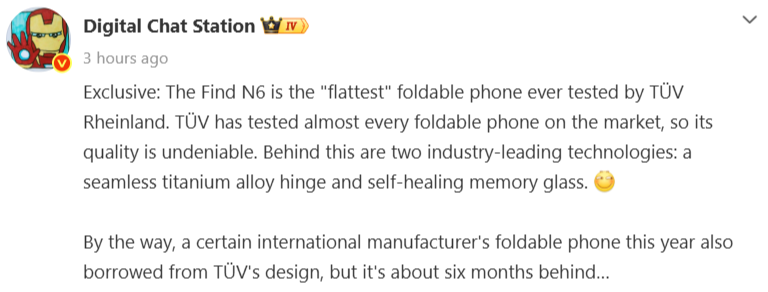
Another frequent leaker, Digital Chat Station, says TÜV Rheinland has already tested the device and rated it the ”flattest” foldable the lab has evaluated so far – a claim tied to two specific technologies: a seamless titanium-alloy hinge and a self-healing memory glass intended to reduce visible creases over time.
The rumored hardware reads like a flagship checklist turned up to 11. Public leaks indicate an 8.12-inch internal folding display with a 6.62-inch cover screen; a camera array led by a 200-megapixel primary sensor plus a periscope telephoto, ultra-wide, and multispectral sensors; two 20-megapixel selfie cameras for folded and unfolded use; and a Snapdragon 8 Elite Gen 5 platform. Battery capacity is listed at 6,000mAh with support for 80W wired and 50W wireless charging, and configurations are said to go up to 16GB of RAM and 1TB of storage, with a rumored variant that includes satellite connectivity. Color options leaked include purple, black, and white.
That spec sheet positions the Find N6 as a direct challenger to the premium foldables from Samsung, Honor, and others – but the real headline is the emphasis on making the inner display lie flat and the crease less visible. If those TÜV tests are accurate, Oppo may be ready to claim a practical improvement that most customers actually notice every time they unfold their phones.
Why this matters: the fold crease has been a persistent UX complaint since the first mass-market folds. Early devices sacrificed thickness and hinge finesse for durability and cost; more recent models have shifted back toward a paper-thin, near-flat fold but still show a line when the light hits it. Samsung’s Galaxy Z series and Oppo’s earlier Find N both narrowed the crease with hinge redesigns and better ultra-thin glass. A successful combination of a titanium-alloy hinge and a genuinely self-healing cover would be a rare instance of materials engineering meaningfully changing day-to-day perception.
There are caveats. Titanium hinges add cost and can make a device heavier unless compensated elsewhere. Self-healing coatings and glass treatments have appeared in marketing before; some promise minor surface recovery from micro-scratches, but they don’t always withstand deep gouges or long-term wear. TÜV certification helps, because it means a neutral lab has stress-tested the phone, but the real test for consumers will be months of use under varied conditions – pockets, keys, heat, humidity, and accidental pressure.
For competitors, Oppo’s move is a double-edged sword. A genuinely flatter foldable increases the bar for all premium foldables and gives Oppo a credence lift in design engineering. But it also forces rivals to match materials and hinge engineering – which raises component cost and supply-chain complexity industrywide. The source material even hints that a major global brand – widely interpreted as Apple in leaks – is exploring similar self-healing materials, suggesting this is already looking like an arms race in materials science, not just software polish or camera megapixels.
What to watch next: Oppo’s official announcement (if March 17 is accurate) and the fine print in TÜV or other durability reports. Pay attention to measurements like folded and unfolded thickness, hinge tolerances, long-term crease photos from reviewers, and independent drop and wear tests. Also look for whether the Find N6 carries a materially higher price because of these materials, or whether Oppo manages to hit a sweet spot where improved feel and durability can be marketed without overly inflating the sticker.
Short version: the Find N6 looks like Oppo’s best shot yet at making the crease an afterthought rather than a defining feature. If the titanium-alloy hinge and self-healing glass work as promised, foldables will feel more like ordinary flagship phones with an extra trick – and that trick is one fewer reason to hesitate before buying.