

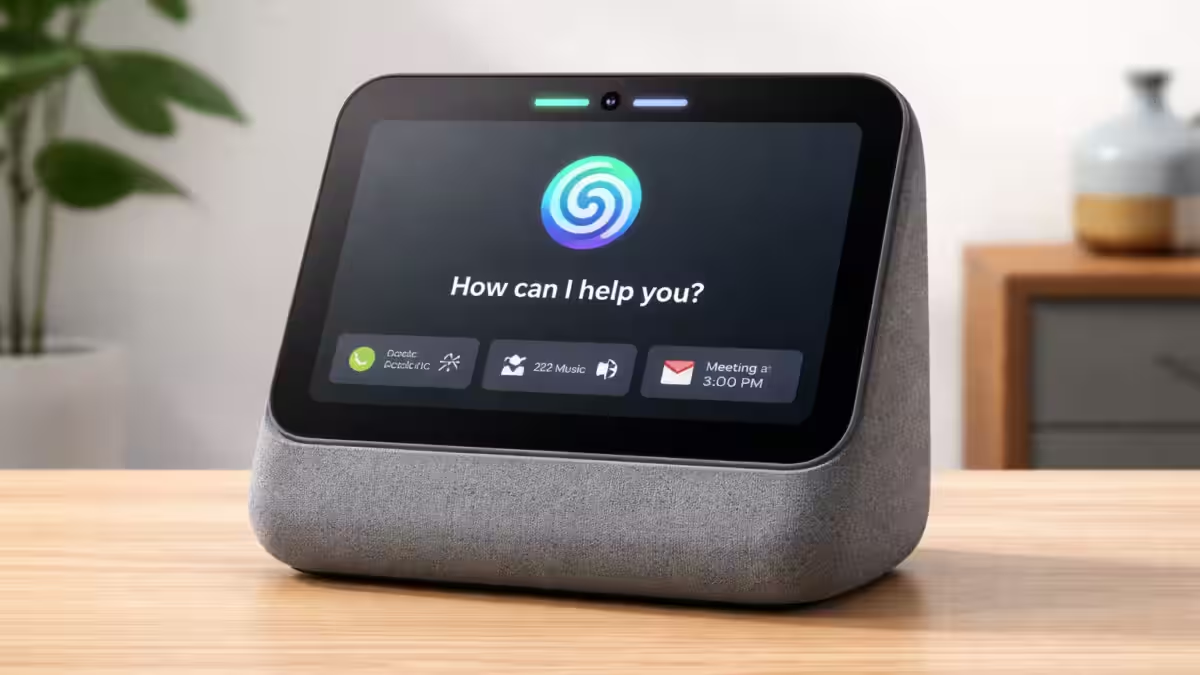
Imagine a speaker that not only answers questions but also watches your living room, recognises faces and offers nudges about your sleep, meetings and habits. That is the product OpenAI is reportedly building – and the reason it matters isn’t novelty. It’s control: who owns the most intimate streams of data in our homes, and how that data shapes behaviour.
According to recent reporting, OpenAI is developing a ChatGPT-powered smart speaker with a built-in camera that can do facial recognition and object identification. The device is said to be priced between $200 and $300 and aimed for an early 2027 launch. OpenAI has assembled a hardware team – reportedly more than 200 people – and purchased a high-profile design firm in 2025 for $6.5 billion to lead the look and feel of its devices.
Why a camera changes everything
Speakers with microphones are old news; many homes already have them. Add a camera and you change the bargaining chip. Visual input enables richer context for an LLM: recognising who’s in the room, what objects are present, even estimating routines. That powers more personalised assistance, but it also multiplies risk. Video and facial templates are among the most sensitive categories of personal data – they can be used for identification, behavioural profiling or even surveillance.
OpenAI’s pitch looks familiar: better, more proactive assistance. The reportedly planned device would suggest actions – ”go to bed early” before an important day, for instance – based on what it sees and hears. That’s useful, until nudges start reflecting commercial priorities or opaque algorithms.
History isn’t on the side of camera-equipped home gear
There is precedent for enthusiastic hardware launches colliding with privacy backlash. Facebook’s Portal and Amazon’s experiments with camera-driven products attracted scrutiny and consumer discomfort, prompting added privacy controls and, in some cases, product rethinks. Amazon’s Echo Look, a camera-driven fashion assistant, was quietly shuttered after failing to find a broad audience. Those examples show two things: consumers are cautious about being watched at home, and companies often underestimate how hard it is to pair AI novelty with durable trust.
Regulation complicates the picture. Laws and regulatory proposals in Europe and parts of the US already treat biometric identification differently from other data types. Any device that performs facial recognition will face more than just consumer skepticism; it may trigger legal limits or enhanced compliance obligations in multiple jurisdictions.
What OpenAI gains and what it risks
For OpenAI, shipping hardware is a logical next step if you believe the future of AI is anchored in daily life rather than browser tabs. A speaker can be a subscription funnel for ongoing LLM access, a way to lock users into a branded assistant and an opportunity to collect multimodal training signals that improve models. It also diversifies revenue beyond API and enterprise deals – useful if funding pressures intensify.
But the risks are material. Hardware margins are thin and manufacturing is capital intensive. Building a device that must process audio, video and highly contextual AI workloads demands either substantial on-device compute (expensive) or heavy cloud reliance (privacy and latency concerns). Then there’s trust. Users are increasingly sceptical of handing raw camera streams to corporate servers, and ChatGPT-class models still hallucinate or display bias. Handing those outputs the authority to nudge behaviour inside homes is ethically fraught.
How competitors and regulators change the calculus
Amazon and Google already sell assistant hardware and have decades of data and distribution. Apple, by contrast, has leaned into privacy as a differentiator; its hardware strategy often avoids always-on cameras in shared spaces. OpenAI will need to persuade users why its assistant is worth switching to, and why the camera-enabled features are essential rather than creepy.
Regulators are watching AI more closely than they were five years ago. Any plan that relies on facial recognition or continuous ambient monitoring will prompt questions from privacy authorities and lawmakers – questions that can delay launches, force architectural changes (for example, local-only processing), or limit features in certain markets.
Verdict and what to watch next
OpenAI’s smart speaker proposal is bold and predictable: companies building the most capable models will try to own the interfaces those models live behind. But the smart home is not a neutral testbed. Consumers, regulators and competitors will all shape what a camera-equipped assistant can actually do.
Watch for three signals in 2026 and 2027: whether OpenAI designs for privacy-first local processing or defaults to cloud inference; how the company prices and bundles the device with subscriptions; and how regulators respond to any facial-recognition claims. If OpenAI wants to win living rooms, it must solve for trust as convincingly as it solves for capability.
And for users, a simple rule: a helpful device that watches you is not the same as a harmless one. Demand clear controls, local processing options and transparent data policies before you plug it in.