

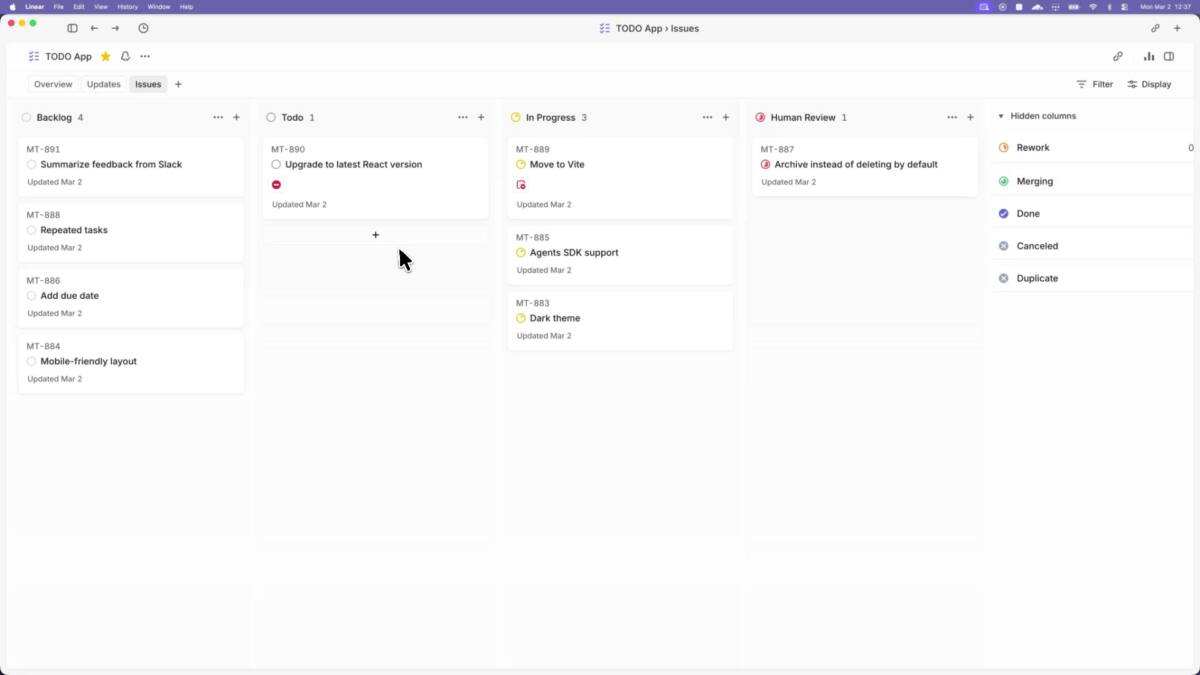
OpenAI’s new tool Symphony aims to redefine how software teams collaborate by automating coding tasks and letting engineers focus on managing work instead of micromanaging coding agents. Designed to operate on isolated, autonomous implementation runs, Symphony monitors project boards and dispatches intelligent agents to handle assigned tasks independently.
The novelty lies in how Symphony integrates with development workflows, such as issue tracking on platforms like Linear. Once it detects work items, it triggers agents that deliver comprehensive proof of completion-ranging from continuous integration (CI) results and pull request (PR) review notes to complexity assessments and even narrated walkthrough videos. Only after these deliverables pass review are changes safely merged without engineers having to oversee every code stroke.
Autonomous coding shifts the manager’s role higher up
Symphony’s approach challenges the traditional developer role that often involves extensive, manual coding paired with constant supervision of automated assistants like Codex. With the automation of task execution, engineers can now focus on managing the pipeline of work itself, providing feedback and validation at a project level rather than dwelling on line-by-line code supervision. This echoes a broader industry shift toward AI-assisted development but moves the focus squarely onto managing outcomes versus managing processes.
Interestingly, Symphony represents what OpenAI calls a ”low-key engineering preview,” clearly signaling it is still experimental and targeted at trusted, mature codebases. It is designed to work best alongside practices such as harness engineering, where the development environment and workflow are already optimized for automated agent integration.
How Symphony fits into the evolving AI coding landscape
Over the past few years, AI-based coding assistants have proliferated, from GitHub Copilot to specialized automated testers. However, many require developers to actively engage with the AI on a granular level. Symphony shifts this paradigm by isolating coding runs and orchestrating agents like a project manager would. This means less cognitive overhead for engineers and a potential increase in throughput and quality control.
There are parallels to continuous integration and deployment pipelines, which automate building and testing but still rely on humans to intervene for complex merges and conflict resolutions. Symphony’s ability to generate walkthrough videos and conduct complexity analysis represents an attempt to deliver a fuller self-service package for developers managing the final approval stages.
Yet, this raises some questions about trust, code quality, and the possible dilution of human oversight in critical software projects. Teams adopting Symphony will need robust testing and verification protocols to avoid subtle bugs or security vulnerabilities slipping through autonomous runs.
Getting started and licensing
OpenAI offers two main ways to experiment with Symphony. Organizations can implement it themselves by following the detailed specification on GitHub or use the reference implementation available in Elixir, with setup instructions provided for easy deployment. Enthusiasts are encouraged to leverage their preferred coding agents to assist in setting up Symphony for their repositories.
As an open-source project under the Apache License 2.0, Symphony invites collaboration and modification, suggesting OpenAI’s intent to foster a community exploring autonomous agent orchestrations.
Symphony raises the question of how far developer automation can go before human input becomes marginal. As AI’s role in programming evolves, the balance between managing work and managing code itself will be tested-and tools like Symphony will be at the forefront of that tension.