

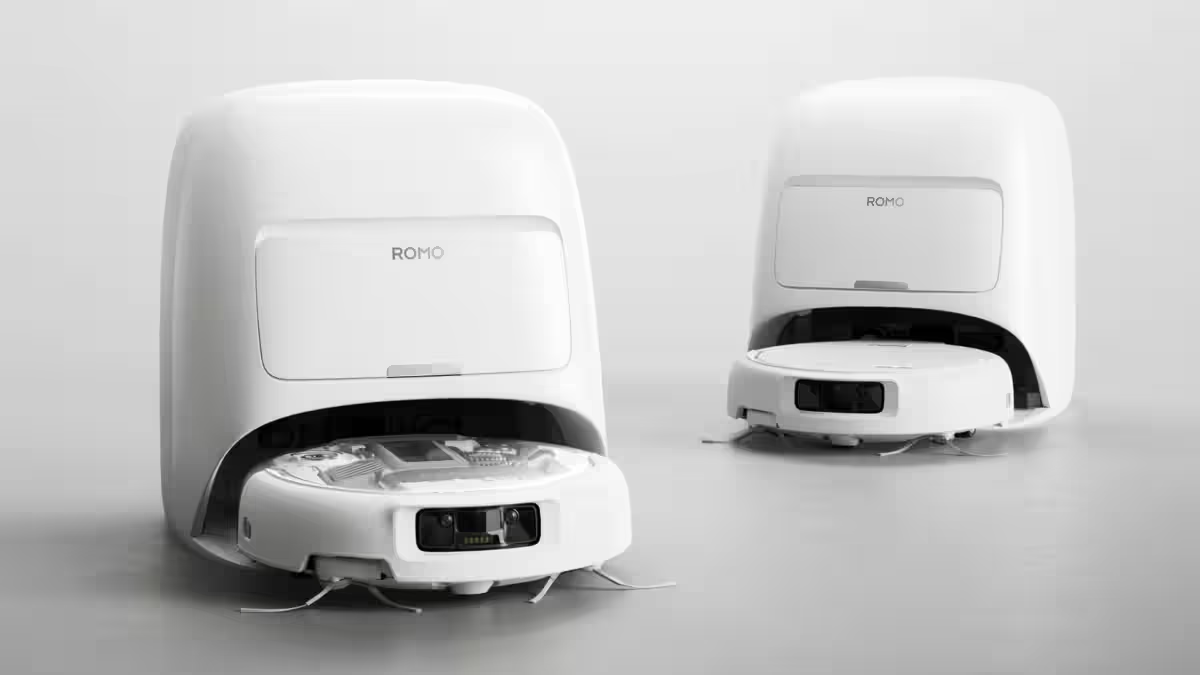
It only took a tinkerer trying to control his own robot vacuum with a PlayStation controller to expose a much larger problem: many connected cleaning robots are essentially roaming sensors dressed as appliances, and a single leaked credential can hand an outsider the keys to thousands of homes.
How a harmless tweak became a privacy incident
An AI strategist built an app to drive his DJI Romo vacuum with a controller. Instead of talking only to his unit, the app returned private tokens that gave access to roughly 6,700 Romo devices worldwide – including floor plans, live camera and microphone streams, and remote control over the robots. Reported coverage says the researcher obtained the token for his own device and that it unlocked servers across regions including the U.S., Europe, and China.
Why this matters beyond a headline
Robot vacuums map homes to navigate efficiently. That map is essentially a blueprint of your living space. Add a camera and microphone for obstacle avoidance or advanced features, and the machine becomes a mobile surveillance platform. When manufacturers rely on cloud-based tokens or weak isolation between accounts, a single mistake can turn those platforms into global peeping devices.
This episode isn’t a theoretical threat. It underscores three recurring failures in consumer IoT: sloppy credential handling, excessive cloud dependence for basic functions, and insufficient segmentation between users and devices on vendor servers.
It’s predictable – and preventable
Security researchers have flagged similar risks for years. The Mirai botnet showed how cheap, internet-connected devices can be hijacked en masse. Device makers have also been criticized for sending telemetry and user data back to servers without clear consent, and for pushing features that require always-on cloud access. Some hobbyists and engineers have proved that vacuums can work perfectly well offline or with local control – eliminating much of the attack surface.
What went wrong here is familiar: a developer tool or token grant intended for a single device was not constrained tightly enough. That allowed the same token or server endpoint to enumerate and control other units. Basic protections could have reduced the blast radius: per-device tokens, short-lived credentials, strict rate limits, and robust authentication checks that bind tokens to a device ID and region.
Who wins and who pays
Customers lose first: exposed floor plans and live feeds are intimate data that can be abused for stalking, burglary planning, or simple privacy invasion. The manufacturer risks reputational damage, regulatory scrutiny, and possible legal liability depending on where affected users live. Security researchers and privacy advocates win only insofar as incidents like this force better practices – but the fix often comes after the worst of the harm is already possible.
What should users and manufacturers do now
For owners:
– Treat robot vacuums like cameras. Disable cameras and microphones if you don’t use those features. – Segment them on a guest or IoT VLAN so a compromised device can’t reach your phones or PCs. – Apply firmware updates promptly and reset credentials after any suspicious activity.
For manufacturers:
– Issue per-device, short-lived tokens and bind them to device IDs and regions. – Design essential functionality to work locally so cloud outages or breaches don’t cripple basic operation. – Publish clear telemetry and data-retention policies, and offer easy opt-outs for nonessential data collection.
What’s likely to happen next
Expect a firmware push and public reassurances. Regulators in privacy-forward jurisdictions may demand reports or audits if sensitive personal data was exposed. Some users will move their vacuums off the main network or disable cloud features; others will trade into simpler, offline models. Long term, this episode should nudge the industry toward better default security – but only if vendors stop treating cloud connectivity as an excuse for lax device-level protections.
Accidents like this are a reminder: connected appliances are convenient, but they also extend your threat surface beyond your front door. A responsible IoT strategy starts with minimizing what devices can leak, and making sure a single token never opens thousands of homes.