

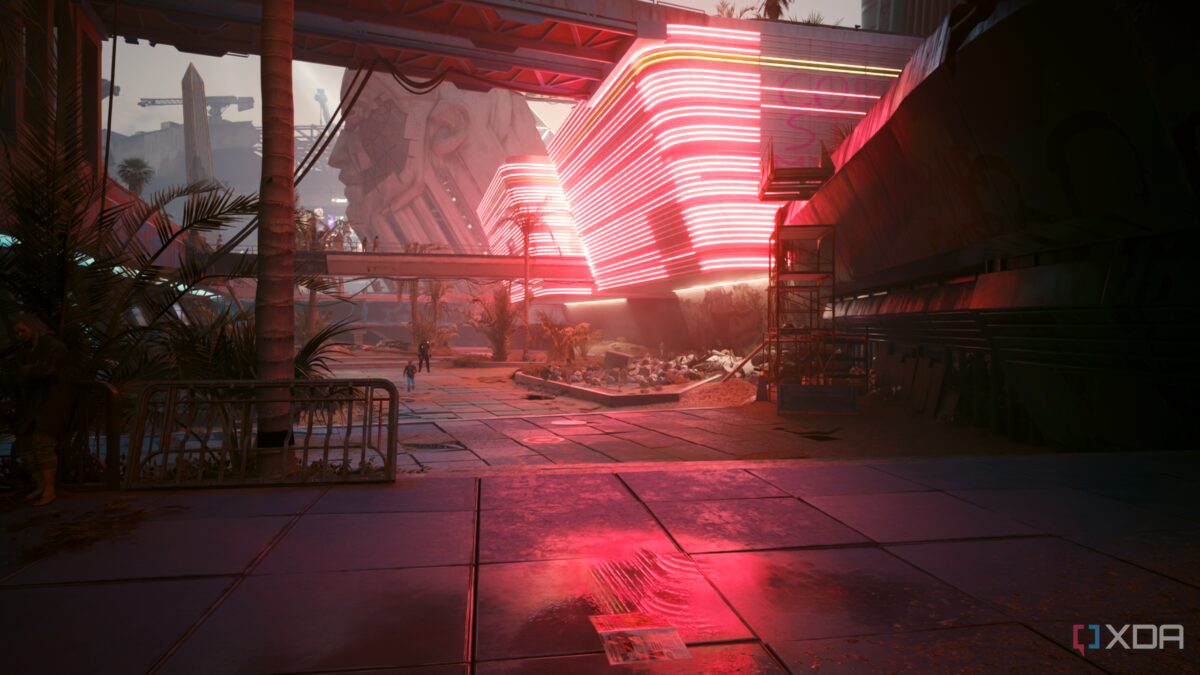
Almost a decade after the launch of Nvidia’s Pascal-based GTX 1080, the company is showcasing just how far GPU technology has surged. Nvidia claims its current Blackwell architecture delivers path tracing performance 10,000 times greater than the Pascal generation that debuted in 2016. Even more ambitious, the firm is targeting a future where AI techniques will boost path tracing by a factor of one million, potentially enabling games with visuals indistinguishable from film-without crippling frame rates.
John Spitzer, Nvidia’s VP of Development & Performance, unveiled these claims during GDC 2026, positioning AI as the key to sidestepping the stagnation of traditional hardware improvements encapsulated in the phrase ”Moore’s Law is dead.” Instead of depending solely on transistor scaling, Nvidia plans to leverage AI-driven optimizations behind the scenes to maintain smooth gameplay alongside advanced ray tracing. This approach promises to deliver cinematic graphics quality while avoiding the notorious performance hits associated with real-time ray tracing.
Looking back, the GTX 1080 revolutionized gaming performance in May 2016, powering titles like Fallout 4 and GTA 5 with ease. Today, those same games can be played on integrated graphics, albeit with reduced fidelity. The leap from Pascal to Blackwell-and now toward an AI-assisted future-underscores how rapidly graphics processing has evolved within ten years, shifting from hardware brute force to intelligent software enhancement.
Path tracing performance improvements since 2016
Path tracing, a technique simulating light bouncing for realistic reflections and shadows, was once beyond the reach of mainstream gaming GPUs. The Pascal GTX 10 series set a high bar in its era but remains far outpaced by today’s Blackwell cards.
Achieving a reported 10,000x improvement in path tracing means Blackwell GPUs can handle far more complex lighting calculations in real time, enabling scenes that look vastly more natural and immersive. Nvidia’s next goal-to multiply that by 100-will lean heavily on AI to optimize workloads dynamically rather than relying solely on hardware power.
This marks a significant shift in GPU development philosophy. Where the past decade relied on transistor density and clock speed improvements, the near future appears to hinge on sophisticated AI algorithms integrated deep into graphics pipelines. By using AI for noise reduction, denoising, and real-time optimization, Nvidia aims to deliver the dream of ”film-like” game visuals without the brutal performance compromises that plague current ray tracing implementations.
AI’s role in Nvidia Blackwell GPUs and future graphics
The death of Moore’s Law-where chip performance no longer doubles every two years-forces GPU makers to innovate beyond traditional hardware improvements. Nvidia’s solution is AI-powered acceleration, which can improve efficiency by anticipating and smoothing rendering workloads.
This approach isn’t entirely new-techniques like DLSS (Deep Learning Super Sampling) have already demonstrated AI’s potential in gaming by upscaling lower-resolution images while maintaining sharpness. Nvidia envisions expanding AI’s role far beyond upscaling into core rendering tasks, fundamentally altering how games use GPU resources.
While Nvidia’s billionfold path tracing target remains aspirational, the company’s leadership in GPU technology and AI integration lends credibility. Still, these bold claims reignite debates over the real progress of ray tracing in gaming. Some argue AI democratizes high-end graphics by bringing expensive effects to lower-end hardware. Others view it as masking underlying hardware limitations, postponing a reckoning in GPU design.
One thing is clear: the future of gaming graphics relies on the fusion of AI and hardware innovation. If Nvidia hits its stride, cinematic-quality visuals at playable frame rates might finally reach mass audiences.