

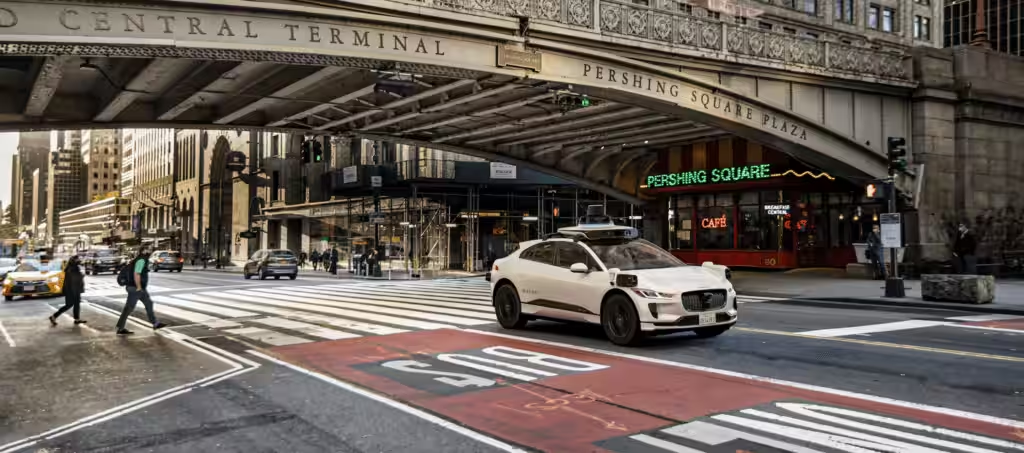
On February 20, 2026, New York Governor Kathy Hochul quietly withdrew a proposal that would have allowed commercial robotaxi services to operate outside New York City. The measure, introduced in January as part of the state’s executive budget, would have let companies seek local government approval for limited autonomous vehicle deployments upstate. For a sector that spends as much time lobbying as it does testing, the reversal is a reminder that deep pockets and glossy demos don’t erase local politics.
What just happened – and why it matters
The immediate consequence is straightforward: plans to open new commercial robotaxi territories in New York state are now on hold. The timing is awkward for one of the sector’s richest backers. Waymo closed a US$16bn funding round just weeks earlier at a US$110bn valuation, underscoring enormous investor confidence in autonomous driving technology. That cash won’t buy permission slips from city halls.
This isn’t a technical setback – regulators and companies can test sensors, software and edge cases in simulation and on closed courses. It’s political. Allowing driverless taxis to operate on public streets touches unions, municipal budgets, liability rules, and voters who see robotaxis as either a safety risk or a threat to livelihoods. In New York, where transit workers and taxi drivers are politically influential, those concerns translate quickly into policy pushback.
The broader pattern: pilots without political cover
Autonomous vehicle deployments have always been patchwork. Firms have run limited commercial services in specific markets – often suburbs or Sun Belt cities where regulators were willing to risk reputational blowback for perceived mobility gains. Other jurisdictions, notably parts of California, have repeatedly tightened conditions after high-profile incidents raised public concern. The result: slow, geographically fragmented rollouts rather than the coast‑to‑coast network companies promise in investor decks.
That fragmentation matters because robotaxi economics assume scale. Big maps, dense ride volumes and predictable rules are how a capital‑intensive service turns into a credible alternative to human drivers. Blocked access to a major state like New York – with dense urban and suburban travel patterns – removes a critical testbed and market for those scale effects to appear.
Who wins and who loses
Short term, labor groups and incumbent drivers score a win: stalled expansion keeps jobs and service models intact a little longer. Municipal officials who argued for caution can claim prudence. Technology companies lose momentum and political capital. For investors, the lost near‑term market is a financial annoyance rather than an existential threat – hence the continuing willingness to invest tens of billions – but repeated regulatory rebuffs raise the cost of scaling.
There are also secondary winners. Regulators and safety advocates gain leverage: each halt or rollback establishes a precedent for tighter oversight, making future approvals conditional on demonstrable safety records, training regimes, or concessions like local hiring rules and revenue sharing. Smaller AV firms that focus on low‑risk use cases – warehouse logistics, controlled-campus shuttles, freight yards – may find the headwinds an opportunity.
What companies will do next
Expect several playbooks to unfold in parallel. Some firms will double down on jurisdictions that are still welcoming, building operational history and datasets they can point to in negotiations. Others will pivot to licensing software, sensors or mapping services where political opposition is irrelevant. And a few will try to buy goodwill: concessions to unions, local hiring guarantees, or revenue-sharing arrangements that blunt political opposition.
There will also be more legal and regulatory choreography. Local governments and state legislatures are likely to demand clearer liability frameworks, reporting requirements, and public‑interest conditions before allowing commercial rollouts. Companies that treat regulation as a checkbox rather than a coalition-building exercise will keep hitting walls.
What this says about the AV era
The episode is a useful corrective to tech‑industry narratives that treat regulation as a temporary nuisance. Building safe, widely accepted autonomous services is as much a political project as a technical one. You can spend US$16bn on engineering and still find yourself running out of friends in the halls of power.
For New York, the withdrawal buys time to negotiate terms and for city leaders to weigh tradeoffs. For Waymo and its peers, it’s a signal: winning tests and venture rounds is necessary but not sufficient. The true rollout will follow a messy, locally negotiated path – and it will reward companies that can pair competent engineering with pragmatic politics.
One way or another, the robotaxi story is leaving the lab and entering the political arena. That transition is noisy, slow and occasionally humiliating for firms used to telling a different story. If the technology is inevitable, its path certainly isn’t.