

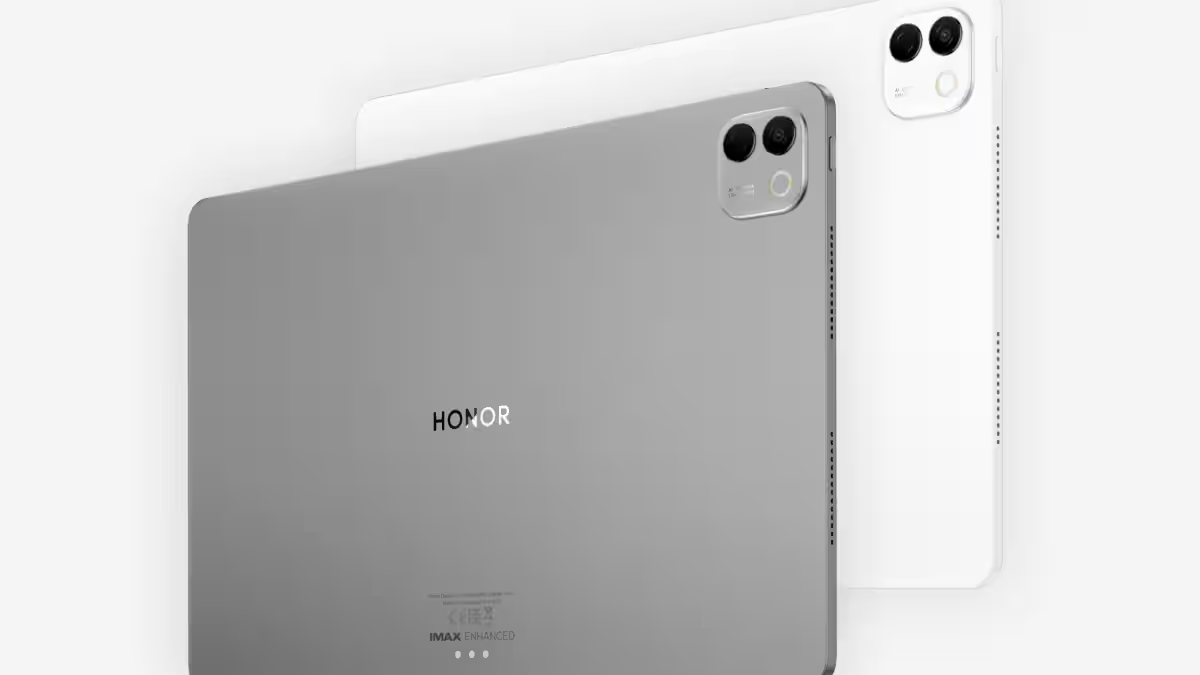
Thin selling points are back. Honor’s latest tablet, the MagicPad 4, shrinks last year’s already-svelte design down to 4.8mm thick – a stat engineered to grab headlines at Mobile World Congress. It’s an impressive engineering feat on paper, but the real question is whether anyone who spends serious time on a tablet will care more about millimeters than battery life, thermal behavior, and practical screen real estate.
The quick facts
The MagicPad 4 moves from a 13.3-inch display to a 12.3-inch panel and chops the chassis from 5.8mm to 4.8mm. Honor swapped LCD for a 165Hz OLED, fit a 10,100mAh battery, and shaved roughly 145 grams off the previous model’s weight. Inside is a Qualcomm Snapdragon 8 Gen 5 with either 12GB of RAM and 256GB of storage or 16GB of RAM and 512GB of storage. It runs MagicOS 10 (based on Android 16) and carries a 13MP rear camera, a 9MP front camera, and eight speakers arranged for a spatial audio experience. Honor has not announced pricing or availability; the company is expected to share more details during its MWC press conference on Sunday, where it will also touch on a move into humanoid robotics.
Why thinness is a headline, not a guarantee
Those 4.8mm matter to marketing teams and anyone who prizes a device that looks like it belongs in a tech museum. They don’t necessarily translate into a better everyday tablet. The thinner the chassis, the less room for a big battery and for thermal headroom – two things tablets need if you want sustained performance for gaming, heavy multitasking, or extended video editing.
Honor has already made a sensible upgrade by moving to OLED and a higher refresh rate; a 165Hz panel is a meaningful bump for smooth scrolling, gaming, and video. But the stated 10,100mAh battery is smaller than those in many large Android tablets, and Honor hasn’t published runtime estimates. OLEDs can be more power-efficient than LCDs for darker content, but bright, full-screen video and long gaming sessions will still test a smaller cell.
Where this fits in the market
Honor is clearly aiming for a slice of the design-conscious, media-first tablet market. The 12.3-inch OLED, eight-speaker array, and Snapdragon 8 Gen 5 give it the ingredients for a premium entertainment device. Compare that to Apple’s thin options – the iPad Air at 6.1mm and the iPad Pro at 5.1mm – and Samsung’s Galaxy Tab S11 at 5.1mm; Honor’s headline is the thinnest among mainstream Android and iPad slate rivals, and only E Ink devices such as the reMarkable 2 (4.7mm) are thinner, albeit for a very different use case.
But mainstream tablet buyers often prize ecosystem, app compatibility, and battery life over bragging rights about thickness. Apple and Samsung lean on software features (fluid multitasking, stylus support, long software support windows) that shape the day-to-day experience more than millimeter counts. Honor’s MagicOS 10 (Android 16) will need to demonstrate similar software polish and update commitments if the device is to compete beyond the spec sheet.
Trade-offs to watch for
Thin devices with flagship silicon have a history of thermal surprises. High-end Qualcomm chips can be power hungry under sustained loads, and cramped internals limit passive cooling options. Expect reviewers to stress-test the MagicPad 4 with long gaming sessions and heavy productivity tasks to see whether Honor sacrificed consistent performance for slimness.
Camera specs (13MP rear, 9MP front) are modest, which signals Honor isn’t aiming for photography enthusiasts. The eight-speaker setup points the marketing at home- or travel-cinema use – and, for better or worse, at people who want loud sound without headphones.
Verdict and what comes next
The MagicPad 4 is an elegant statement: Honor can make one of the thinnest mainstream tablets on the market without resorting to E Ink. It’s a smart move if your goal is to win attention at MWC and among buyers who prize form as much as function. But thinness is a trade – and the device’s real-world appeal will hinge on how Honor balances battery life, thermal behavior, software, and price.
We’ll know more when Honor reveals pricing and availability at its MWC press event. Until then, the MagicPad 4 reads like a design win for the company and a reminder that engineering headlines often come with practical compromises.