

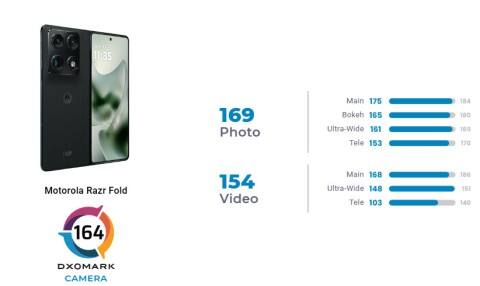
Motorola’s latest Razr Fold, the company’s first horizontal foldable phone, has unexpectedly secured a spot in DxOMark’s top 10 camera phone rankings, challenging assumptions about foldables’ photographic capabilities. Though not marketed primarily as a camera powerhouse, the Razr Fold’s triple 50-megapixel rear cameras combine to deliver image quality that rivals traditional flagship smartphones.
Equipped with a versatile camera setup, the Razr Fold features three 50MP sensors: a primary wide-angle (1/1.28” sensor, f/1.6 with OIS), an ultra-wide (1/2.76” sensor, f/2.0), and a telephoto lens (1/1.95” sensor, 3x optical zoom with OIS). Complementing this hardware is advanced autofocus with dual-pixel PDAF that ensures sharpness across various shooting conditions. The phone also supports impressive video specs, including 8K recording at 30fps with Dolby Vision HDR, 4K at 120fps, and super slow-motion 1080p at 240fps.
During DxOMark’s evaluation, the Razr Fold garnered praise for accurate exposure measurement, natural white balance, and a wide dynamic range, which kept details intact even in challenging lighting. The device excelled at retaining fine detail and suppressing noise while delivering rapid autofocus. Portrait mode benefited from smooth and realistic background blur, a feature not commonly refined on foldables so far.
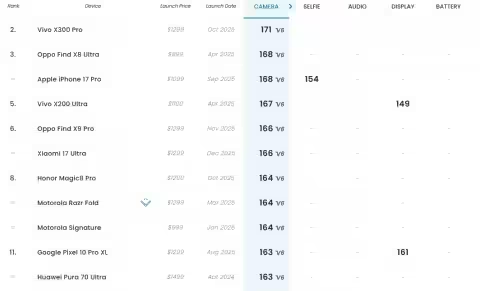
That said, the phone is not without flaws. Artefacts such as halos and color fringes occasionally appeared in photos, diminishing image purity. Video capture showed some motion doubling, and autofocus responsiveness at dusk was sometimes sluggish. Additionally, footage shot into bright backlighting suffered from pronounced digital noise, revealing the limitations of foldables’ compact sensor arrays compared to typical flagship slabs.
By clinching eighth place globally on DxOMark’s camera list and topping all foldable phones, Motorola is staking a claim in an area where previous folding phones often lagged. This performance underscores rapid improvements in foldable camera tech and hints at increasing pressure on competitors like Samsung’s Galaxy Z Fold series, which have traditionally set the pace for foldable innovation but sometimes fell short in imaging prowess.
The Razr Fold’s achievement also speaks to changing consumer expectations. Users want advanced photography without sacrificing the compactness and novelty of foldables. By bridging this gap, Motorola could influence future designs that prioritize camera excellence alongside foldability, shaking up a segment that’s still defining itself years after its debut.