

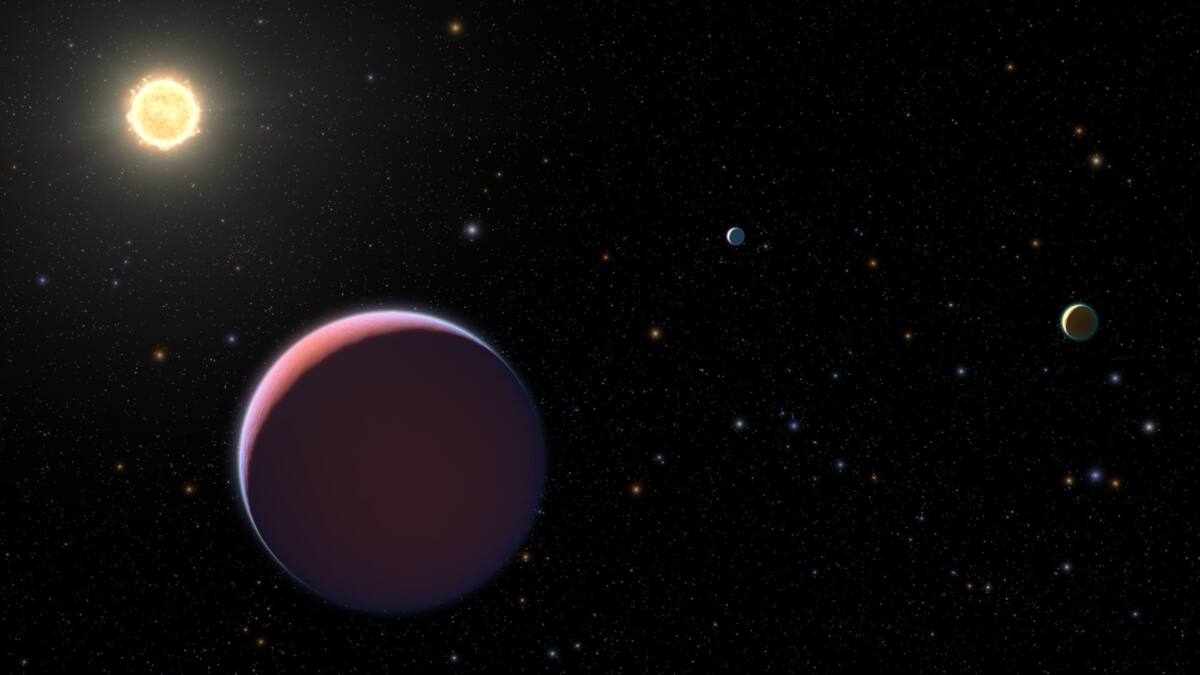
At 2,615 light years away, the Kepler-51 system contains bizarre exoplanets that challenge our understanding of planet formation. These planets are so puffy and lightweight that if placed in water, they’d float like cotton candy. Yet even the James Webb Space Telescope’s instruments cannot pierce the thick atmospheric haze shrouding them. This spectral fog frustrates astronomers, obscuring clues to how these ghostly giants grew so enormous without accumulating the dense cores typical of gas giants.
Kepler-51d, along with its siblings 51b and 51c, are roughly the size of Saturn-between 7.1 and 9.7 Earth radii-but have masses only a fraction of Saturn’s, weighing just 3.7 to 5.6 times Earth’s mass compared to Saturn’s 95 Earth masses. This results in densities more akin to fluffy cotton candy than solid planets or even typical gas giants. Discovered by the Kepler Space Telescope through precise transit and gravitational tug measurements, these three planets defy standard planet formation theories that require massive cores to draw in thick atmospheres.
Previous observations with the Hubble Space Telescope failed to detect any specific atmospheric molecules, hinting at a pervasive haze blanketing these exoplanets. To probe deeper, astronomers targeted Kepler-51d using JWST’s Near Infrared Spectrometer, expecting to capture spectral fingerprints of gases like hydrogen, helium, methane, or other trace compounds that could reveal the planets’ origins and migration history.
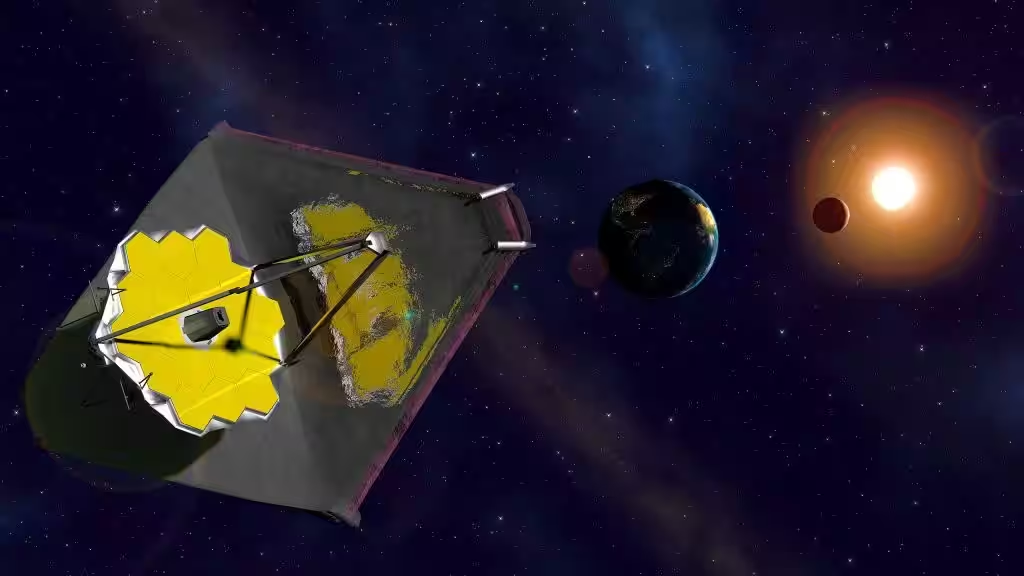
Yet JWST returned another dead end: no chemical signatures emerged through the haze, underscoring the stubborn opacity of these ethereal atmospheres. Scientists compare the scale of this haze to that enveloping Titan, Saturn’s largest moon, but magnified to a size nearly equivalent to Earth’s radius. Such thick atmospheres are unprecedented, posing a significant puzzle about how these small cores captured such massive gaseous envelopes so close to their star-considering these planets orbit well within Venus’s path if placed in our solar system.
One possibility is that the Kepler-51 worlds formed farther out and migrated inward, but the exact mechanisms remain murky. The system’s youth, at about 500 million years old, offers a clue that we might be observing a fleeting stage where stellar winds from their still-active star gradually strip away the fluff. Fast forward a billion years, and these planets could shrink down to dense cores, leaving behind a more conventional planetary skeleton.
Ongoing JWST observations of Kepler-51b may shed new light if clearer atmospheric signals emerge. Such findings could help unlock the mysteries of these cotton candy giants, transforming our grasp of planet formation diversity beyond familiar solar system blueprints.