

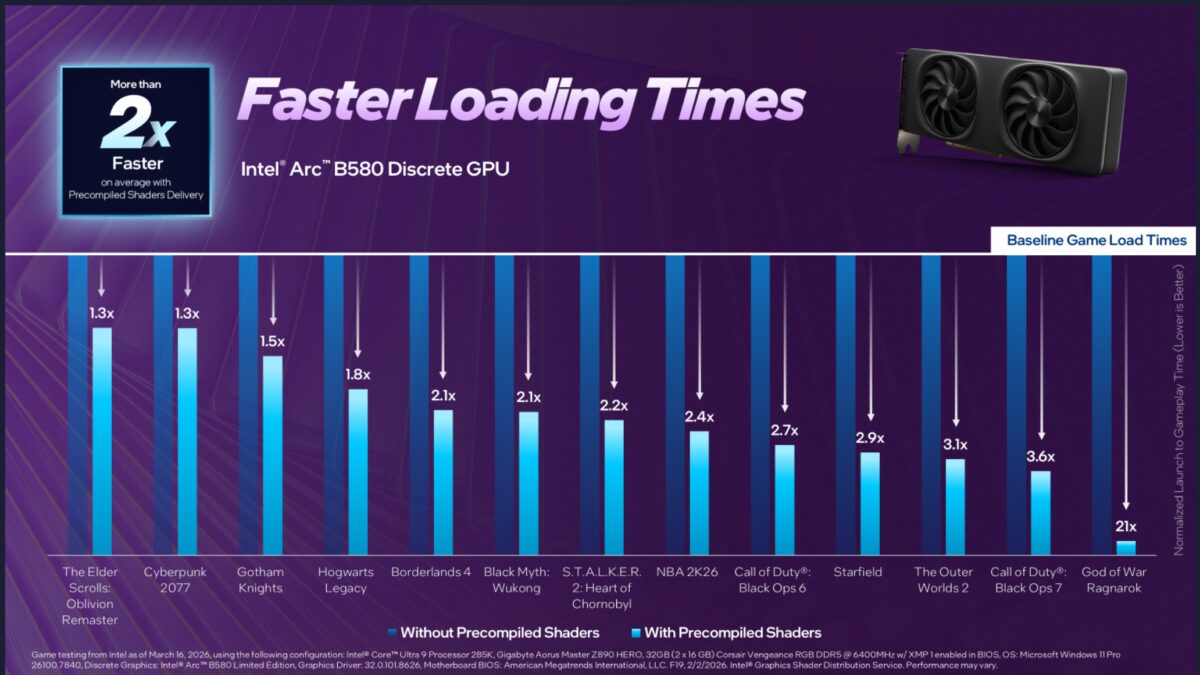
Intel has introduced a cloud-powered service that promises to cut PC game load times dramatically-sometimes by as much as 37 times. This new feature, embedded in Intel’s Graphics Driver 32.0.101.8626, caches precompiled shaders remotely and downloads them to a user’s system, sidestepping the usual wait for on-device shader compilation. The service targets Intel Arc graphics cards and Core Ultra processors, currently supporting a select roster of popular Steam games.
Shaders are essentially the set of instructions games use to render graphics tailored to your hardware. Traditionally, these shaders compile locally during game loading, which adds to wait times and occasional stutters during gameplay. By offloading this compilation to the cloud, Intel’s cloud-based precompiled shaders not only speed up game startup but also smooth the gaming experience by reducing shader-induced stutters. This method mirrors what Microsoft revealed last year, aiming to create a similar cloud-based database for a broader range of hardware using a State Object Database (SODB) format to manage shader data universally.
Intel’s cloud-based precompiled shaders currently support its Intel Arc B-Series and A-Series discrete graphics cards as well as the integrated Arc graphics found in Intel Core Ultra CPUs. Because this involves fewer hardware configurations than Microsoft’s broader ecosystem, Intel can more precisely tailor precompiled shaders. For now, the service is compatible only with certain new and upcoming Steam titles like God of War Ragnarok, Cyberpunk 2077, Starfield, and Borderlands 4, with more games expected to join the list over time.
Activating the feature requires a quick setting change within the Intel Graphics Software: navigate to Graphics > 3D Rendering > Precompiled Shaders and toggle it on. Once enabled, supported games will benefit from faster loading and fewer in-game hitches caused by shader processing.

Intel’s cloud-based shader service follows a surge in cloud-assisted game optimization efforts. While consoles avoid these hiccups due to their uniform hardware, PC gaming’s fragmented ecosystem has long dealt with such issues. Microsoft’s parallel project addresses this diversity with a universal shader cache aimed at supporting a wider range of GPUs and CPUs beyond a single manufacturer. This push from two industry giants signals a broader trend toward reducing game load times and delivering smoother experiences for PC players.
The rise of cloud-based precompiled shaders shows how the cloud is increasingly becoming a tool not just for streaming but for real-time performance enhancements at the local hardware level. With more games relying on complex shaders, cloud-hosted shader compilation could become a standard feature, potentially eliminating wait times that have long frustrated PC gamers. Whether this approach expands beyond Intel and Microsoft depends on how developers and GPU makers embrace these shader databases in future hardware and software updates.