

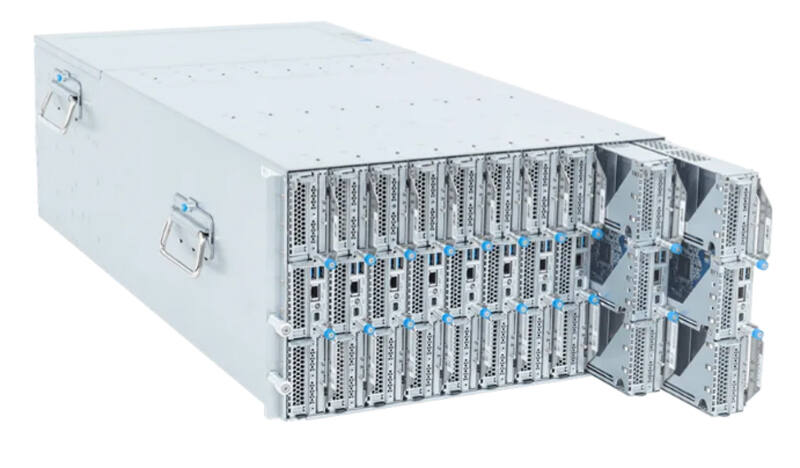
Gigabyte Technology has unveiled its new high-density B683-Z80-LAS1 server, featuring ten nodes in a 6U chassis and designed to juggle cloud hosting, AI workloads, and other demanding tasks. What sets it apart is direct liquid cooling that covers CPUs, memory, storage, and PCIe expansion cards alike-a rare all-encompassing thermal approach aimed at taming up to 500-watt AMD EPYC processors.
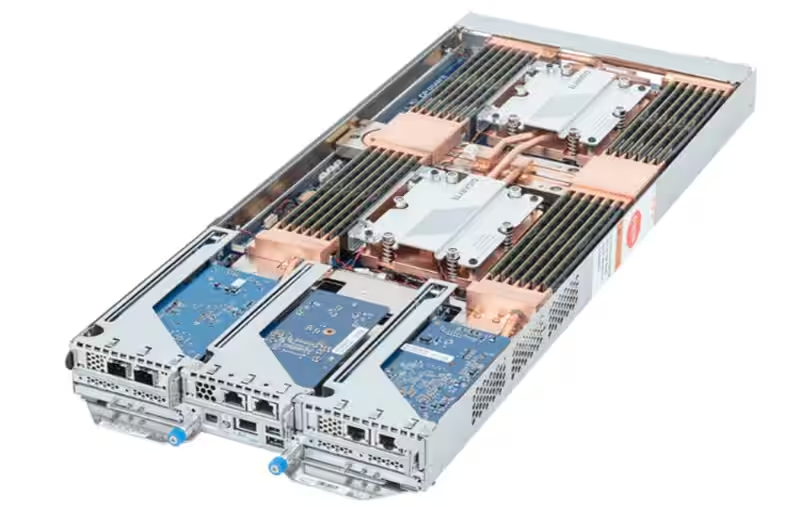
Each node supports dual AMD EPYC 9005 Turin or 9004 Genoa CPUs using Socket SP5 (LGA 6096), with TDP ratings soaring up to 500 watts. The memory subsystem runs on a hefty 12-channel configuration with 24 DDR5 slots supporting speeds of 4800 to 6400 MT/s, ideal for data-intensive applications.
Connectivity and management don’t fall short: every node includes an ASPEED AST2600 controller with Mini-DP interface, a 1GbE management port, three low-profile PCIe 5.0 x16 expansion slots, USB 3.2 Gen1 Type-A ports, and dual E3.S NVMe drive bays. Gigabyte claims that its liquid cooling system removes up to 90% of the heat generated across critical components, markedly improving performance stability under hefty workloads. Complementing the cooling are four 80 mm fans to maintain airflow, and the system operates reliably between 10°C and 35°C ambient temperatures.
Powering the server are twelve 3200-watt PSUs certified to the stringent 80 PLUS Titanium standard, ensuring maximum energy efficiency. The chassis itself measures 447 × 262.3 × 900 mm and tips the scales at around 38 kilograms, balancing density with manageable size and weight.
This server’s targeted liquid cooling strategy highlights a shift in how high-density AI and cloud workloads can be kept in check thermally without resorting to bulky air-cooling setups. While liquid cooling has been around for some time, integrating it so comprehensively at the node level-covering RAM and expansion cards-signals rising emphasis on efficiency and thermal headroom as CPU power and density grow relentless.
Competitors like HPE and Dell have focused primarily on air-cooled solutions or partial liquid cooling targeting CPUs only. Gigabyte’s approach could give it an edge in segments where operational costs and thermal throttling risks are critical, especially given the increasing prevalence of 500W-class processors in dense compute platforms.
Whether this will set a new server design trend depends on the broader market embracing such cooling complexity despite potential maintenance challenges. Still, for enterprises chasing raw performance per rack foot and looking to squeeze out every watt of compute, the B683-Z80-LAS1 is a compelling option that reflects the evolving demands on infrastructure hardware in 2026 and beyond.