

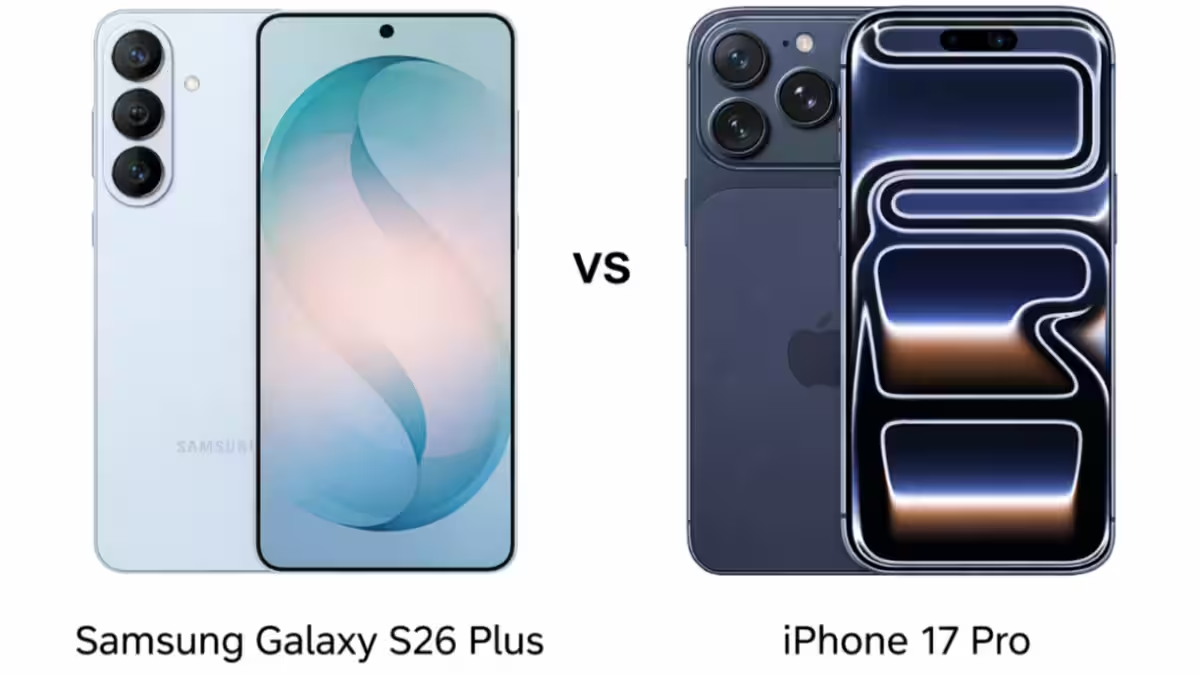
Buying a flagship in 2026 has quietly become a decision about priorities: do you want the biggest battery, brightest and sharpest screen, and the sort of hardware that looks good on a spec sheet – or do you want a phone that turns footage into finished work with minimal fuss? One hands you more display, more battery, and a longer spec list for a bit less cash. The other sells you refined performance, pro-level video tools, and the magnetic pull of an integrated ecosystem.
Why this split matters more than ever
Smartphones stopped being simple pocket computers years ago. Today a handset can be a portable editing studio, a travel safety device, or a battery you carry around. The S26 Plus doubles down on the ”hardware first” play: 6.7-inch Dynamic LTPO AMOLED 2X at 1440p with a quoted 2600-nit peak and a 4900mAh battery with 45W wired charging. The iPhone 17 Pro goes the opposite route: denser feel, higher peak brightness at 3000-nits on its 6.3-inch LTPO Super Retina XDR OLED, and a camera system designed to move creators through an entire production pipeline – ProRes, Dolby Vision, Apple Log 2, and spatial video.
Design and display: immersion versus calibration
On paper, the S26 Plus wins the immersive-display argument: larger 6.7-inch panel, higher resolution, and Samsung’s long-standing edge in vivid AMOLED panels. For media consumption and maximal screen real estate, that matters. Apple counters with a smaller but brighter panel (6.3-inch, 3000-nit) and color tuning that aims to be predictable across apps, which is why many professionals prefer its output for critical work.
Materials are a close call: the Galaxy uses Gorilla Glass Victus 2 and Armor Aluminum 2; the iPhone has Ceramic Shield 2 and an aluminum alloy that feels denser in hand. Both are IP68 rated, though the iPhone gets a nod for a deeper water-resistance feel. If pocket comfort and one-handed use matter, the iPhone’s compactness helps; if screen real estate and punchier visuals are the priority, Samsung pulls ahead.
Performance, storage and battery trade-offs
Performance is a study in different philosophies. Samsung ships Snapdragon 8 Elite Gen 5 or Exynos 2600 depending on region, paired with 12GB of RAM and UFS 4.x storage. Apple relies on the A19 Pro with the same 12GB of RAM, but NVMe storage options up to 1TB. The memo here is familiar: Android gives you raw specs and flexibility (and extras like Samsung DeX and Wireless DeX), while Apple extracts more consistent real-world snappiness from its silicon-software integration.
Battery paints a clearer separation: the Galaxy S26 Plus brings a 4900mAh pack and 45W wired charging (20W wireless), engineered for long usage days. The iPhone 17 Pro uses a smaller 3998-4252mAh battery, but leans on software efficiency and faster short-burst wired charging (advertised as 50% in 20 minutes), plus 25W MagSafe. If you need endurance and fewer pit stops, Samsung is the pragmatic pick. If you prefer predictable day-to-day longevity and faster top-ups, Apple can still satisfy.
Cameras and video: versatile snaps versus production-ready tools
Samsung offers a 50MP main sensor, a 10MP telephoto with about 3x optical reach, and a 12MP ultrawide. Photos aim for punch and instant-share readiness. Apple packs three 48MP sensors – main, periscope telephoto, and ultrawide – plus LiDAR. The hardware tilt toward multiple 48MP sensors and a periscope telephoto gives the iPhone clear advantages for zoom and for depth-aware workflows.
Where the iPhone 17 Pro clearly differentiates itself is video: 4K ProRes, Dolby Vision capture, Apple Log 2, and spatial video are aimed at creators who want to shoot, grade, and publish without a PC-heavy pipeline. Samsung reaches 8K, and supports HDR10+ and gyro-EIS, which is great for clarity and stabilization, but Apple’s end-to-end tooling – capture formats, ecosystem editing apps, and faster storage on higher-end configs – makes it easier to produce platform-ready content quickly.
Money matters: identical base price, different realised value
Both start around $1100, but regional pricing diverges: approximately ₹120,000 for the Galaxy S26 Plus versus ₹135,000 for the iPhone 17 Pro in the same market. That gap amplifies the value argument for Samsung: more display, bigger battery, and higher advertised wired charging power for the same headline price. Apple’s premium buys you ecosystem stickiness, advanced video features, and perceived longevity – the kind of benefits that feel subjective until you try them.
How competitors and history shape this pair
Neither phone exists in a vacuum. Google’s Pixel series has leaned into computational photography and software-driven features rather than raw sensor counts; OnePlus and Xiaomi push fast charging and aggressive pricing. Samsung’s long-running DeX feature still has few true equivalents – it’s a differentiator for users who want a laptop-lite experience. Apple’s ongoing push into spatial media and LiDAR-backed capture looks like groundwork for future AR and content platforms.
Also note a broader industry trend: makers are increasingly shifting where they add value – Samsung piles on hardware and versatility, Apple tightens the hardware-software loop, and targets creator workflows. Both are viable strategies, but they attract different customers and buying rationales.
Who should buy which phone?
- Buy the Galaxy S26 Plus if you value a larger, sharper display, longer battery life (4900mAh), faster top-end wired charging (45W), and slightly better hardware-for-price.
- Buy the iPhone 17 Pro if you prioritize pro video features (ProRes, Dolby Vision, Apple Log 2, spatial video), periscope telephoto flexibility, tighter performance consistency, and the iOS ecosystem.
- If you flip phones often or rely on specific apps and services, the ecosystem should be the decider: DeX and Android flexibility versus iOS integration and creator tooling.
Verdict and short-term outlook
There isn’t a single ”winner” that fits every buyer. The Galaxy S26 Plus is the clearer choice for value-oriented power users who want the biggest battery and a more immersive display at roughly the same price. The iPhone 17 Pro wins for creators and anyone who wants pro-grade video features and the kind of software polish that makes complex tasks feel simple.
Expect this split to persist: Android vendors will keep pushing hardware density and charging, while Apple will continue to convert pro workflows into mainstream features. Your next upgrade should start with the question: which do you want the phone to do for you first – power through a long day, or shoot something that doesn’t need much postwork?