

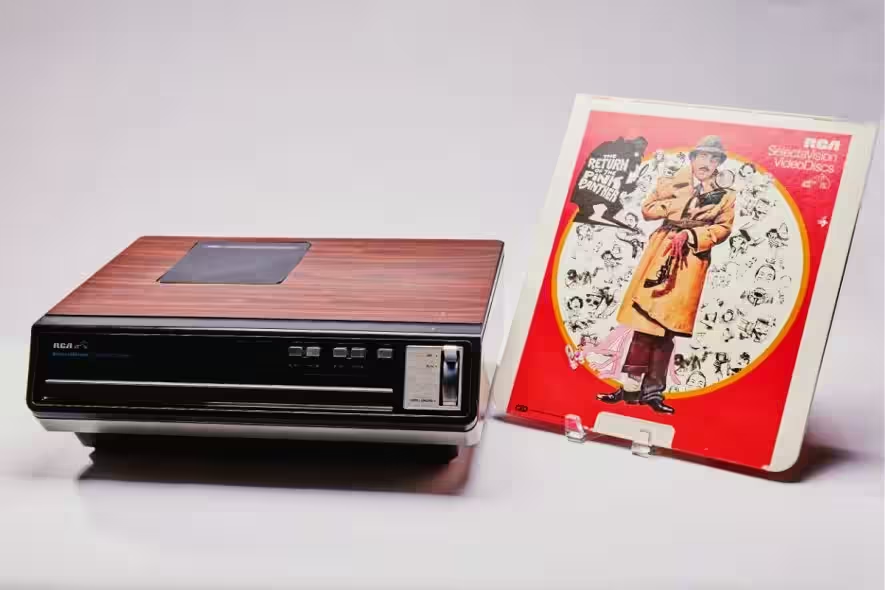
Before streaming and compact discs dominated our media consumption, the 20th century saw an experimental rush of audio and video formats that challenged conventional norms-ranging from the mechanical tape loop of the Tefifon, to the capacitive disc technology of RCA’s CED, and the laser-based analog vinyl players. These formats highlight how media tech evolution was anything but a straight line.
The Tefifon, launched commercially in late 1940s Germany, was essentially a marriage of vinyl and tape technology. Instead of a disc with a spiral groove, it used an endless loop of plastic tape embossed with a microscopic groove to mechanically reproduce sound. This innovative format aimed to combine the uninterrupted playback of tape with the authentic analog sound of a record player, stretching playtime to an hour or more without interruption.
While Tefifon’s sound quality landed somewhere between brittle shellac records and early vinyl LPs, its main appeal was durability. Housed in a cartridge, the tape was shielded from dust and scratches. Its slow tape speed allowed longer continuous play than the 78 RPM records then common. Yet as magnetic tape systems improved-offering longer playtimes plus recording capabilities-the Tefifon’s mechanical limits made it obsolete by the 1960s, largely remaining a German curiosity rather than a global competitor.
Capacitance Electronic Disc (CED): the doomed vinyl-video hybrid
In the early 1980s, as videotape recorders gained traction and LaserDiscs promised superior quality, RCA introduced the Capacitance Electronic Disc (CED)-a bold yet retrograde attempt to bring video to a vinyl-like format. The 12-inch plastic discs slid into protective cartridges and used a stylus that read fluctuations in capacitance between a titanium electrode and the disc groove, producing an NTSC video signal.
The CED could deliver about an hour of video per side, requiring users to flip the disc for feature-length movies, reminiscent of LP records. Though the disc’s resolution roughly matched VHS, the physical contact with the stylus caused inevitable wear, noise, and reduced lifespan-problems faced by vinyl records but magnified in the realm of video.
CED’s entry into a market dominated by VHS’s recordability and LaserDisc’s superior, contactless playback proved its downfall. By 1984, RCA had ceased production after steep losses. The format’s failure underscores the risk of reviving outdated mechanical technologies in an age swiftly embracing magnetic and optical innovations that offered greater flexibility and longevity.
Laser vinyl: chasing pristine analog with beams of light
The laser turntable concept emerged long before the digital era: imagine playing records without the click and wear caused by a needle scratching grooves. In 1989, Japanese company ELP realized this by building the Laser Turntable, which used multiple laser beams to trace the microscopic undulations in vinyl grooves, converting them into audio signals without physical contact.
This optical approach eliminated mechanical wear and promised exceptional fidelity, ideal for rare or archival records. But it also revealed unexpected flaws: traditional needles tend to ”sweep” dust aside, while the laser precisely detects every particle and scratch, amplifying surface noise. Moreover, the laser system struggles with warped or damaged records where a physical stylus’s flexibility can adapt.
Because of their complexity and high cost, laser turntables have remained niche items for collectors and sound archivists rather than mainstream consumers. However, their commercial persistence in the digital age signals a renewed appetite for preserving analog sound with minimal physical intrusion, contrasting sharply with vinyl’s tactile culture where imperfections and ritual hold artistic value.
The stories of Tefifon, CED, and laser vinyl offer fascinating snapshots of media formats that challenged the prevailing technologies of their time by blending old and new principles, only to be outpaced by more versatile or user-friendly standards. They remind us that media history is littered with ambitious detours-some doomed, some rediscovered by enthusiasts-each reflecting cultural and technological tensions about how we want to experience sound and images.