

Tech audiences care about eclipses because they expose real-world performance limits across cameras, networks and AI pipelines. On March 3, 2026, photographers across North America, Oceania and Asia captured the Moon turning a deep, bloody red – images that flooded social feeds and global galleries. Those photos tested low-light camera performance, image-stacking workflows and content-delivery systems as millions watched. For machine-learning teams they provide noisy, varied training data useful for denoising and reconstructing faint detail. For engineers studying atmospheric optics, the eclipse offers measurable color shifts caused by Earth’s atmosphere. For streaming platforms and photo hosts, it’s a lesson in scale and latency. And for citizen science, coordinated observations build datasets about Earth’s upper atmosphere. That crossover – where a celestial event becomes data for hardware testing, cloud infrastructure and AI models – is why a total lunar eclipse still matters to the international tech community and media platforms worldwide.
Several photographers across North America, Oceania and Asia recorded the total lunar eclipse on March 3, 2026. Earth’s shadow washed the lunar surface in a deep, blood-red hue, creating a spectacle that continues to captivate both professional astronomers and skywatching enthusiasts.
From the moment the Moon entered the full umbra-commonly called the Blood Moon-images of both the partial phases and the satellite’s full immersion in shadow began appearing online.
Impressive eclipse shots from around the world
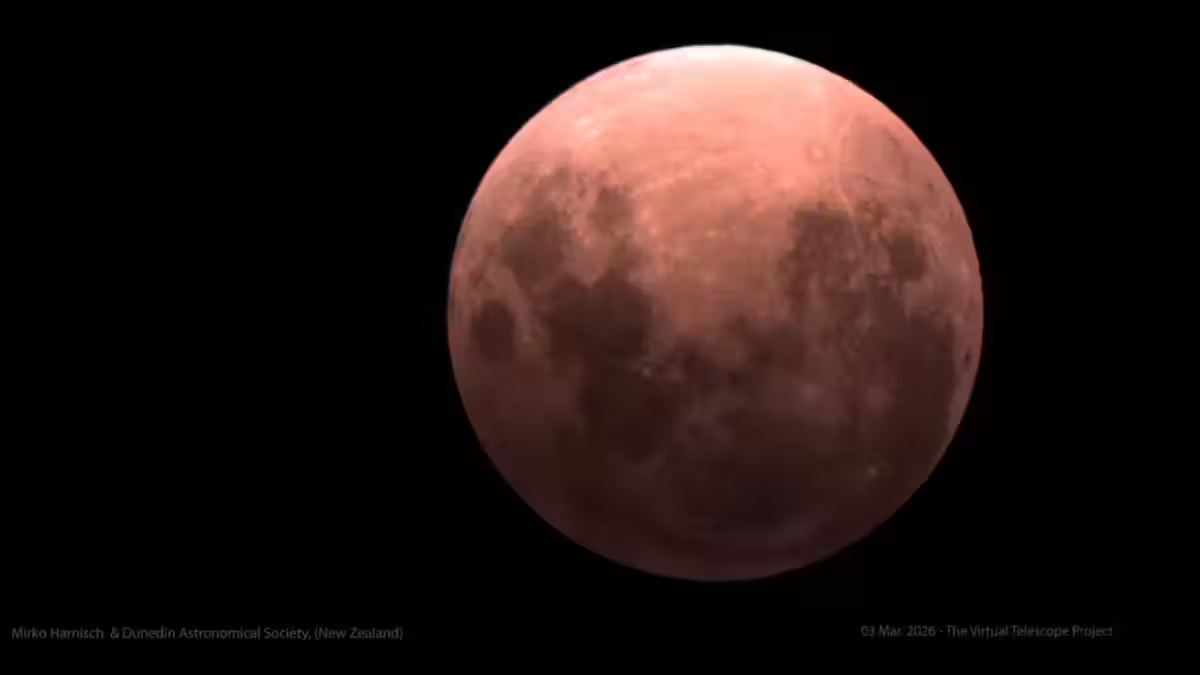
Working with the Dunedin Astronomical Society, photographer Mirko Harnish captured the lunar disk against the New Zealand night sky. The gradual sweep of Earth’s shadow muted the Moon’s darker maria, including Mare Crisium and Mare Fecunditatis – remnants of ancient lava flows – creating a beautifully subtle contrast across the surface.
In Manila, photographer Ted Aljibe produced a striking image of the full Moon with Earth’s ghostly shadow hanging over part of the disk – a portion of the lunar surface remained hidden as the eclipse entered its initial phase.
A mobile observatory operated by Time and Date out of California shared an atmospheric frame in which the red tint of the Moon gently highlights the contours of the lunar plains against a black sky.
Photographer Phil Walker, based in northern New Zealand, contributed an especially evocative shot showing the Moon during totality as if it had absorbed the light of every sunrise and sunset around Earth.
The event is also known by the popular name Worm Moon because it occurs in early spring, when thawing ground and warming soils bring worms and insects back to life. The reddening of the Moon happens because Earth’s atmosphere bends and scatters sunlight, casting the satellite in those vivid shades.
The total lunar eclipse concluded at 9:23 a.m. US Eastern (14:23 GMT) when the Moon exited Earth’s penumbra. For Russian readers used to tracking events by Moscow time, that corresponds to 17:23 MSK on March 3, 2026. Regardless of time zone, the photos and live observations will stick in many memories as a reminder of how surprising the sky can be.
Experts say eclipses like this are valuable moments not just for astronomers but also for broad public engagement with space. Watching how sunlight, filtered and refracted through Earth’s atmosphere, paints the Moon over thousands of kilometers is a rare and hypnotic display – an accessible way to connect people with atmospheric science and observational astronomy.
From a tech perspective, these events drive improvements across imaging and distribution chains: smartphone astrophotography keeps getting better, image-stacking and denoising algorithms become more robust with diverse inputs, and online platforms refine how they host and stream large live and photo-rich events. For those who missed the eclipse live, leading sites are compiling in-depth coverage and global galleries that collect the best images from around the world – a second chance to study and enjoy the spectacle.