

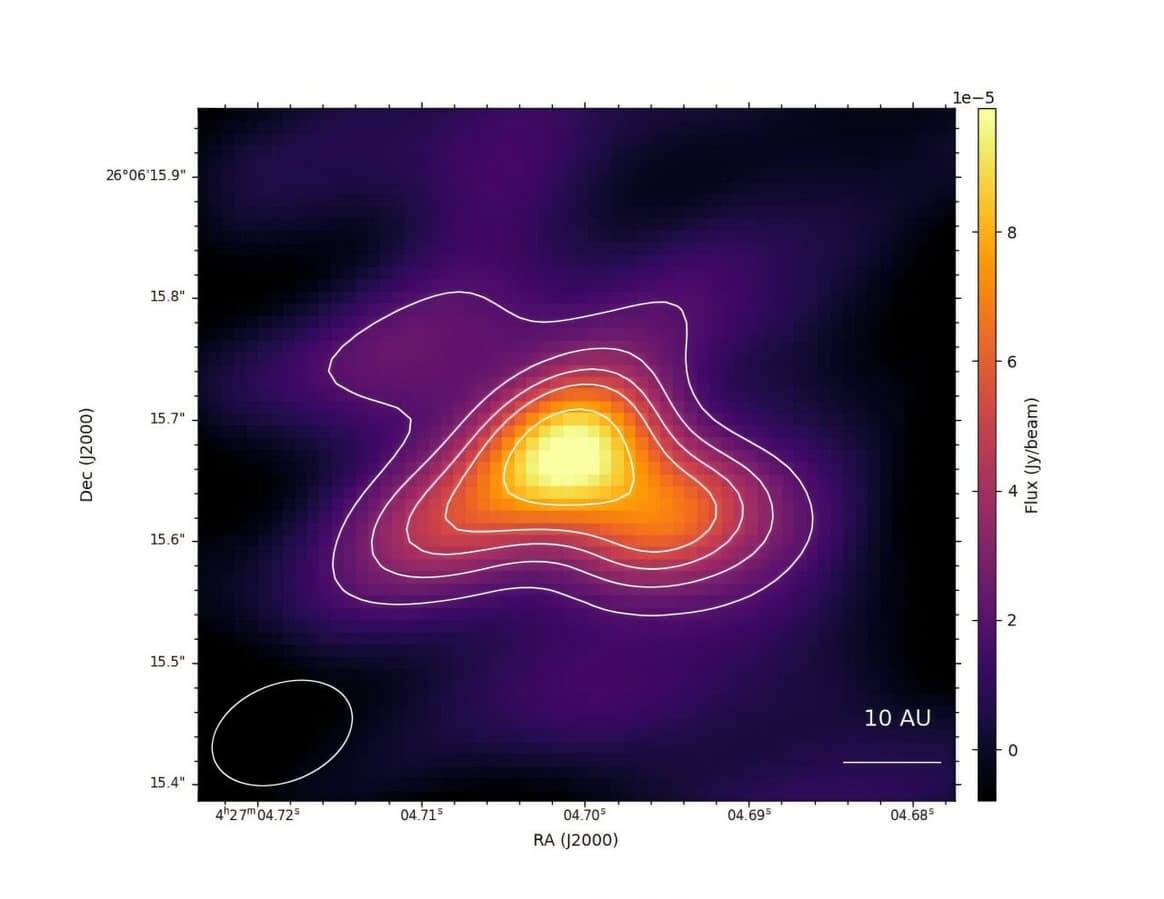
A British radio telescope network has spotted centimeter-sized ”gravel” in the disks around two young stars, giving astronomers a clearer look at the earliest stage of planet formation. The findings, presented at the National Astronomy Meeting in Durham, suggest that worlds may start assembling much farther from their parent stars than many models once assumed.
The targets are DG Tau and HL Tau, both about 450 light years from Earth. In plain terms, these are cosmic nurseries, and the new observations show the raw material that can clump together into larger bodies before becoming planets. That matters because the messy middle stage is exactly where a lot of theories get vague and observational data gets hard to come by.
What e-MERLIN saw in DG Tau and HL Tau
The work comes from PEBBLeS, short for ”Planet Earth Building-Blocks-a Legacy eMERLIN Survey.” It uses e-MERLIN, a seven-antenna radio interferometer spread across the UK over 217 kilometers and tied together with a high-speed optical network. That setup gives it the sensitivity and resolution to pick out protostellar disks at about 4 centimeters, which is exactly where centimeter-sized particles light up best.
- Targets: DG Tau and HL Tau
- Distance: about 450 light years
- Scale of particles: about 1 centimeter
- e-MERLIN span: 217 kilometers across the UK
- Observing wavelength: about 4 centimeters
The images of DG Tau show the particles at distances comparable to Neptune’s orbit, and similar results were reported for HL Tau. That pushes the start of planet building into the outer regions of disks, not just the tight inner zones where many people instinctively picture rocky worlds forming.
Why astronomers care about the missing middle
Gas and dust disks around young stars have been known since the 1990s, and astronomers have cataloged about 2,000 fully formed exoplanets. The awkward gap has always been the in-between phase: when tiny grains become pebbles, pebbles become clumps, and clumps eventually turn into planets. Those stages are harder to detect because the material is spread thin and the emission gets faint fast.
That is why this result is useful beyond the two stars themselves. It supports the idea that planet formation can begin much farther out than expected, even at orbital distances similar to Neptune’s. If that holds up across more systems, the old picture of planet assembly being mainly an inner-disk affair will need a rewrite.
SKA will be the next, much bigger test
Researchers say the coming Square Kilometre Array should take this kind of work much further. The telescope, planned for South Africa and Australia, is expected to begin operations in 2031 and could examine hundreds of planetary systems with far finer detail. In other words, e-MERLIN has shown the method works; SKA is being positioned as the instrument that can do it at scale.
For now, the result is a neat reminder that planets do not begin as elegant little spheres. They start as gravel, dust, and a lot of patience. The open question is how common these outer-disk building blocks really are – and whether the Solar System is the rule, or just the best-known exception.