

Microsoft has officially rolled out Shader Execution Reordering (SER) as part of DirectX Raytracing 1.2 in the latest DirectX Agility SDK (version 1.619), aiming to make ray tracing workloads run more efficiently across GPUs. Originally pioneered by Nvidia’s RTX 40-series hardware in 2022, SER rearranges GPU shader execution to reduce unpredictable ray tracing costs, and early benchmarks highlight Intel Arc B-series graphics cards enjoying up to a 90% frame rate increase when using SER-enabled rendering.
Ray tracing is notoriously variable due to dynamic light bounces and reflections, which can bog down GPU cores unevenly and reduce throughput. SER mitigates this by dynamically grouping similar shader tasks, creating more coherent workloads that keep the GPU busy with fewer idle cycles. This is a sophisticated solution to the longstanding challenge of balancing highly divergent ray tracing threads on massively parallel hardware.
Microsoft’s demonstrations using SER show Nvidia GPUs seeing around a 40% performance uplift in demanding ray-traced scenes, but strikingly, Intel’s Arc B-series GPUs nearly double their frame rates with up to 90% improvement. This is a significant leap given these GPUs previously struggled with ray tracing performance compared to Nvidia’s established lead. Now that SER is part of the standard DirectX SDK, it paves the way for more GPU vendors, including AMD, to introduce similar hardware-level optimizations that match or surpass Nvidia’s innovations.
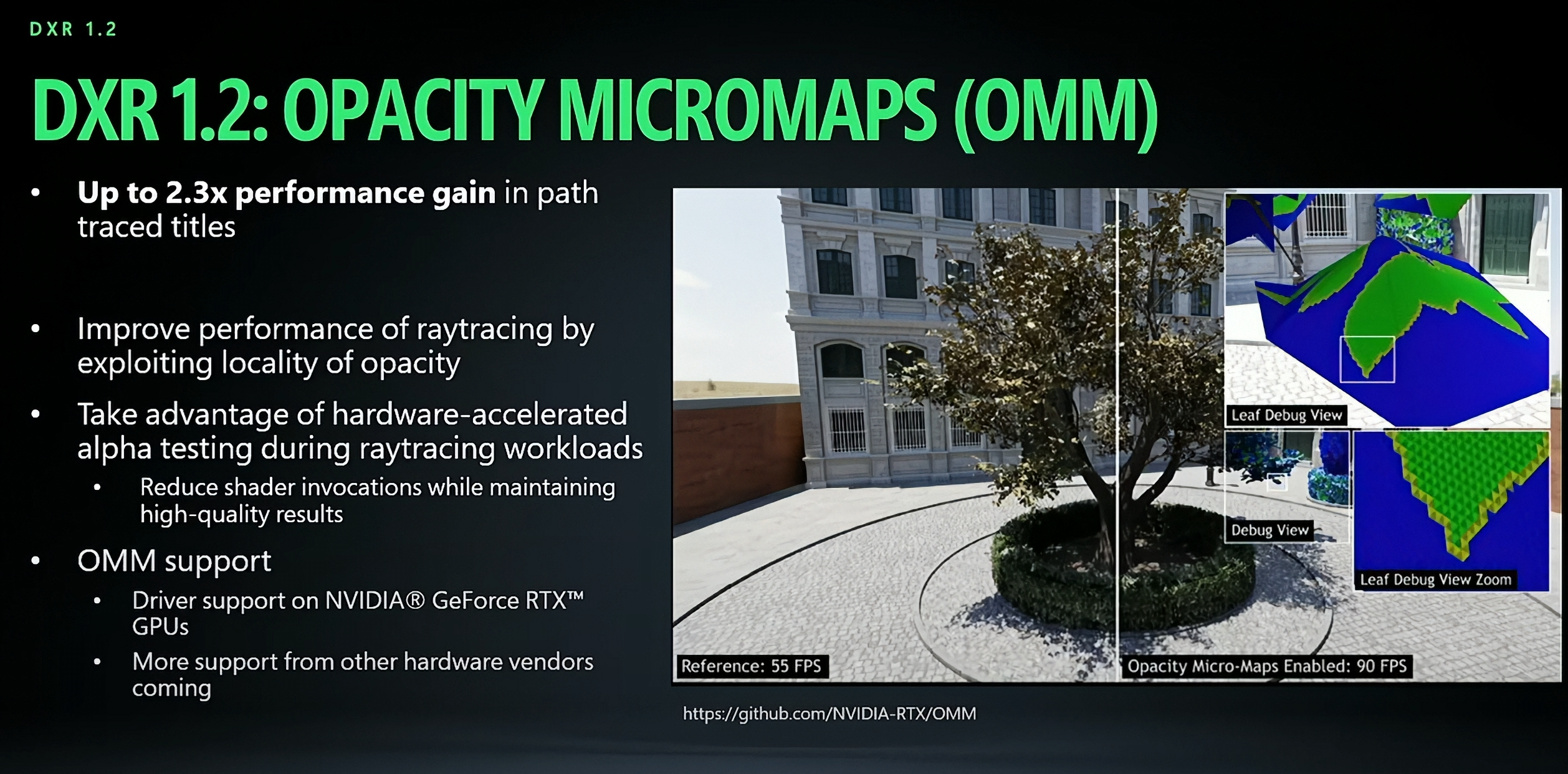
Another companion feature debuting with this SDK release is Shader Model 6.9, which facilitates developer access to both SER and Opacity Micromaps (OMMs), further streamlining ray tracing workflows. The catch, however, is that these capabilities depend on game developers adopting them. Until popular titles implement SER and OMMs, gamers won’t witness these gains broadly. Still, the groundwork is now laid for shader-level optimizations to become more mainstream.
Additionally, this update includes support for long vector operations and 16-bit float processing, reflecting Microsoft’s push to optimize performance for VRAM-heavy games struggling on cards with less than 12 GB memory. Such features show that behind-the-scenes APIs and shader models are quietly evolving to tackle practical bottlenecks in real-world gaming scenarios, not just pushing theoretical advances.
While Microsoft’s SDK advances level the playing field somewhat, Intel’s dramatic FPS jump from SER indicates their Arc GPUs may be carving out a niche in efficient ray tracing without the raw silicon horsepower of Nvidia’s latest models. This could subtly shift ray tracing dynamics in the midrange GPU market, where price-performance considerations are critical.
Overall, bringing SER into the DirectX Agility SDK signals a maturation of ray tracing technology-standardizing sophisticated workload scheduling approaches that were once proprietary Nvidia hardware features. It also raises questions about how quickly AMD and others will catch up with their own SER implementations and how soon game engines will integrate these optimizations. Until then, ray tracing performance improvements may remain confined to niche demos rather than transforming the gaming mainstream.