

AI systems solving deep math problems used to be a novelty. Now Claude Opus 4.6 has advanced a decades-old combinatorics question – one Donald Knuth worked on – from isolated examples to a construction that works for all odd m. That matters to engineers and researchers because it shows generative AI can produce concise, verifiable mathematical constructions, not just prose or code. It shifts how teams tackle exploratory math and algorithm design: rather than brute-force searches on tiny instances, AI can suggest scalable, human-readable patterns. That has implications for cryptography, network design and any field relying on combinatorial structures. It also forces a rethink of verification workflows, academic credit and the skills mathematicians need when collaborating with AI. For international tech audiences, Claude’s result is an inflection point – where machine reasoning augments human insight to yield rigorous, publishable mathematics and where R&D pipelines may begin embedding generative models into discovery.
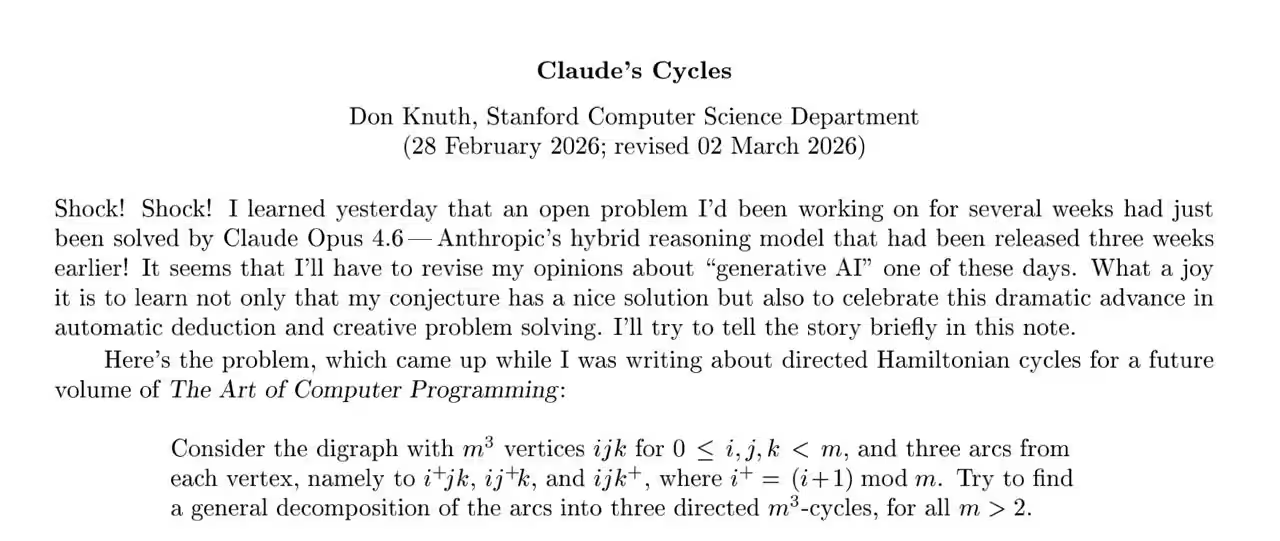
Artificial intelligence Claude Opus 4.6 tackled a problem that Donald Knuth – the legendary scientist and author of The Art of Computer Programming – once studied. The question is about partitioning the directed edges of a graph into three directed Hamiltonian cycles, each visiting every vertex exactly once. Until now, solutions were known only in special cases.
The problem is set up like this: the vertices of the graph are all triples of integers (i, j, k) in the range from 0 to m−1. From every vertex there are three outgoing arcs – one that increments i, one that increments j, and one that increments k, each taken modulo m. The task is to split every arc into three Hamiltonian cycles that cover all vertices, for any m > 2. Knuth and collaborators managed to prove the statement only for m = 3; empirical searches found solutions for small m up to 16.
Claude Opus 4.6 – an AI designed to tackle hard computational and combinatorial challenges – after an hour of computation produced a construction that works for all odd values of m. This result not only extends the known boundary but sets a new benchmark for how generative AI can contribute to mathematical discovery.
Why Claude’s cycles matter for math and AI
The directed-graph problem is a classic in graph theory and combinatorics, and its difficulty stems in part from sheer scale – the graph’s size grows as m³. Manual or brute-force approaches are limited to tiny m, which blocked efforts to produce a general theory. By contrast, Claude Opus 4.6 avoided exhaustive enumeration and produced a general algorithmic construction that covers all odd m.
That elevates AI from a raw number-cruncher to a collaborator that can propose structural, human-readable solutions. Knuth – widely regarded as a master of algorithms – has reportedly expressed surprise and respect for the result. The label ”Claude’s cycles” has already begun appearing as a name in the emerging mathematical literature, and it may mark the start of deeper human-AI coauthorships in pure math.
Context and prospects: where AI success in graph theory leads
Use of generative AI in pure mathematics remains relatively rare. Known precedents include AI-assisted theorem proving and searches for counterexamples, but those have often stayed within the realm of assisting proofs or checking lemmas. Claude Opus 4.6’s move from isolated examples to a scalable construction is a step change: it suggests models can now hypothesize general combinatorial patterns, not just point to specific instances.
For Russian readers: Knuth’s name and The Art of Computer Programming carry heavy weight in our mathematical tradition – many specialists grew up studying his algorithms and notation. The m³ growth (the graph volume increases as m³) helps explain why early work stalled at small m; what looks straightforward on paper becomes computationally huge fast. In Russia’s strong combinatorics and algorithms community, advances like Claude’s cycles are discussed not only for novelty but for their potential to seed rigorous, verifiable constructions that can be scrutinized and formalized.
These achievements push hybrid workflows: humans frame the problem and interpret results; AI performs the heavy pattern search and proposes constructions. Expect this to accelerate progress in topology, number theory, optimization and other areas where combinatorial objects matter. But there are practical and cultural hurdles: published acceptance will likely require mechanized verification or human-checkable proofs derived from the AI’s output.
Open questions remain. Can AI and mathematicians extend Claude’s construction from odd m to even values, or will new ideas be necessary? How will the community handle authorship and credit when a model proposes a major new construction? And crucially, how do we make AI-suggested mathematics reproducible and formally verifiable?
My take: Claude Opus 4.6’s result is a real inflection point, not because a model beat humans at a puzzle, but because it produced a compact, scalable construction that human experts can study, refine and-importantly-formalize. The next stages should focus on translating the AI’s output into machine-checkable proofs and on creating best practices for collaborative discovery: versioning model outputs, provenance for suggested lemmas, and reproducible verification pipelines. If that infrastructure arrives, the partnership between human intuition and machine search could reshape how new theorems are proposed and validated – accelerating discovery while keeping mathematical standards intact.