

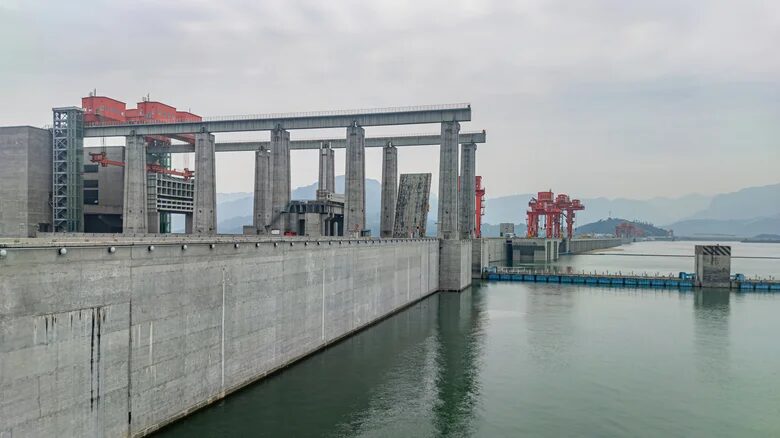
China built a ship elevator beside the Three Gorges Dam because the alternative was painfully slow: before the lift, vessels had to crawl through five-stage locks for nearly three hours. The ship elevator cut that trip to roughly 40 minutes, hoisting ships weighing up to 3,000 metric tons about 370 feet up the side of one of the biggest hydro projects ever built.
How the China ship elevator replaces a slow lock system
The Three Gorges Dam already reshaped the Yangtze River, and not gently. It can generate huge amounts of power, but it also acts as a 175-meter-tall barrier on China’s longest river, so moving boats through it became a logistics problem as much as an engineering one. The ship elevator was designed to speed up that bottleneck, and it has been doing the job for about a decade.
By February 2024, the system had carried over a million passengers and 15 million tonnes of cargo. That’s the sort of traffic that turns a flashy engineering stunt into actual infrastructure. Other major river systems have used locks for centuries, but this is the more aggressive answer: if the staircase is too slow, install an elevator.
Inside the ship lift chamber
The first idea, approved in 1992, was to hang the lift chamber with steel cables. Engineers later scrapped that because of stability concerns, which is probably the right instinct when your object is supposed to move ships, not terrify them. In 2003, German engineering firm Krebs and Kiefer came up with a different approach built around Archimedes’ principle.
- The chamber is filled with water, and the ship floats inside it.
- Concrete counterweights suspended from cables are pushed down into the water.
- The displaced water helps lift the elevator chamber.
- Four gear-driven mechanisms lock the ship at four support points to stop tilting or sloshing.
- Damping systems absorb seismic forces and transfer excess energy into the tower columns.
That last part matters more than the brochure language suggests. An earthquake-resistant ship lift is not a nice-to-have feature; it is the difference between a bold engineering solution and an expensive metal headache. The fact that the system is built to resist seismic movement says as much about China’s willingness to overbuild infrastructure as the dam itself.
Why the Three Gorges ship elevator is more than a curiosity
Ship lifts are rare because they are expensive, complicated, and extremely specific to the geography around them. But when a river route matters as much as the Yangtze does, shaving more than two hours off a crossing becomes a serious productivity win. The Three Gorges lift is basically the industrial version of refusing to wait in traffic.
The obvious question is whether similar systems will spread. Probably not everywhere, because most waterways do not have a dam the size of a small nation sitting in the middle of them. Still, the Three Gorges example shows where heavy engineering is heading: fewer elegant theories, more giant moving parts, and just enough physics to keep the whole thing from wobbling into the river.